The box of matches inside us
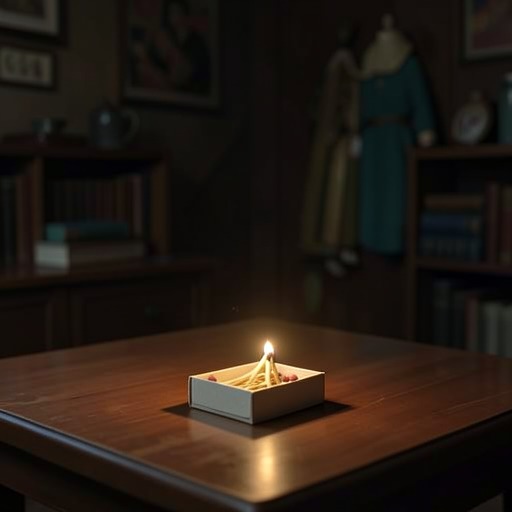
Like Water for ChocolateThe box of matches inside us is John Brown’s inherited theory that emotion sustains the soul: each person carries an inner capacity for fire, but that fire requires another person’s breath and some form of stimulus to ignite. The image turns a scientific demonstration into a language for intimacy, depletion, and the danger of having one’s strongest feelings repeatedly extinguished. When John explains the theory to Tita, its meaning is immediate and painful: she recognizes herself in the damp matches and in the failure of every flame she has managed to kindle.
The experiment behind the image
The explanation follows a demonstration involving phosphorus and oxygen. The doctor places a small amount of phosphorus in a tube closed at one end and filled with mercury, then melts it over a candle flame. Using a small bell jar containing oxygen, the doctor transfers the gas very slowly. When the oxygen reaches the top of the jar and meets the melted phosphorus, the resulting explosion is brilliant and instantaneous, like a flash of lightning. The experiment gives the theory a material sequence: the necessary elements are present, but ignition depends on their meeting under the right conditions.
How the matchbox works
John connects the experiment to the human body, which, he says, contains the elements needed to produce phosphorus. His grandmother’s theory imagines every person born with a box of matches inside, unable to strike those matches alone. Oxygen comes, for example, from the breath of a loved person; the candle may be food, music, a caress, a word, or a sound. These are not interchangeable decorations around an already complete feeling. In the theory, they are what make ignition possible: an encounter or stimulus sets off an intense emotion, and the person experiences a moment of dazzling force.
The flame’s warmth then grows within the person and slowly fades with time. Another explosion can revive it, so emotional life depends on discovering what kindles a particular person’s matches. The theory makes that discovery a condition of living well: the combustion produced by an ignited match nourishes the soul. If the triggers remain unknown, the box grows damp, and eventually not one match can be lit. The image therefore describes more than a passing feeling. It links the body’s response, the conditions supplied by another person or experience, and the soul’s continuing need for emotional nourishment.
Extinguishing and Tita’s recognition
The theory also gives emotional harm a concrete form. If the soul is deprived of nourishment, it leaves the body and wanders among deep shadows, searching vainly for food. It does not understand that the abandoned body, now cold and defenseless, is the only source capable of providing what it needs. The separation is presented as a consequence of failed ignition: without fire, the body and soul lose their sustaining connection.
Tita understands the theory not as an abstraction but as a description of her own condition. She recognizes how true it is and admits inwardly that her matches are damp and moldy, with no prospect of another being lit. The tragedy is not that she has never known what can ignite her. She knows what sets off her emotional explosions; each time she has managed to light a match, however, it has persistently been blown out. The image thus distinguishes the capacity to feel from the chance to sustain feeling: Tita’s knowledge of her own desires has not protected their flame.
John extends the metaphor to people whose frigid breath can put out even an intense fire. Their mere presence, in his account, can extinguish another person’s matches; keeping a distance from them makes the flame easier to protect. As he says this, he takes one of Tita’s hands and tells her that damp matches can be dried and that a cure exists. Tita responds with tears, and John gently dries them with his handkerchief. The gesture does not demonstrate that the cure has already worked, but it places his reassurance within a scene of physical tenderness rather than leaving it as theory alone.
The inner fire and the luminous tunnel
John’s account also warns against the opposite danger: igniting every match at once. A single match should be lit at a time, he says, because an emotion powerful enough to kindle them all together would create a radiance beyond ordinary sight. In that brilliance, a tunnel would appear, showing a path forgotten at birth and calling the soul back toward its lost divine origin. The soul, in this account, longs to return to the place from which it came, even though that return leaves the body lifeless. The matchbox image therefore holds two thresholds at once: the sustaining warmth of renewed feeling and the overwhelming light associated with departure from bodily life.
John traces the theory to his grandmother, who taught him its secrets, and says that since her death he has tried to demonstrate it scientifically. That aim joins the intimate image to the phosphorus experiment: a private inheritance is being tested through observable materials, even as its claims extend to the soul and its origin. After offering the explanation, John leaves Tita time to answer. She remains silent, and he proposes a break before showing her a game he and his grandmother used to play. The theory remains between them without a spoken reply; Tita’s tears and her recognition of the damp matches supply the scene’s clearest evidence of what the image has touched.