Tita
Like Water for ChocolateTita is the youngest De la Garza daughter, a gifted cook whose life is constrained by a family rule that assigns her to care for her mother instead of marrying. Born in tears on a kitchen table, she grows into the kitchen’s most accomplished practitioner and makes cooking a language for emotions she cannot freely express. Her love for Pedro and her resistance to inherited authority shape a life whose memory survives in a cookbook passed down through her family.
Identity and Origins
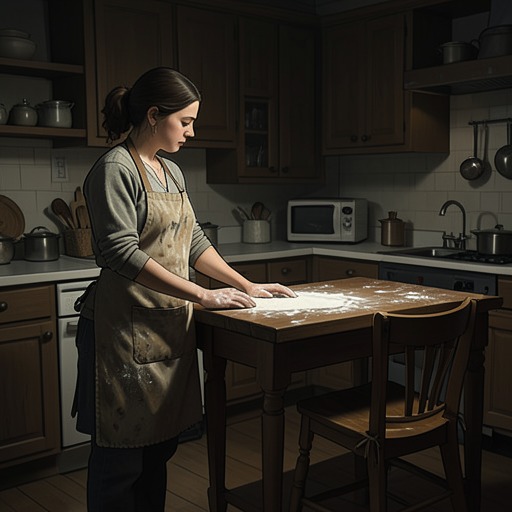
Tita’s beginning binds her to the kitchen before she can speak or choose. While her mother is still carrying her, Tita cries so intensely when onions are chopped that her sobs bring on premature labor. She is born on the kitchen table among the smells of cooking, already crying as she enters the world. In the account Nacha tells, her tears spill over the table and across the floor; after the water dries, Nacha sweeps up enough salt to fill a ten-pound sack. The salt is kept for cooking, turning Tita’s extraordinary arrival into a household resource as well as a family story.
That origin helps explain the kitchen’s lasting importance to Tita. It is not simply the place where she performs domestic work: it is the setting of her birth, her apprenticeship, and the craft through which she develops knowledge and influence. Her life there begins under family authority, but the culinary skills she inherits also give her a domain that Mama Elena cannot entirely control.
Inherited Duty and the Work of Care
Mama Elena tells Tita that, as the youngest daughter, she must care for her mother until her death. She presents this as an established family obligation, not a question open to discussion. When Tita asks whether Pedro intends to seek her hand, Mama Elena forbids the prospect and insists that the tradition has never been challenged. After Tita tries to question its fairness and practical logic, her mother ignores her and does not speak to her for a week.
Tita’s objections expose what the rule leaves unresolved. If she cannot marry or have children, she wonders who will care for her in old age; she also questions why the youngest daughter is considered best suited to the task and whether the daughter expected to sacrifice her future has any say. The questions remain unanswered in a family where obedience is demanded immediately. The rule restricts Tita’s romantic life, but it also assigns her the household’s continuing labor without asking what future that labor leaves for her.
The routine at Mama Elena’s house makes that obligation concrete. Tita’s hands are expected to prepare meals, tend the fire, feed animals, wash dishes, make beds, and keep up the cycle of household work. During her later stay with John Brown, she reflects on how completely those tasks had been prescribed for her. Away from her mother’s commands, she stares at her hands and is startled by the freedom to decide what they might do. She has not yet learned how to make a choice for herself; the possibility of choice is itself a change in her life.
Cooking as Inheritance and Communication
After Nacha dies, Tita grieves as though she has lost her real mother. She is appointed the ranch’s official cook, succeeding Nacha in a line of cooks who have passed culinary knowledge between generations. The appointment recognizes her unusual skill, but it also gives her access to a sphere where taste, smell, texture, and their effects cannot be governed as completely as Mama Elena would like. Pedro brings her roses to mark her first year in the position, and the gesture deepens an attachment that the household has long tried to keep apart.
Tita’s cooking can convey what ordinary speech cannot. When she prepares quail in rose petal sauce, the meal carries her desire toward Pedro, with Gertrudis becoming the bodily medium through which that emotional message passes. The episode makes food a form of communication among people constrained by secrecy and family rules. It also connects Tita’s private feeling to the labor of preparing and serving a dish: emotion travels through ingredients and a meal rather than through a direct declaration.
She records the recipe that night in Tita’s cookbook, specifying that the quail may be served on individual plates so the rose garnish will not slide off-center. The practical precision of the instruction sits beside her thoughts about Gertrudis’s departure and what may have happened after she vanished from sight. Tita prepares the dish every year in tribute to her sister’s liberation, taking particular care with the garnish. Thus the recipe preserves both a method of cooking and the memory of a rupture in the family’s order.
Love, Conflict, and the Right to Choose
Pedro declares his love to Tita after their hands accidentally touch as they bend to pick up the same tray. He asks whether he may hope to win her love and presses her for an answer. Their relationship develops under the family prohibition that prevents Tita from marrying, and the desire between them repeatedly has to coexist with secrecy and constraint. Later, Pedro comes to Tita’s room and their relationship becomes sexual; the encounter marks a decisive change in their intimacy, though it does not remove the larger conflicts around them.
Tita also has a relationship with John Brown. After he takes her away from the ranch, she is so shaken that she withdraws to her room and sometimes does not taste the food brought to her. Her attention fixes on her hands, which had previously been directed by Mama Elena’s daily demands. In this period she is not ready to talk, and she recognizes John’s care without yet finding words for what she feels. Later, when she asks him to call off their approaching marriage, she cannot explain her reasons at that moment. Her uncertainty makes clear that gratitude, affection, and the freedom to choose do not automatically resolve into a settled future.
Her conflict with inherited duty later centers on Esperanza. Tita helps Rosaura with a diet and a remedy, but she is troubled by the future Rosaura intends for her daughter: a life of caring for her mother rather than making her own choices. Earlier, Tita and Pedro had resisted Rosaura’s plan to keep Esperanza from school. After extended discussions, Rosaura agrees to send her to the best school, while Tita teaches her lessons about love and life through the kitchen. When Alex courts Esperanza, Tita supports the young couple against Rosaura’s opposition. The pattern Tita was made to endure thus becomes a rule she helps prevent from passing to the next generation.
Separation, Death, and Narrative Legacy
After Tita returns to the ranch following an attack, she and Mama Elena face each other in silence. Their unspoken reproaches sever the tie of blood and obedience that had bound them. Yet Tita still cares for her mother, preparing her meals with particular care and making ox-tail soup in the hope that she will recover. The moment holds together two facts that the family rule had treated as inseparable: Tita can provide care, but care does not restore her submission or erase the injury between them.
Years later, the pact between Tita, Pedro, and Rosaura has required Tita and Pedro to keep their relationship secret and forgo having a child together. It also assigns Tita a part in Esperanza’s upbringing: Tita is responsible for feeding her, while Rosaura directs her education. Although the arrangement is observed for the most part, Tita supplements the education Rosaura intends with her own knowledge. When Rosaura’s opposition to Esperanza’s courtship brings the conflict back into the open, Tita no longer treats the agreement as a reason to let family tradition determine the younger woman’s future.
After Pedro dies, Tita turns to the memories of their shared life and to the candles John had given her. As she recalls their first meeting, the first touch of their hands, the roses, and later moments of intimacy, the candles become a means of rekindling the inner fire she associates with Pedro. Their deaths set Tita’s bedspread and the ranch ablaze. When Esperanza returns from her wedding trip, the ranch is buried beneath ash; the surviving possession she finds is Tita’s cookbook, which she later bequeaths to her own child.
The novel’s final frame shows Tita’s influence continuing through food and inheritance. The narrator prepares Christmas rolls, remembers her mother’s cooking and stories, and connects her own tears while chopping onions to the sensitivity attributed to Tita. The recipes keep Tita present not as an abstract family legend but through repeated acts of cooking and remembered taste. The cookbook carries her story forward, while the land beneath the burned ranch becomes fertile and supports the narrator’s family. Tita’s life is constrained by a tradition designed to keep a daughter in service; her enduring legacy instead passes through skills, stories, and choices that reach beyond the household that imposed it.