Tita and Chencha's Relationship
Like Water for ChocolateTita and Chencha's Relationship is shaped by the work and authority of the De la Garza household, but it becomes more than a shared place in its routines. Chencha, the maid, and Tita work alongside one another in the family’s kitchen; later, Chencha reaches Tita when she has lost contact with ordinary life, and Tita in turn offers Chencha care when she is overwhelmed. Their bond is practical as well as affectionate: it is expressed in preparing food, sharing memories, carrying news, and recognizing when the other needs help or distance.
Shared Work in the Household
Sausage making gathers the women of the household around the dining-room table: Mama Elena, her daughters Gertrudis, Rosaura, and Tita, Nacha, and Chencha. Their preparation begins the day before, with peeling garlic, cleaning chiles, and grinding spices. The work is collective, but it takes place under Mama Elena’s authority; when she ends the day’s gathering, everyone moves at once to clear the table and take up other assigned chores. Chencha and Tita therefore share a working environment in which domestic labor is both a routine necessity and part of the family’s hierarchy.
That hierarchy weighs especially heavily on Tita, whose future Mama Elena defines through the youngest-daughter tradition: she must remain at home to care for her mother. Tita questions who established the rule and whether the daughter required to obey it has any say in her own future, but the household expects immediate compliance. Chencha is not presented as having the same family status or the same conflict over marriage and inheritance. As a maid, she participates in the household’s labor without belonging to the circle of daughters. Their connection grows within that unequal structure, through proximity and shared work rather than equal authority.
Care Through Food and Memory
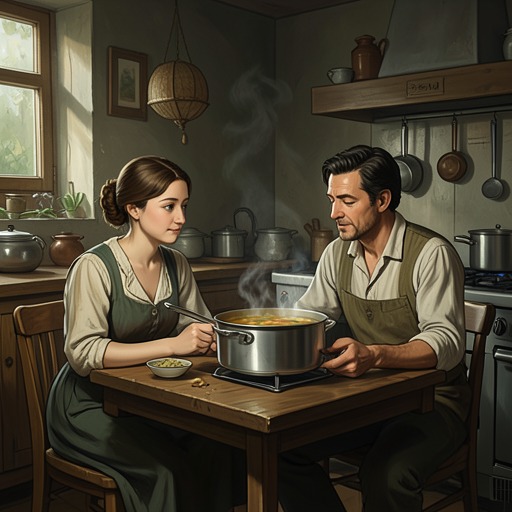
The clearest expression of Chencha’s care comes during Tita’s withdrawal at John Brown’s house. After months away from her senses, Tita has not returned to eating with pleasure or speaking. Chencha brings ox-tail soup, and John carries it into the room. On tasting it, Tita recalls Nacha and their shared kitchen life: childhood games, market trips, warm tortillas, and the times they made the soup together. The dish reconnects her with a sequence of familiar experiences and with the person who had cared for her as a child.
Chencha’s contribution is not simply to deliver a meal. She brings food associated with Tita’s past into a period when Tita cannot find her way back to it on her own. As Tita eats, the memories return, and she begins to cry; with the recipe’s first step, chopping onion, she is able to remember how to cook. The soup also gives Chencha and Tita a shared activity in the present: they laugh over the memories and cry as they remember the recipe’s steps. In this scene, the act of feeding becomes a means of companionship and reconnection, joining Chencha’s practical help to Tita’s remembered bond with Nacha.
Trust, News, and Separation
When John sees Tita crying, he is about to leave, but Tita speaks to him for the first time in six months and asks him to stay. Chencha is there with her, and as Tita listens to the news and gossip she moves from tears to smiles. Chencha explains that Mama Elena had forbidden visits and would not forgive Tita for blaming her for Roberto’s death. She also brings a letter from Gertrudis, which Tita reads privately. Chencha’s visit thus reconnects Tita not only with familiar food and memories but with news of the family from which she has been cut off.
Afterward, Tita and Chencha decide that Tita will not return to the ranch. Tita asks Chencha to tell Mama Elena. Carrying that decision back is difficult: Chencha crosses the bridge between Eagle Pass and Piedras Negras while trying to work out how to deliver the news, aware that any version is likely to anger Mama Elena. The task makes Chencha a trusted intermediary between Tita and the household she has left. Their closeness does not remove Chencha’s fear of Mama Elena’s authority; it gives her a difficult message to carry on Tita’s behalf.
Mutual Support After Trauma
The care between them later runs in the other direction. After Chencha has suffered a violent attack by bandits, she is depressed and believes that no man will marry her. She speaks bitterly about the judgment she expects from men, and Tita cannot find a way to draw her out of that despair. Tita holds and comforts her, as she has each night since Chencha returned, but does not pretend that reassurance alone will resolve what has happened.
Instead, Tita recognizes that remaining near Mama Elena on the ranch will not help Chencha recover. She lets Chencha go and sends her to the village with Nicholas the following day. The decision echoes their earlier separation: Chencha had helped Tita leave the ranch, and now Tita supports Chencha in leaving its immediate reach. Their relationship is defined not by a promise that either can solve the other’s troubles, but by practical attentiveness—to food, news, comfort, and the need for distance. Within a household where obedience and domestic service govern women’s lives, that attentiveness gives their bond its force.