Tita and John Brown’s romance and engagement
Like Water for ChocolateTita and John Brown’s romance and engagement offer Tita a relationship grounded in care, patience, and the possibility of a life beyond the De la Garza family’s rules. John helps her recover after her breakdown and treats her decision-making with respect; Tita, in turn, accepts his proposal before eventually telling him she cannot marry him because she loves Pedro. The relationship ends without marriage, but John’s response makes the separation an act of painful honesty rather than a contest over Tita’s choice.
Care and Recovery
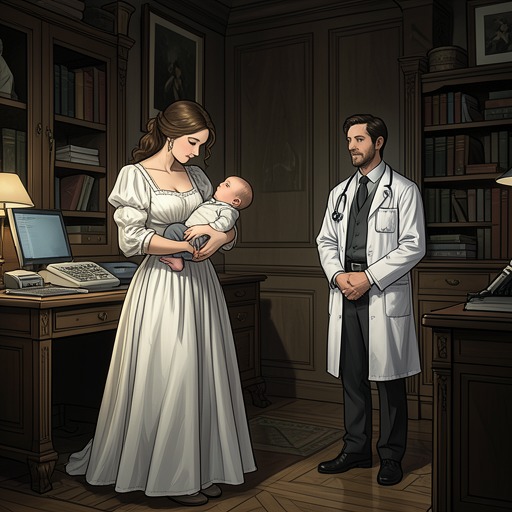
John’s relationship with Tita begins in the aftermath of her breakdown. Ignoring Mama Elena’s order, he takes Tita to live in his home rather than placing her in an institution. Tita is deeply grateful: in the doctor’s house, John’s warmth in his words and manner helps her feel better day by day. She remembers his careful attention when she arrives in a distressed condition, and understands his practical kindness as having rescued her from horror.
The laboratory behind the patio becomes a place of particular ease for both of them. Tita sits by its window while John works, but the faint warmth of the light cannot overcome her chronic chill, even beneath the heavy woolen bedspread she continues to make with yarn John bought for her. The bedspread connects her to a familiar activity, while his provision of the yarn and his care for her make that activity part of a new domestic intimacy. Her recovery is not represented as an instant cure: she improves gradually in an environment where she is treated gently and allowed to proceed at her own pace.
John also tries to help Tita find a way back into communication. He tells her that damp matches can be dried and that a person must take care not to ignite them all at once; in his account, an overwhelming blaze can open a luminous passage toward the soul’s origin. His language gives Tita a way to think about her own capacity for feeling without demanding that she immediately explain herself. He then invites her to write, rather than speak, the reason for her silence. Using phosphorus that will glow in the dark, she writes that she does not want to talk. John has arranged the exercise so the message will become visible, but its importance lies in Tita’s act of expressing a choice. The written words mark a first step toward freedom, and his approach respects her silence even as he offers a way out of it.
Affection and the Promise of Marriage
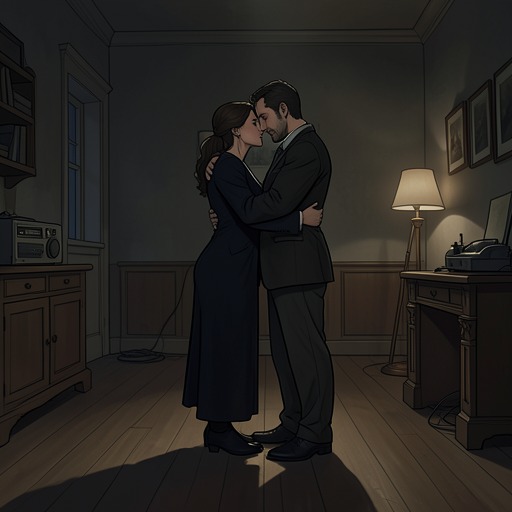
Tita’s feelings for John develop through both his kindness and the security she experiences in his presence. When she returns to care for Mama Elena, the older woman’s presence revives Tita’s fear that her own fragile hope will be extinguished. Tita runs from the room and collides with John as he arrives to visit the patient. His embrace steadies her, and she wonders whether the peace and security she feels with him may be a truer form of love than the agitation and anxiety she associates with Pedro. She pulls away, but the contrast stays with her: John’s closeness reassures her, even as her feelings remain unresolved.
John makes his intentions clear to Mama Elena while discussing the need for a cook. He praises Tita’s cooking and says that one day he will ask for her hand. Mama Elena insists that Tita cannot marry. John does not provoke her further, but has already resolved to marry Tita whether or not her mother approves; he also believes Tita is no longer bound by the destiny Mama Elena has imposed. His proposal thus represents more than a declaration of affection: it offers a future not governed by the family rule that has restricted Tita’s choices.
Tita accepts John’s proposal during a period when she believes she is ready to begin again. At a moonlit gathering, he gives her a dress bought in San Antonio, Texas, whose colors remind her of the doves’ plumage without bringing back the painful associations attached to her earlier retreat. She and John seal their engagement with a gentle kiss. Tita recognizes that the kiss does not affect her as Pedro’s does, but hopes that her long-dampened spirit may eventually be kindled by John’s presence. Her acceptance is sincere, though it does not erase the difference between her feelings for the two men.
Engagement and Conflicted Choice
When John formally asks for Tita’s hand, Pedro, acting as head of the household, gives his sullen approval. The discussion turns to a wedding date, but John wants to delay the ceremony so he can travel to the northern United States and bring back his only living aunt. Tita experiences the delay as a problem: she wants to leave the ranch, and Pedro’s proximity, as quickly as possible. John’s wish to include his aunt is consistent with his careful, deliberate manner, while Tita’s urgency reflects the emotional pressure of remaining at the ranch.
John gives Tita a diamond ring to formalize their engagement. As she looks at its light, her thoughts turn to Pedro’s eyes and to a poem Nacha taught her as a child. The juxtaposition makes visible what the engagement cannot settle: Tita has accepted John’s promise, but her attention is still drawn toward Pedro. Later, she regrets the harm she believes she has done to John, who brought her back to her senses and helped her find a way toward freedom. Her gratitude does not make her love for him interchangeable with her love for Pedro, and the difference becomes harder to conceal.
After John has been away, Tita sees his cart return earlier than expected. She is glad to see him and at the same time frightened by the conversation she knows she must have. He arrives with a large bouquet and embraces her warmly; when he kisses her, he recognizes that something in her has changed. Their reunion brings affection and apprehension together: Tita still cares for John, but cannot continue the engagement as if nothing has happened.
Honesty, Respect, and Separation
Tita tells John that she believes they should call off the wedding. When he asks why, she explains that while he was away she had been with a man she had always loved and could no longer marry him. The disclosure identifies Pedro as the rival John had already intuited. John does not treat Tita’s confession as a reason to punish or shame her. He tells her that what she has done does not change what is essential to him, and that he would still be glad to share his life with her. At the same time, he asks her to consider carefully whether he is the man she wants. If she chooses John, he is prepared to marry her; if she chooses Pedro, John says he will congratulate him and ask him to treat Tita with respect.
John’s answer preserves Tita’s agency at the moment when she might have expected his hurt to become a demand. His willingness to remain her companion does not force her decision, and his recognition of Pedro as her love shows that he understands the situation even before she fully explains it. Tita is moved by his generosity and admires him more, but that admiration deepens rather than resolves her doubts. Their bond reaches its clearest expression not in a wedding, but in John’s decision to let Tita choose freely.
The Unfulfilled Engagement
Tita and John do not marry. For twenty years, Tita and Pedro keep their relationship secret under an agreement with Rosaura, who wants to preserve the appearance of a successful marriage and raise Esperanza within the family household. Their arrangement requires Tita and Pedro to hide their meetings and to forgo having a child together; in return, Tita is allowed to help feed Esperanza while Rosaura oversees her education. John’s earlier engagement therefore remains a genuine but unfulfilled alternative to a life structured by secrecy and family obligations.
At Esperanza’s wedding, the guests’ departure leaves Tita and Pedro together with John and Chencha. John notices the strength of Tita and Pedro’s attraction and leaves, aware that he is the third person in their situation. Tita is hurt to see him go alone, and the narrative notes that he never found someone else after she refused him. His departure closes the possibility of their marriage without diminishing the care that had defined their relationship. John had offered Tita companionship without coercion; when she chose otherwise, he honored that choice, even though the separation remained painful for both of them.