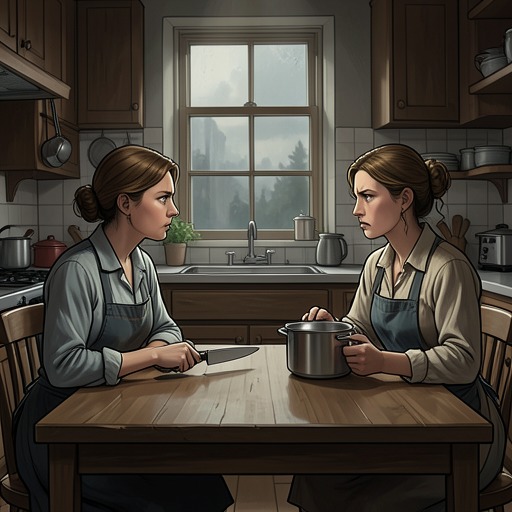
Tita and Rosaura's Confrontation
Like Water for ChocolateTita and Rosaura's Confrontation brings a long-standing dispute over Pedro into the open and shifts its stakes to Esperanza, whom both sisters regard as central to the family’s future. Rosaura insists on her status as Pedro’s wife and as the child’s mother; Tita rejects the family rule that had denied her the right to marry and refuses to let Rosaura impose it on the next generation. The scene ends not with an agreement but with Rosaura taking Esperanza away from Tita’s care and threatening to exclude Tita from the household.
Setting and Background
The confrontation takes place in the kitchen, where Tita and Rosaura face one another across the ordinary remains of a meal. Tita removes her plate, sips her coffee, and carefully breaks apart the ends of the tortillas used for the chilaquiles. In the family, tortilla edges and hard-roll crusts are saved for the chickens. The sisters maintain an unblinking stare while Rosaura opens the conversation, making a familiar kitchen routine the setting for a dispute that has been deferred for years.
Their history is inseparable from the family’s rule that the youngest daughter must remain unmarried to care for her mother. That rule had denied Tita the same choice of marriage available to Rosaura, even though Tita and Pedro had been in love. Tita names the injustice directly: she says she will continue to defy the tradition, and argues that Rosaura had no right to come between two people who loved one another. Rosaura answers from the authority of the custom, treating Tita’s claim to Pedro as illegitimate because Tita was not permitted to have a boyfriend in the first place.
The Dispute over Pedro
The sisters give sharply opposed accounts of Pedro’s marriage. Rosaura argues that he turned to her when he had the opportunity and that she married him because he wanted it. Tita counters that Pedro married Rosaura in order to remain near her. Rosaura refuses to settle his motives, saying that the marriage is an accomplished fact and that she will not accept being made a public laughingstock.
Her grievance is not simply that Pedro and Tita have a history. Rosaura recalls that people on the ranch saw Tita weeping beside Pedro and holding his hand, leaving Rosaura feeling exposed and ridiculed. She says she will tolerate their private involvement if it remains undiscovered, but insists that she will continue to be Pedro’s wife in the household and in public. She warns Tita against allowing their relationship to become visible again. The position is contradictory but deliberate: Rosaura does not claim that Pedro’s feelings are hers to control, yet she demands that the marriage and its public appearance remain intact.
The argument also reveals how differently the sisters understand dignity. Rosaura sees public humiliation as the injury she must prevent; Tita sees the marriage itself as founded on the denial of her right to choose. Neither accepts the other’s account as a sufficient answer. What began as a delayed conversation about Pedro becomes a contest over whose version of the family’s history will govern their conduct now.
Esperanza and Household Authority
Esperanza’s crying interrupts the argument as it rises in intensity. Rosaura announces that she will feed her daughter herself and will no longer allow Tita to do so, accusing Tita of offering a harmful example and influence. The dispute therefore moves beyond the sisters’ past and into Tita’s place in the child’s daily life. Esperanza is not merely the subject of an abstract disagreement: Rosaura’s decision removes a form of closeness that Tita deeply values.
Tita responds that she will not let Rosaura force the same restrictive tradition on her daughter. Rosaura answers by asserting that her own small family is respectable and that she will keep Tita away from Esperanza. She also claims the authority of the house, which had been left to her by Mama Elena, and threatens to make Tita leave if she does not comply. The threat is not carried out in the scene, but it gives Rosaura’s position a material basis: she can invoke both motherhood and ownership of the home to enforce the boundary she is drawing.
Rosaura leaves the kitchen to feed Esperanza, taking with her the mush Tita had prepared for the baby. That detail sharpens the reversal: Tita has made the food, but Rosaura determines who will give it to the child. Tita is left in anguish because Esperanza is among the people she loves most. As she tears apart the last piece of tortilla in her hand, the ordinary task that began the scene becomes an outlet for distress she cannot turn into a settlement with her sister.
Family Secrets and Significance
The sisters’ argument occurs within a family history already shaped by concealed relationships and contested inheritance. After opening Mama Elena’s box of letters, Tita learned that Mama Elena had loved Jose Trevino, but had been prevented from marrying him because of his ancestry. The correspondence also disclosed that Gertrudis was Jose’s daughter, not the daughter of Mama Elena’s husband. Tita initially kept the letters rather than destroying them; later, when Gertrudis’s marriage to Juan was threatened after the birth of their child, Tita revealed the secret to protect Gertrudis from blame. Juan was furious, but the couple remained together and were often happy.
That earlier disclosure provides a contrast to Tita’s confrontation with Rosaura. Tita had used a family secret to challenge the meaning attached to Gertrudis’s parentage and help preserve a marriage. Here, she challenges the family rule that once constrained her own future and tries to prevent Rosaura from passing it on to Esperanza. The scene makes the conflict between the sisters more than a quarrel over Pedro: it shows family authority being claimed through marriage, motherhood, reputation, and the right to determine a daughter’s life. Its immediate outcome is separation between Tita and Esperanza, while the question of whether the younger generation will inherit the old rule remains unresolved.