Tita's Final Confrontation with Mama Elena's Ghost
Like Water for ChocolateTita’s Final Confrontation with Mama Elena’s Ghost is the scene in which Tita directly rejects her dead mother’s continuing authority over her life. The confrontation briefly brings Tita relief and resolves her fear that she is pregnant, but it does not simply end the haunting: the last trace of Mama Elena’s image becomes a moving light that precipitates an accident at the party below. The scene joins emotional release to physical danger, making Tita’s declaration of independence the turning point in a chain of consequences she cannot control.
Background and Confrontation
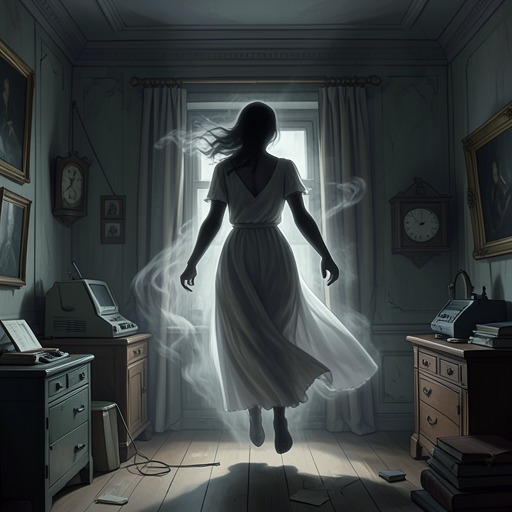
The scene begins with Pedro singing beneath Tita’s window. Tita has been resting, but the song draws her to the window; seeing Pedro, she recognizes that he is drunk. Juan accompanies him on guitar. Tita worries that Rosaura may still be awake and that the serenade could provoke trouble. This private anxiety becomes an open confrontation when a furious Mama Elena enters Tita’s room.
Mama Elena blames Tita and Pedro for creating a threat to the household and orders Tita to go somewhere else before anyone is harmed. Tita answers by turning the demand back on her mother: she says that she is entitled to live as she chooses and insists that Mama Elena leave her alone. Rather than pleading for permission or attempting to soften the disagreement, Tita names her rejection plainly. The conflict is therefore not only about Pedro’s presence or the risk of scandal; it is a direct contest over who has the authority to govern Tita’s life.
The Ghost’s Retreat and Tita’s Relief
Tita’s defiance coincides with an extraordinary change in Mama Elena’s apparition. The imposing figure shrinks until it is no more than a tiny light, while Tita feels relief. Her abdominal discomfort and breast pain subside, and her body relaxes. The sequence links the ghost’s retreat with the easing of the physical symptoms that had made Tita fear she was pregnant.
The delayed menstrual flow then confirms that Tita is not pregnant. The revelation resolves her immediate uncertainty, but it does not make the scene uncomplicatedly triumphant. For a moment, the disappearance of the apparition and the release of Tita’s physical distress seem to close the confrontation. Yet the remaining light begins to spin, showing that Mama Elena’s image has not simply passed out of the scene. Tita’s declaration has altered the ghost’s form and ended its hold on her in that moment, but the remnant continues to act in the shared space of the ranch.
From the Room to the Party
The light leaves through the window and darts toward the patio, where the party continues. Pedro, still drunk, stands beneath Tita’s window singing Estrellita; the rebels around him are also drunk. Gertrudis and Juan dance nearby, apparently unaware of the approaching danger. The scene sets Tita’s intensely private confrontation against a public gathering whose participants do not understand what is moving toward them.
The light reaches an oil lamp near Pedro and makes it explode. Oil spreads flames onto him. Tita hears the commotion, goes to the window, and sees Pedro running across the patio. Gertrudis catches up with him, tears a skirt from her dress, wraps it around him, and knocks him to the ground. Her quick response brings the immediate sequence to its close, while the accident redirects the consequences of Tita’s confrontation onto Pedro. The scene establishes the danger without making the people at the party aware of its supernatural origin.
Consequences and Significance
The confrontation produces two sharply different outcomes. Tita’s fear of pregnancy ends, and the ghost’s imposing form recedes; at the same time, the light left behind turns a moment of apparent relief into an accident. The narrative moves from accusation and self-assertion, through bodily release, to sudden disorder at the party. These changes occur in rapid succession, so that emotional resolution does not mean that every consequence has been settled.
The window connects the separate spaces and actions: Pedro’s song draws Tita to it, Tita witnesses the party from it, and the light passes through it on its way to the patio. What begins as a conflict between mother and daughter thus crosses into the wider household. Tita’s refusal to submit is decisive within the room, but the scene also shows how the haunting’s last trace can reach people beyond that confrontation. The event’s force lies in this uneasy transition: an assertion of autonomy and release from uncertainty is followed, almost immediately, by an unintended danger.