
Meditation, Discipline, and the Self
LimonovThis flow traces how prison and encounters with spiritual practice expose a quieter dimension beneath Limonov’s combative identity.
increasing Bearing strength in each event
 decreasing
Bearing strength in each eventdecreasingLearning to Sit Still
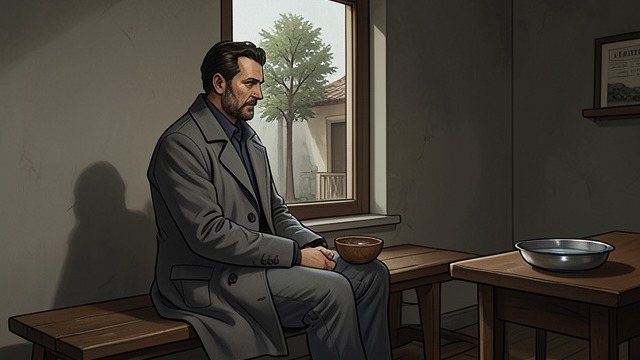
A Practice Outside His Persona
Discipline without spectacle
Meditation offered a form of attention that did not require an audience, a rival, or a political cause. For someone accustomed to treating activity as proof of life, stillness initially seemed unproductive.
A different use of will
The practice required observing thoughts rather than conquering them. It presented self-command as attention and patience, not merely the ability to endure pain or dominate others.
The Trapper’s Lessons

Attention to the World
Learning practical knowledge
Zolotarev taught Limonov how to fish, prepare food, and recognize the natural environment. His expertise rested on close observation rather than on the political abstractions that filled Limonov’s life in Moscow.
Calm as a form of strength
The guide’s quiet confidence gave Limonov an alternative model of authority. Their time together made spiritual practice seem less like an imported idea and more like a way of inhabiting the world.
The Night of Music

A Brush with Transcendence
An experience outside ordinary time
Alone in the cabin, Limonov felt as if time and space had opened into a reality more vivid than ordinary life. The experience came with music he could not verify, heard on a night when he was thinking intensely about death.
Meaning after the event
His companions denied that any ceremony had occurred, but Limonov treated the experience as real and transformative. It prepared him to interpret later meditation as a way to stand beyond fear and desire.
Pasha’s Instruction

Meditation in a Crowded Cell
A teacher among convicts
Pasha Rybkin taught Limonov a simple practice of sitting upright and observing the breath. The lesson came from a prisoner whose austere habits and calm demeanor contrasted with the violence associated with his criminal history.
Practical value under pressure
Limonov quickly adapted the practice to prison corridors and transfers. It gave him a way to create an inward refuge amid noise, surveillance, and uncertainty.
Nirvana at the Aquarium

A Sudden Opening
An ordinary task
While cleaning an official’s aquarium, Limonov focused on his breathing and the work before him. Without warning, his ordinary sense of time and space seemed to stop, and the moment became intensely real.
Returning to desire
He understood the experience as a brief encounter with nirvana, followed by a return to ordinary anxiety and ambition. The event did not turn him into a saint; it showed him a possible freedom from the desires that had driven his life.
Before 2000, through Limonov’s earlier encounters with meditation
Summer 2000, during the Altai retreat
Spring 2001, after Zolotarev’s death
2002, in the Saratov prison cell
During Limonov’s imprisonment at Engels
