
The Contradictions of Political Identity
LimonovThis flow follows Limonov’s movement among communism, nationalism, fascist aesthetics, revolutionary politics, and democratic opposition without a settled ideological home.
increasing Bearing strength in each event
 decreasing
Bearing strength in each eventdecreasingA Soviet Boy’s Patriotism
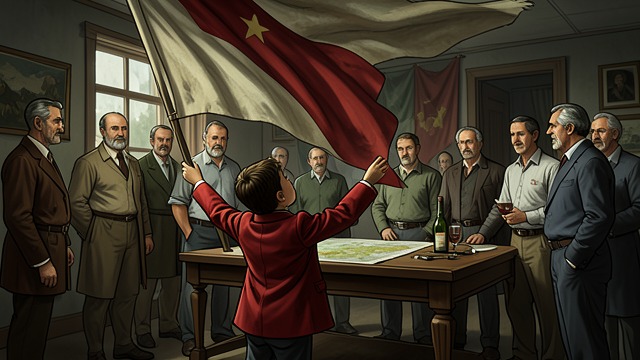
Patriotism Before Ideology
Pride in victory and empire
Limonov grew up proud of the Soviet victory over Nazi Germany and the power of the state. His family’s ordinary life did not lead him to identify with the dissident account of a society defined entirely by repression.
A rebellious patriot
His later political radicalism did not begin as a rejection of the country. He wanted to rebel against its timid, ordinary inhabitants while retaining the pride in national strength he had absorbed as a child.
The Red and the Provocative

Styling Political Contradiction
Stalin as provocation
In Paris, Limonov toasted Stalin and mocked conventional anti-communist pieties. The statements were partly sincere and partly designed to disturb a fashionable scene that prized cynicism.
A politics in performance
His public identity joined left-wing symbols, authoritarian admiration, and punk irreverence. Rather than resolve these contradictions, he made their collision part of the attraction of his persona.
The Brown-Red Alliance
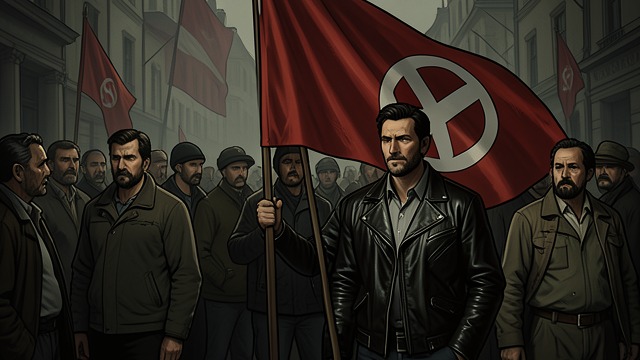
Beyond Left and Right
A mixed political pantheon
Limonov and Alexander Dugin combined communist and fascist references, treating the conventional distinction between them as less important than vitality and opposition to liberal order. The synthesis produced an intentionally unsettling movement.
Style and doctrine diverge
The party’s recruits often cared more about punk counterculture and group loyalty than Dugin’s theory. National Bolshevism became both an ideology and a social style whose members did not always share the same beliefs.
The Underdog’s Changing Side

Loyalty Without a Fixed Camp
Serbs, then Muslims
Limonov initially identified with Serbian forces and later praised Muslim peoples he encountered in Central Asia and Chechnya. His political sympathies shifted as he found new groups he perceived as proud, poor, and threatened.
A consistent emotional logic
The changes were less a stable doctrine than a recurring attraction to the outsider or underdog, especially when that group expressed toughness and resentment. The pattern could generate solidarity but also make him vulnerable to romanticizing violence.
The Democratic Dissident by Circumstance
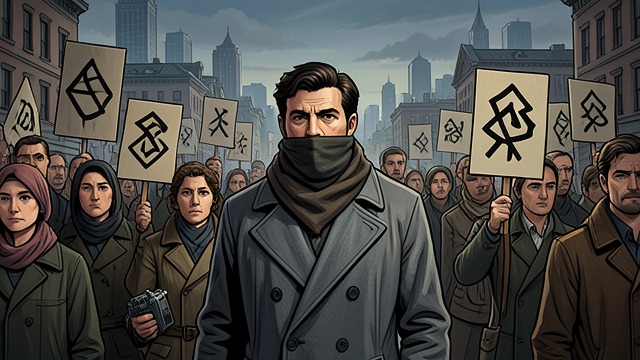
A Role He Did Not Choose Ideologically
Defending public rights
Limonov joined demonstrations for constitutional freedoms and worked with democratic activists. His role as an opponent of Vladimir Putin gave him a new public position that differed sharply from his earlier contempt for liberal politics.
The unresolved self
He did not become a conventional democrat, and Carrère does not present his participation as ideological conversion. The contradiction remained visible: a man who distrusted human-rights language used it because the state had made it a necessary ground of resistance.
1950s–1960s, during Limonov’s youth
1980s, in Paris
Early 1990s, during the creation of National Bolshevism
1991–1995, across the Balkan and Central Asian conflicts
2006–2009, in opposition to Putin
