Cattle
Little House on the PrairieCattle enter the world of Little House on the Prairie not as a physical presence but as a sound carried on the still summer air. One evening, as Laura and Pa sat outside under a big moon while Pa played his fiddle, Laura heard a strange, low sound far away. Pa identified it at once: 'Cattle!' he said. 'It must be the cattle herds going north.' The distant lowing resolved into what Laura thought was a song, and Pa confirmed that the cowboys were singing to their cattle, telling them it was time to sleep. This moment establishes cattle as a feature of the prairie's vast soundscape, a sign of life and movement beyond the family's small claim on the land, and it links the herds to the haunting, lonely music that would come to define the cowboy's world for Laura.
The Cowboys and the Cattle Drive
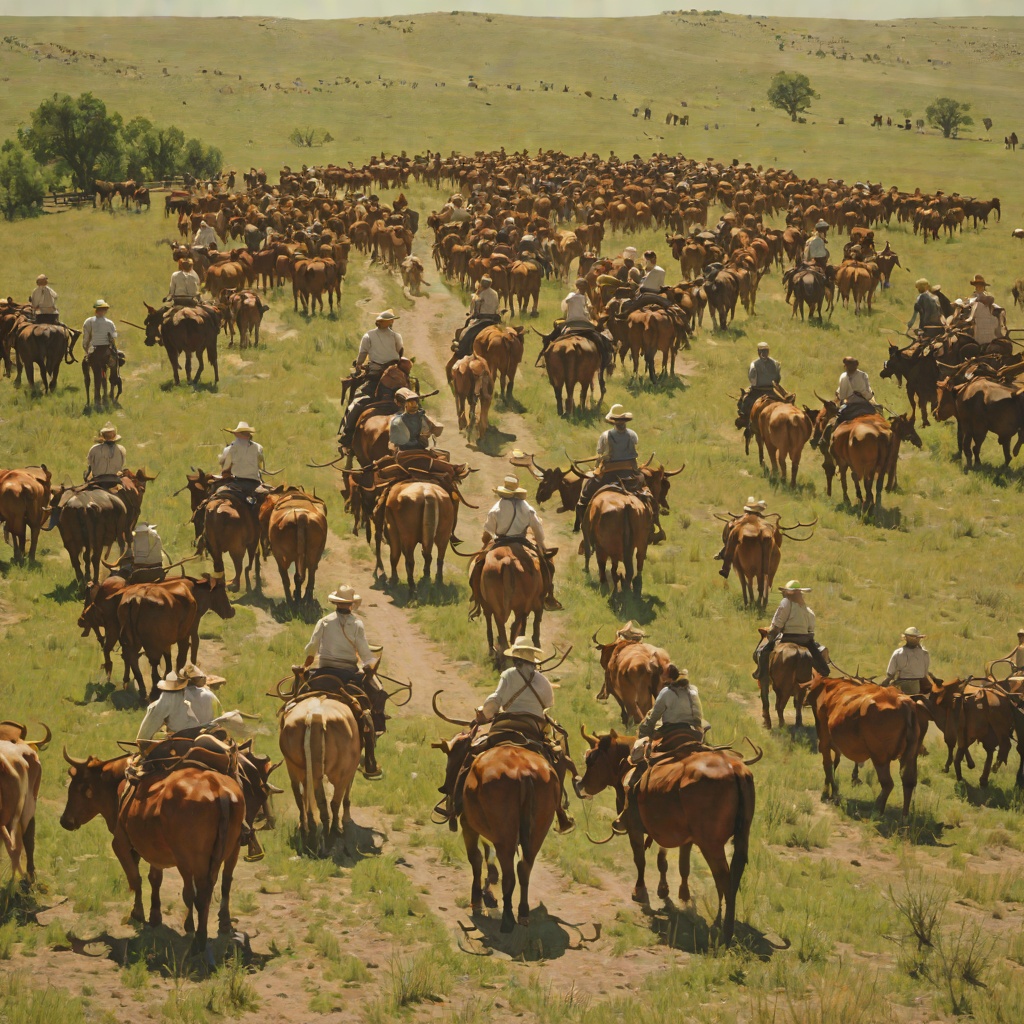
The next morning, the abstract sound became a concrete encounter. Two strange men were sitting on horses by the stable, talking to Pa. They were as red-brown as Indians, wore big, wide hats and cowboy boots, had handkerchiefs tied around their necks, and carried guns at their sides. These were cowboys, and they brought Pa a piece of luck: they wanted him to help move the cattle across the creek, and they would pay him with beef. Ma's eyes shone at the prospect. Pa tied his biggest handkerchief around his neck, showing Laura how a cowboy pulls it up over his mouth and nose to keep out the dust, and then rode Patty down the Indian trail. All day the sun shone hot, the sound of the cattle herds came nearer, and Laura and Mary could see the dust they made. Pa came home at sunset covered in dust, with dust in his hair and around his eyes, and dust falling from his clothes. The cattle moved slowly, eating grass as they went, so the work was not finished in a single day. That night, Pa fell asleep soon after supper, while Laura lay awake listening to the sounds of the cattle and the high, lonely songs of the cowboys, which sounded like the crying of wolves under the moon and made her feel sad.
The Cow and Calf Arrive
The cattle drive culminated in a gift that transformed the family's circumstances. Late one afternoon, Laura saw Pa riding home with two cowboys, a cow, and a little black-and-white calf. The cowboys had given Pa the cow because she was too thin to sell, and the calf because it was too small to travel; they had also given him the beef they had promised. Ma's eyes opened wide at the sight of their new animals. Pa tied the cow to the stable and went out to get some milk for Baby Carrie. The family watched the baby drink all that good milk, her little red tongue cleaning her milky lips as she laughed. Ma cooked the beef, and everyone felt happy; nothing had ever tasted as good as that thick, red meat. The cattle were far away now, and the girls could no longer hear the songs of the cowboys. The arrival of the cow and calf thus marked a moment of abundance and domestic contentment, a tangible reward for Pa's labor on the prairie.
Laura's Longing and the Cattle's Departure
The cattle also stirred a powerful desire in Laura. When she saw a cowboy on a black-and-white horse riding fast to get in front of the running cattle, waving his big hat and shouting as he moved them along, she ran around outside, waving her hat and shouting wildly herself. Ma rebuked her: 'Stop that! A young lady shouldn't shout like that.' Laura's response was direct: 'I wish I could be a cowboy, Ma.' This moment crystallizes the tension between Laura's frontier spirit and the domestic expectations placed on her as a girl. The cattle, and the cowboys who drove them, represented a life of freedom, movement, and adventure that stood in contrast to the settled, orderly world of the little house. The cattle's departure, marked by the fading of the cowboys' songs, left the prairie quiet again, but the impression they made on Laura lingered.
Cattle and the Wider Prairie World
The cattle were not the only large animals to shape the family's experience of the prairie. The horses Pet and Patty were essential to the family's survival, pulling the plough that broke up the grassy earth when Pa was preparing to plant potatoes. The plough turned over the rich land, which Pa liked because there wasn't a tree or stone in it. Cattle also appear in the context of the family's other encounters with the wild. When Pa rode Patty across the prairie without his gun, he was surrounded by wolves that walked along with him 'like a pack of dogs going along with a horse,' jumping and playing with each other; he was lucky they weren't hungry. The wolves, like the cattle, were part of the prairie's animal life, and the family's relationship with them oscillated between fear and a kind of wary coexistence. The cattle, by contrast, were a source of sustenance and connection to the wider frontier economy, linking the Ingalls family to the cowboys and the great herds moving north.
The Cattle's Significance in the Frontier Narrative
The cattle's role in the novel extends beyond their immediate material benefits. They are part of the larger story of white settlement and the transformation of the prairie. Pa's explanation of why the Indians had to move west—'When white settlers arrive in a place, the Indians have to move away from there'—was part of the same logic that brought the cattle herds and the cowboys to the prairie. The cattle represented the commercial and agricultural forces that were reshaping the land, just as the plough was breaking up the grassy earth. The cowboys' songs, which Laura found so sad and beautiful, were a sign of this new order, a music of the frontier that would soon give way to the settled farms and towns that the Ingalls family's own journey was helping to create. In this sense, the cattle were not merely animals but agents of the historical change that the novel both celebrates and quietly mourns.