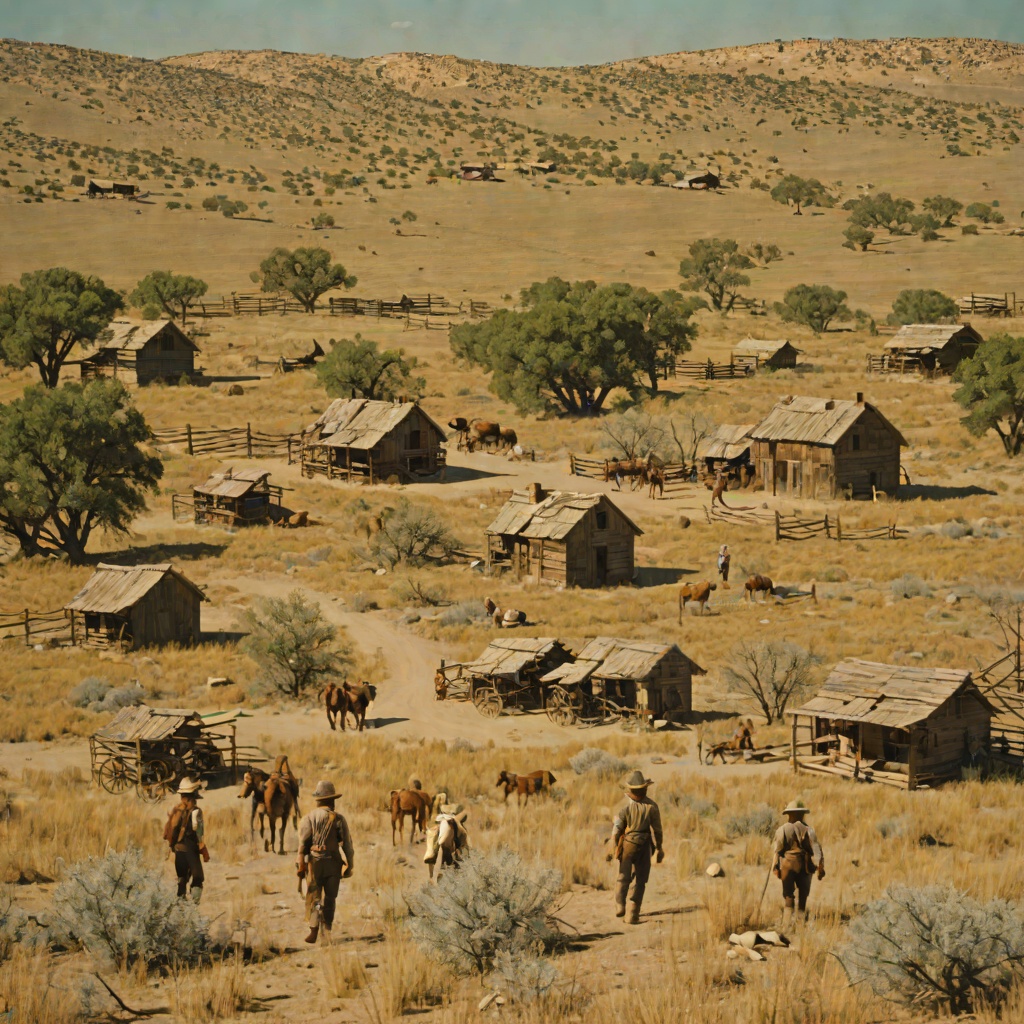
You never know what will happen next, nor where you will be tomorrow, when you are travelling in a covered wagon.
Little House on the Prairie“You never know what will happen next, nor where you will be tomorrow, when you are travelling in a covered wagon.” is a concluding expression about the radical uncertainty of migration. Spoken as the narrative reaches its end, it gathers the Ingalls family’s westward movement, their temporary settlements, and their exposure to the unfamiliar future into one memorable principle: a family travelling in a covered wagon cannot assume either what the next day will bring or where that day will find them.
Meaning and Form
The expression joins two kinds of uncertainty. “What will happen next” concerns events, including dangers and opportunities that cannot be predicted in advance. “Where you will be tomorrow” concerns place and belonging, since a travelling family may still be on the road, arriving somewhere new, or preparing to move again. The sentence therefore treats time and geography together. The future is not only unknown in its contents; it is also unknown in its location.
The covered wagon is the expression’s decisive concrete image. It represents movement with limited security: the family is not settled behind permanent walls, and the road does not guarantee a fixed destination. At the same time, the wagon carries the family forward, so uncertainty is inseparable from possibility. The phrase does not describe confusion in the abstract. It locates uncertainty in a recognizable way of life, in which travel itself makes tomorrow provisional.
Position at the Ending
The expression appears immediately before the closing statement of the book. Pa has just remarked to Caroline Ingalls that the country is a great one, while warning that wild Indians and wolves will remain there for many years. His observation places promise beside danger: the new country is attractive, but it is not yet safe or fully controlled. The expression follows naturally from that contrast, transforming the family’s immediate circumstances into a broader reflection on their future.
The final scene also gives the expression an emotional counterpoint. Charles Ingalls and Caroline Ingalls are still and silent, while Mary Ingalls and Laura Ingalls are quiet as well; Laura Ingalls, however, feels excited inside. The family’s silence suggests the weight of the risks Pa has named, whereas Laura Ingalls’s excitement shows that the unknown is not presented only as a threat. The same future that troubles the adults can stir anticipation in a child. The expression preserves both responses without resolving the tension between them.
Relation to the Ingalls Family’s Journey
For the Ingalls family, travelling in the covered wagon has made uncertainty a recurring condition. Their movement westward means that home is repeatedly made temporary and then left behind. The wagon is consequently more than transportation: it is the setting in which the family experiences departure, endurance, arrival, and the possibility of another departure. The expression gives verbal form to the instability underlying those changes.
Its wording also broadens the story beyond a single destination. Even at the end, the family’s future cannot be reduced to the place they have reached. Pa’s warning about continuing dangers makes clear that arrival has not erased hardship, and the family’s silence indicates that the meaning of the new country is still being absorbed. The expression leaves the road conceptually open. It suggests that the end of one move may be only a pause within a life shaped by movement.
Narrative Function
As a closing reflection, the expression converts plot into outlook. Earlier dangers and movements are no longer treated as isolated incidents; they become evidence for a durable understanding of frontier life. The sentence also gives the book a forward-looking ending. Rather than explaining everything that will happen after the family’s arrival, it emphasizes that the future remains undisclosed.
This openness is carefully balanced by the narrator’s concrete frame. The reader is not asked to imagine unlimited possibilities detached from the story. The uncertainty belongs specifically to people travelling in a covered wagon, and it is intensified by the known presence of wild Indians and wolves and by the family’s mixed silence and excitement. The expression therefore closes the narrative without closing the world. Its significance lies in making uncertainty itself the final horizon: the family has reached the end of this account, but not the end of the road’s unknown possibilities.