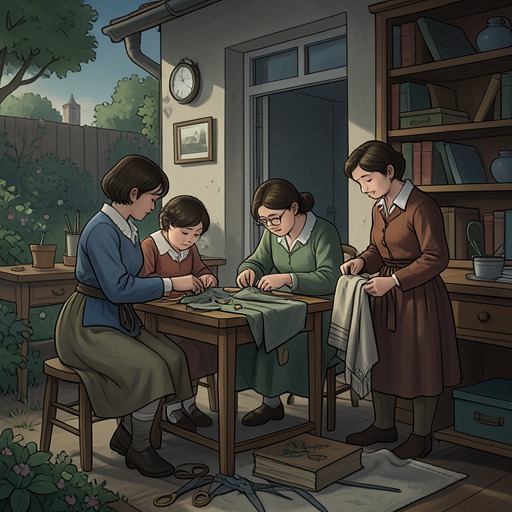
Amy Curtis March
Little WomenAmy Curtis March is the youngest of the March sisters and the family’s self-conscious little artist: pale and slender, blue-eyed, yellow-haired, and consistently mindful of her manners. Her childhood is marked by a mixture of vanity, accomplishment, social awareness, and genuine creative talent. Across the novel, she learns to convert a desire for beauty, status, and recognition into a more durable form of generosity and self-command, becoming the member of the family whose artistic and social ambitions are finally joined to a mature understanding of love.
Identity and Early Character
Amy is introduced as “a regular snow maiden,” carrying herself like a young lady who knows the importance of deportment. Although the youngest sister, she considers herself a person of consequence, and her polished little airs distinguish her from the more impulsive Josephine March and the retiring Elizabeth March. Her appearance is part of her self-conception: she is pale and slender, with blue eyes and yellow hair curling over her shoulders, and she treats elegance as both a pleasure and a discipline.
Her most persistent childhood grievance is her nose. Josephine March once dropped her into a coal hod when she was a baby, and Amy becomes convinced that the accident has permanently deprived her of an aristocratic, Grecian profile. No one else considers the feature important, but Amy feels the deficiency deeply and fills sheets of paper with handsome noses as consolation. The episode is comic, yet it establishes a serious pattern in her character: she is unusually alert to how she appears, how she is judged, and how far her present circumstances fall short of the refinement she imagines.
That self-consciousness coexists with real gifts. Her sisters call her “Little Raphael” because she is happiest copying flowers, designing fairies, and illustrating stories. She draws animals over her sums, fills atlas pages with copied maps, and produces caricatures from her books, even while managing her lessons well enough to avoid constant punishment. Her accomplishment is not limited to drawing: she can play twelve tunes, crochet, and read French with only limited mispronunciation. She is also good-tempered and popular among her schoolmates, possessing what the narrative calls the happy art of pleasing without effort. Amy’s elegance is therefore not wholly artificial; it rests on discipline, charm, and a genuine capacity to learn.
Ambition and the March Household
Amy grows up in a household defined by scarcity and wartime separation. When the sisters discuss giving up Christmas presents because the winter will be hard and men are suffering in the army, she objects that it is unfair for some girls to possess plenty of pretty things while others have nothing. Her protest reveals both the material basis of her vanity and the family’s moral pressure upon it. The March sisters have Father and Mother and one another, but Mr. March is away where the fighting is, and the girls are asked to turn private deprivation into willing sacrifice.
Amy’s relationship to the family’s wartime duties is less openly fervent than Josephine March’s. Josephine March wishes she could serve as a drummer or nurse near Mr. March, while Margaret March warmly praises his decision to become a chaplain despite being too old and weak to serve as a soldier. Amy instead notices the discomforts of military life: tents, bad-tasting food, and tin mugs. Her response does not make her disloyal; it shows the difference between her sisters’ temperaments and her own, as she experiences public hardship through the lens of bodily comfort, decorum, and domestic concern.
The March household also teaches Amy that work and obedience are forms of character. When a telegraph announces that Mr. March is gravely ill, Mrs. March assigns Amy the practical duty of helping Hannah retrieve the black trunk while the others prepare for the journey. Before leaving, Mrs. March tells the girls to remain active rather than use idleness to escape grief, and specifically asks Amy to help, obey, and remain safely at home. Amy’s place in the family is thus not merely ornamental. Her contribution is measured through small acts of reliability within the domestic crisis.
Three years later, the war is over and Mr. March is safely home. The family remains poor, but he serves a small parish and acts as its moral head, conscience, anchor, and comforter. Amy’s later development takes place against this restored family stability: her ambitions do not arise from a rejection of the March household, but from a continuing effort to reconcile its ethical inheritance with her wish for beauty, distinction, and a wider life.
Artistic Desire and the World Beyond Home
Amy states her central ambition with unusual clarity: her greatest wish is to become an artist, travel to Rome, paint fine pictures, and be the best artist in the whole world. The scale of the dream is both youthful and revealing. She does not merely want to draw for pleasure; she wants artistic mastery, international experience, and public distinction. Josephine March describes the sisters as ambitious, since all except Elizabeth March wish to be rich, famous, and gorgeous in every respect, while Elizabeth March is content after receiving the Laurence piano. Amy’s ambition is consequently part of a larger family pattern, but it has a distinctive visual and cultural form.
The contrast between the March house and the Laurence mansion sharpens Amy’s aspirations. A low hedge separates the Marches’ shabby brown house from the stately stone mansion of James Laurence, whose grounds, conservatory, coach house, and rich interiors display the comforts unavailable to the March family. Josephine March imagines the mansion as an enchanted palace, and when Theodore Laurence leads her through its rooms, its library contains books, pictures, statues, cabinets of coins and curiosities, bronzes, and a great open fireplace. The house represents not only wealth but access to cultivated objects and spaces. Amy’s taste for art and elegance grows within a social world where such refinement is materially visible on the other side of a hedge.
Josephine March’s “castle in the air” expresses an imaginative version of the same desire for a future not yet secured. Amy’s dream of Rome is more concrete: it gives her ambition a destination and a professional identity. Yet her development depends on learning that the highest form of refinement cannot be reduced to a Grecian nose, fashionable accomplishment, or social display. The novel repeatedly places her attraction to appearances beside the discipline required to turn aspiration into character.
Europe and Emotional Maturity
Amy eventually travels to Europe to seek the Old World, which is described as newly beautiful to young eyes. Her departure is watched by her father and friend, who hope that gentle fortunes will accompany her. The journey gives physical scope to the artistic and social world she had imagined from home, carrying her beyond the hedge-bound geography of the March neighborhood and into the places associated with culture, travel, and cultivated experience.
During her travels, Amy moves from Nice to Vevay because the heat drives the party away in May; the route proceeds slowly through Genoa and the Italian lakes before reaching Switzerland. These details matter because Europe is not presented as a single romantic destination but as a sequence of changing places through which Amy learns patience, distance, and emotional independence. At Vevay, she receives no letter telling her that Elizabeth March is failing. By the time the news reaches her, it is too late to return in time to say goodbye, and the family decides that she should not shorten her visit, allowing absence to soften her sorrow.
Amy bears the decision quietly, but her heart is heavy. She longs to be home and looks wistfully across the lake, waiting for Theodore Laurence to come and comfort her. The passage exposes the cost of her foreign opportunity: the dream of travel has been fulfilled at the precise moment when family presence becomes most necessary. Her response is neither childish protest nor indifference. She submits to the family’s judgment while carrying grief across distance, a sign that her emotional life has deepened beyond the self-regarding complaints of her childhood.
Theodore Laurence comes as soon as he learns what has happened. Although he is in Germany when the news reaches him, he immediately packs his knapsack, says goodbye to his fellow pedestrians, and travels to keep his promise. He reaches Vevay and hurries toward La Tour, where the Carrols are staying, unwilling even to wait for assistance from the servant who tells him that the family has gone out on the lake. Amy’s longing and Theodore Laurence’s urgent journey bring their relationship into focus through shared vulnerability: Europe, once the setting of Amy’s ambition, becomes the space in which love is tested by grief and separation.
Love, Marriage, and Family Continuity
When Amy and Theodore Laurence write to announce their engagement, Margaret March worries that Josephine March may find it difficult to rejoice. Josephine March is initially grave, but then accepts the news calmly and begins making hopes and plans for “the children” even before reading the letter twice. The engagement therefore completes a major emotional reversal. The pairing is not treated as a triumph of wealth or social advancement; it is welcomed because Amy’s earlier susceptibility to what Josephine March calls the “mercenary spirit” has been overcome by love.
The engagement also changes the meaning of Amy’s European accomplishment. Her travel has not simply carried her toward artistic fame or fashionable distinction. It has placed her in a new emotional situation, where she must value loyalty over display and accept that intimate responsibility can interrupt personal plans. Her love for Theodore Laurence joins the March family to the Laurence family more closely, transforming an old neighborhood contrast between poverty and luxury into a durable family alliance.
Amy’s marriage makes her Mrs. Laurence, but the narrative does not end with marriage as a passive reward. In the astonishing year that follows, Josephine March finds herself married and settled at Plumfield, while a household of six or seven boys grows around the Bhaers. James Laurence repeatedly brings forward touching cases of destitute boys and asks the Bhaers to take them in, offering to pay something toward their support. Through this extended household, Amy’s marriage becomes part of a larger network of care rather than an isolated romantic conclusion.
Theodore Laurence remains closely bound to his grandfather and to Amy. He describes how the March sisters and the Laurence family have helped him, placing one hand on James Laurence’s head and the other on Amy’s golden head; the three are never far apart. Their physical closeness embodies the novel’s preferred form of prosperity: not possession alone, but a family gathered through gratitude, mutual aid, and affection. Amy’s golden-haired childhood image remains, but it now signifies belonging within a relationship sustained by shared duty.
Development and Significance
Amy’s arc moves from external self-fashioning toward inward cultivation without requiring her to abandon beauty, art, or ambition. Her concern over her nose, her accomplished manners, and her wish to be the greatest artist in the world all belong to the same developing consciousness: she wants to become someone worthy of admiration. The novel’s moral question is whether admiration can be secured through appearance alone. Amy’s answer, enacted over time, is that elegance must be joined to patience, generosity, emotional courage, and love.
Her character also broadens the novel’s account of female possibility. She is not asked to imitate Josephine March’s rebellious energy or Elizabeth March’s self-effacing goodness. Instead, her path gives artistic aspiration, travel, social intelligence, and cultivated manners a legitimate place within the family’s moral world. Her ambition begins in a language of fame and perfection, but her maturity is measured by how she responds when art, travel, and personal pleasure collide with illness, bereavement, and family claims.
At Plumfield, the family’s social boundaries are further redrawn. James Laurence’s charitable interventions bring poor boys as well as rich into the household, and the boys’ presence transforms the once prim and orderly estate into a lively school and refuge. Amy’s final position within this enlarged family confirms that her refinement has not isolated her from hardship. The youngest March sister who once measured suffering through pretty things becomes part of a household where care is extended across class lines and where family is made through continued action.
Amy Curtis March therefore represents a distinct version of growth in Little Women. She begins as a girl preoccupied with her face, her accomplishments, and the elegant future she can imagine; she ends as a woman whose beauty and ambition have been absorbed into a network of love, grief, marriage, and practical responsibility. Her decisive achievement is not the conquest of Rome or the attainment of universal artistic fame, but the conversion of cultivated desire into a form of character capable of enduring distance, recognizing love, and helping sustain the family she has never ceased to value.