Beth March–Mr. Laurence relationship
Little WomenThe Beth March–Mr. Laurence relationship is one of the most delicate forms of kinship in Little Women: a bond between a shy girl and a grieving old man that begins across a hedge and ends by overcoming both fear and pride. Its decisive language is not courtship or formal adoption, but music and gifts. Mr. Laurence recognizes Beth's goodness and vulnerability, while Beth's gratitude reaches the private grief he has kept behind his crusty exterior.
Distance and First Impressions
The relationship grows out of the spatial and social arrangement of the neighborhood. The March family home is an old, brown, comparatively shabby house, while the Laurence mansion is a stately stone residence marked by comfort, luxury, well-kept grounds, and a conservatory. A low hedge separates the two estates, making the boundary both visible and passable. To Jo, the mansion looks like an enchanted palace, but it also seems lonely and lifeless: no children play on its lawn, no motherly face appears at its windows, and only Mr. Laurence and his grandson are regularly visible there.
Beth is drawn to the house because of its piano, yet she cannot overcome her fear of entering it. When she visits with Jo, Mr. Laurence stares at her heavily and calls out loudly, frightening her so badly that her feet chatter on the floor. She retreats from the mansion and declares that she will never return, not even for the beloved piano. Her withdrawal is not indifference; it shows how strongly an intimidating social space and an alarming first encounter restrict her desire for music and companionship.
Music as an Invitation
Mr. Laurence repairs the breach without confronting Beth directly. During a brief call, he guides the conversation toward music, speaking about great singers, fine organs, and amusing musical anecdotes. Beth, initially hidden in a distant corner, creeps nearer until she is listening behind his chair. He then presents her wish as a practical favor, suggesting that the girls use the piano so that it will remain in tune because Laurie has neglected his music. He further removes every obstacle by explaining that the girls need not see or speak to anyone and may enter when the house is empty.
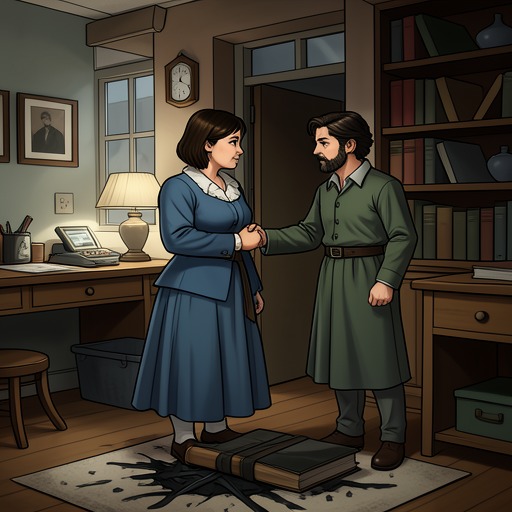
Beth finally takes his hand and tells him that the young ladies care very much. Mr. Laurence asks whether she is the musical girl and, without frightening her, invites her to come and play as much as she likes. His kindness is carefully adapted to her temperament: instead of demanding sociability, he grants her privacy; instead of forcing trust, he creates a safe route toward it. Beth's blushing gratitude and wordless squeeze of his hand show that the invitation is experienced as a precious gift rather than a mere convenience.
The emotional meaning of his welcome becomes explicit when Mr. Laurence says that he once had a little girl with eyes like Beth's. He kisses her and leaves hurriedly, revealing that her resemblance has touched an old loss. Beth, liberated from fear, enters the mansion soon afterward and approaches the instrument with trembling fingers. Once she begins to play, she forgets her fear, herself, and everything except the delight of music, which feels like the voice of a beloved friend.
The Piano and Reciprocal Gifts
Beth's visits soon become nearly daily. Her little brown hood slips through the hedge, and the drawing room is haunted by music that arrives and departs unseen. She does not know that Mr. Laurence opens his study door to hear the old-fashioned airs he loves, that Laurie guards the hall against interruption, or that exercise books and new songs are placed in the rack for her benefit. The relationship therefore develops through discreet acts of care. Mr. Laurence protects the conditions in which Beth can flourish, while allowing her to believe that she is simply enjoying a permitted pleasure.
Beth responds through labor. A few weeks after Mr. Laurence's visit, she decides to make him a pair of slippers because he has been so kind and she has no other way to thank him. After serious discussions with Meg and Jo, the sisters choose a pattern, buy the materials, and help with the difficult portions. The slippers bear cheerful pansies on a deep purple ground, and Beth works early and late until they are finished. With Laurie's assistance, she places them on Mr. Laurence's study table, accompanied by a short, simple note.
The old gentleman's letter turns the private exchange into an acknowledgment of shared feeling. He writes that he has owned many pairs of slippers but never any that suited him so well as Beth's, and explains that heartsease is his favorite flower because the slippers will remind him of their gentle giver. He says he likes to pay his debts and therefore sends something that once belonged to the granddaughter he lost. The gift is not merely valuable property: it carries memory, grief, and the possibility of renewing affection.
From Gift to Family Feeling
Beth is overwhelmed when she sees the little cabinet piano waiting for her, with a letter addressed to Miss Elizabeth March on its glossy lid. The instrument is complete with candle brackets, green silk, a gold rose, a rack, and a stool. Its material details make the gift intimate and legible: it is not an abstract inheritance but a preserved object from a child whom Mr. Laurence loved. Beth's love of music has enabled the old man to redirect an object associated with bereavement toward a living child who can use and cherish it.
The gift also changes Beth's behavior. She deliberately crosses the garden and hedge, enters the Laurence house, and knocks at Mr. Laurence's study door before she can lose courage. When he invites her in, she begins to thank him but cannot finish the speech. Remembering that he has lost the little girl he loved, Beth instead puts both arms around his neck and kisses him. Her gesture is spontaneous rather than ceremonious, and its lack of social calculation is precisely what reaches him.
Mr. Laurence is astonished, but he welcomes the embrace. His crustiness vanishes; he sets Beth on his knee and lays his cheek against hers as though he has recovered his own granddaughter. Beth, in turn, ceases to fear him and talks with him as comfortably as if she had known him all her life. Their relationship thus moves through a clear transformation: the mansion changes from an intimidating enclosure into a hospitable home, the piano changes from a forbidden object into a shared medium, and the old man changes from a frightening stranger into a grandfather-like companion.
Narrative Significance
The bond between Beth and Mr. Laurence exemplifies the book's larger pattern of turning separation into community through concrete acts of generosity. The March and Laurence households begin on opposite sides of a hedge and differ sharply in wealth, but the boundary does not remain a barrier. Christmas charity, neighborly attention, music, handmade work, and carefully offered gifts make the two families increasingly intimate. Mr. Laurence also responds to the March family's kindness: after Hannah tells one of his servants about the girls giving up their Christmas breakfast for a poor family, he sends a supper to replace what they sacrificed, explaining that he knew Mr. March years earlier and wished to express friendly feeling toward his children.
The relationship is especially powerful because both parties give what the other lacks. Beth offers music, trust, and affectionate recognition of Mr. Laurence's loneliness. Mr. Laurence offers access, protection, musical materials, and finally the piano connected with his lost granddaughter. Their exchange is not a transaction in which generosity creates obligation; each gift makes the next expression of affection possible. The narrative's claim that love casts out fear becomes visible in Beth's movement from frightened retreat to an unprompted embrace, while gratitude conquers the pride and hardness that have protected Mr. Laurence from renewed tenderness.
The same ethic continues beyond this early neighborhood friendship. The Laurence family's resources repeatedly enter the March family's life without erasing the Marches' dignity, and later Mr. Laurence helps provide for poor boys at Plumfield, where Jo and Professor Bhaer establish a school. In that broader arc, the Beth–Mr. Laurence relationship serves as an early model of how private sorrow can be transformed through generous attention: not by forgetting the dead granddaughter, but by allowing her piano, her memory, and the love attached to them to enter a new living relationship.