Beth survives the scarlet fever crisis
Little WomenBeth’s survival of the scarlet fever crisis is a hard-won turn from anticipated death to temporary reprieve. After nursing the Hummel family’s dying baby, Beth becomes seriously ill, and the March household is forced to confront the possibility of losing its gentlest member. Her fever finally breaks, her breathing becomes easy, and the doctor says she will probably recover, but the crisis permanently alters how Jo and the family understand Beth’s frailty and the limited time remaining to them.
Causes and Background
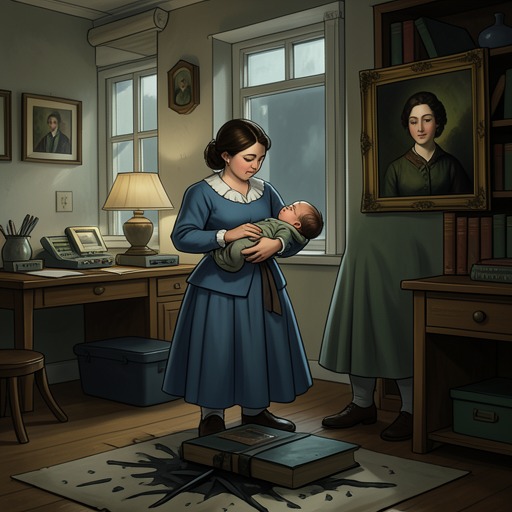
Beth’s illness begins in an act of charity rather than recklessness. When the Hummel family’s baby dies in her lap, Beth remains holding the child until Mrs. Hummel returns with the doctor. The doctor identifies scarlet fever in the household, noting that Heinrich and Minna have sore throats, and warns Beth to go home and take belladonna immediately. Beth has already recognized that her own headache, sore throat, and strange sensations resemble the symptoms described in her mother’s medical book. Her willingness to enter a poor family’s home, comfort the children, and assume practical responsibility exposes her to the disease, while also revealing the self-forgetting compassion that defines her.
The crisis occurs within a family already strained by wartime separation. Mr. March is away serving as a chaplain, and the sisters have learned to measure ordinary happiness against the fear that he may be ill or never return. When a telegraph reports that Mr. March is very ill, Mrs. March must leave for Washington, instructing the daughters to continue their work because work is a blessed solace and to remember that they never can be fatherless. The household therefore loses its mother just as Beth’s condition becomes dangerous, while illness, war, and separation converge around the family’s sense of security.
The Crisis and Reversal
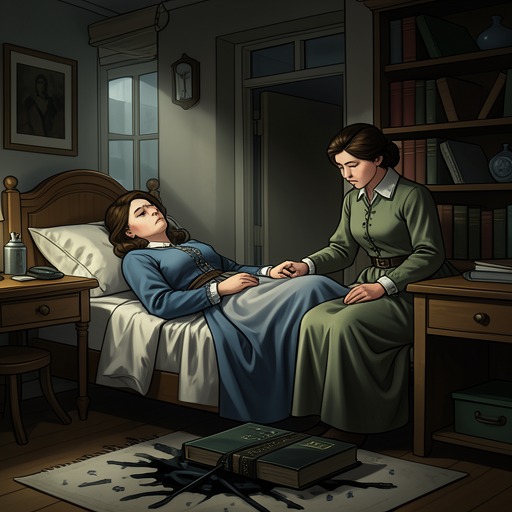
Beth’s fever produces a new domestic order of constant observation and improvised care. Dr. Bangs visits twice a day, Hannah sits up at night, Meg keeps a telegram ready in case immediate news must be sent, and Jo refuses to leave Beth’s side. Beth remains intermittently conscious and worries about those beyond her bed: she sends loving messages to Amy, asks that her mother be told she will write, and tries to obtain pencil and paper so that Mr. March will not think she has neglected him. Even in delirium and weakness, her attention continues to move outward toward family duty.
On the first of December, Dr. Bangs examines Beth at length, holds her hot hand, and quietly tells Hannah that Mrs. March should be sent for if she can leave her husband. The medical judgment changes the emotional meaning of the illness from grave danger to an apparent final crisis. Jo sends for her mother, then tells Laurie that Beth no longer recognizes them or speaks coherently. The family’s two supports seem absent at once: Mr. March is away, Mrs. March has been summoned, and Jo feels that God is too distant to help. Laurie’s physical presence and handclasp offer immediate human consolation, but they cannot yet resolve the fear of death.
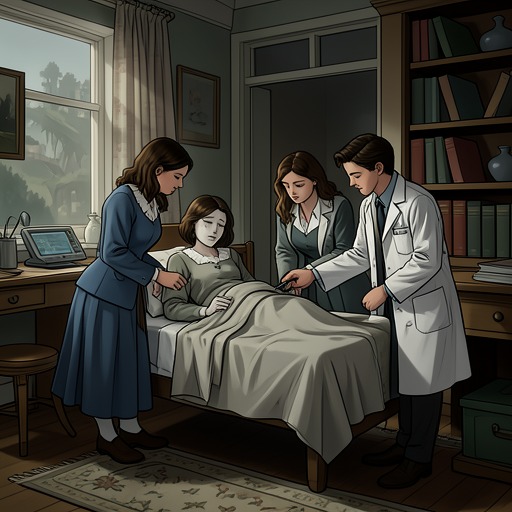
The reversal comes during the night. Jo sees Beth’s fever flush and pain disappear and mistakes the pale stillness of her face for death, whispering, "Goodby, my Beth. Goodby!" Hannah then examines her and recognizes the decisive bodily signs: Beth is sleeping naturally, her skin is damp, and she breathes easily. The doctor confirms the change, telling the girls that the little girl will pull through this time and ordering quiet and sleep. The household moves from mourning preparations to guarded rejoicing, with Jo and Meg holding one another on the dark stairs because their relief is too full for words.
Family Response and Return of Hope
The recovery is inseparable from the family’s network of care. Mrs. March had prepared to travel under the pressure of her husband’s illness, and Jo had gathered nursing supplies because hospital stores might not be adequate. Laurie secretly telegraphed Mrs. March, while John Brooke answered that she would come at once. When Laurie reveals this, Jo reacts with hysterical laughter, embraces him, and clings to him in sudden relief. Her response shows how quickly bodily fear can pass into an almost uncontrollable release when the missing mother is restored to the household’s future.
The arrival of Mrs. March completes the movement from isolation toward protection. Bells sound at the door, Hannah cries out, and Laurie announces that she has come. Beth’s survival is thus presented not as an isolated medical triumph but as a collective rescue: the doctor’s judgment, Hannah’s night watch, the sisters’ nursing, Laurie’s intervention, and the mother’s return all participate in carrying the family through the danger. The event also confirms the March household’s wider relations with the Laurence family, whose help had already been offered when Mrs. March departed for Washington.
Recovery, Change, and Foreshadowing
Beth survives the immediate scarlet fever crisis, but she does not simply return to her former condition. When Jo comes home in the spring after an absence, she notices a change that those living with Beth have scarcely perceived. Beth is only a little paler and thinner than before, yet she has a transparent, fragile appearance, as if the mortal body were gradually being refined away. The earlier recovery therefore becomes a temporary reprieve rather than a complete restoration. Its apparent happy ending contains the first clear sign that the fever has left Beth vulnerable and that her family’s fear was not misplaced.
Jo responds to this altered condition by taking Beth to the seashore, where the quieter setting and fresh air may strengthen her. Beth does not want to travel far from home, and the sisters prefer one another’s company to society. Their closeness gains a new poignancy because they seem instinctively to sense that a long separation is approaching. The scarlet fever crisis has taught Jo to read changes in Beth’s body, while Beth’s later decline turns the earlier recovery into part of a larger pattern of illness, care, and anticipatory grief.
Narrative Significance
The event’s decisive value shift is from communal life toward threatened loss and back toward hope, though the return is incomplete. Beth’s illness reveals the costs of charitable action, the vulnerability of a family divided by war, and the practical labor required to sustain a sick person. It also distributes knowledge unevenly: Beth understands her symptoms through the medical book, the doctor interprets the danger, Hannah reads the physical signs of improvement, and Jo experiences the crisis as an emotional struggle between trust and despair.
Beth’s recovery intensifies rather than cancels the novel’s meditation on mortality. The March family later welcomes Mr. March home after the war, and he becomes the household’s moral anchor, but Beth’s body remains marked by the illness. In the spring, she entrusts Jo with the duty of becoming everything to their parents when she is gone, and she dies quietly after the family has learned to live under the shadow first glimpsed during the fever. The survival scene consequently matters because it grants the sisters more time, strengthens their bond, and makes the later loss more tragic: hope is genuine, but it is not the same as permanence.