Delectable Mountain
Little WomenDelectable Mountain is the March sisters’ name for a hill they visit during their holiday, transforming a familiar natural height into a symbolic place of work, fellowship, and aspiration. Its significance lies in the way the sisters use imagination not to escape responsibility but to give their responsibilities a larger meaning: while carrying their tasks outdoors, they reenact a pilgrimage and look toward a hoped-for future.
Setting and Physical View
The hill belongs to the countrylike suburb surrounding the March family home and the Laurence mansion, an area of groves, lawns, large gardens, and quiet streets. From the opening in the wood, the view expands across a wide blue river, the meadows beyond it, the outskirts of the great city, and green hills rising toward the sky. The elevated position makes the hill a place of visual release, contrasting with the houses and hedges that organize everyday social space below.
The scene is especially charged by the autumn sunset. Gold and purple clouds lie on the hilltops, while silvery white peaks rise into the ruddy light like the airy spires of some Celestial City. The view therefore joins the material landscape to the sisters’ religious and literary imagination. It is not merely scenery observed from a height; it becomes a visible promise of a destination that remains beyond the immediate neighborhood.
Work, Play, and Pilgrimage
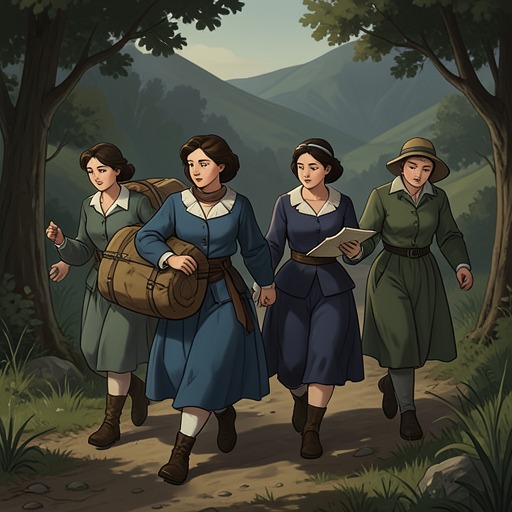
The March sisters reach Delectable Mountain during a holiday organized around purposeful activity. Their mother wants them outdoors as much as possible, so they bring their work in bags, wear old hats, and use poles to climb the hill. They have each taken on a task and worked at it seriously, completing their allotted portions rather than wasting the vacation in idleness.
Their play as pilgrims gives this labor a narrative form. By reviving a game they played years earlier, the sisters make continuity itself part of the experience: childhood invention survives, but it now accompanies the more mature discipline of completing work. The hill’s name comes from The Pilgrim's Progress, and its meaning depends on that association with a journey toward a better country. The sisters’ imagined pilgrimage is thus both playful and earnest, expressing hopes that are not yet fulfilled but are made more vivid through shared ritual.
Relationships and Shared Vision
Delectable Mountain is a collective creation of the March family rather than a solitary retreat. Its meaning emerges through the sisters’ cooperation: they carry their separate tasks together, climb by the same improvised method, and pause to look outward at the same changing view. The hill allows domestic discipline and imaginative freedom to coexist, so that work becomes a social activity rather than a private burden.
The place also opens a space for communication with Theodore Laurence. When Jo points out the panorama, Theodore Laurence sits up to examine it and responds to its beauty. Amy, who wishes she could paint the scene, adds another form of artistic attention. The moment links Jo’s energetic imagination, Theodore Laurence’s sensitivity to beauty, and Amy’s visual ambition without erasing their differences. The hill becomes a meeting point where the sisters’ inner hopes can be shared with a sympathetic neighbor.
Spatial and Thematic Significance
The hill gains force through its contrast with the nearby homes. The March family home is an old brown house, bare and shabby after the vines and summer flowers have disappeared, while the Laurence mansion is a stately stone house marked by comfort and luxury. A low hedge separates the two estates, making the neighborhood a visible arrangement of material difference and social distance. Delectable Mountain, by contrast, is a shared outlook beyond those boundaries: its value comes from the view, the activity, and the company rather than from ownership or decoration.
The hill also reverses the apparent opposition between duty and pleasure. The sisters do not reach it by abandoning their tasks; they bring those tasks with them and find enjoyment in completing them. In this sense, Delectable Mountain represents a form of moral cultivation in which labor becomes compatible with happiness. The view toward the Celestial City gives their daily efforts an imaginative horizon, while the repeated return to outdoor work keeps that aspiration grounded in practice.
Place in the Book’s Pattern of Transformation
The imaginative use of space seen at Delectable Mountain anticipates the broader transformation of family places in the story. The March sisters repeatedly turn ordinary structures and boundaries into sites of communication, play, authorship, or mutual care: the garden lies between neighboring homes, the hedge can become a postal route, and private interiors can become stages for intellectual and emotional exchange. Later, Plumfield becomes a home and school filled with six or seven boys, including poor children whom the Bhaers take in, changing a formerly orderly domestic domain into a lively boys’ community.
Delectable Mountain is therefore an early and concentrated example of the book’s spatial imagination. A hill becomes a pilgrimage station; a sunset becomes an image of a distant city; and a holiday task becomes part of a shared moral adventure. The place matters less as a permanent destination than as a way of seeing: it teaches the sisters to recognize beauty beyond their immediate circumstances and to connect hope with the active, communal work of living.