Dovecote
Little WomenDovecote is the small brown house prepared for Margaret March and John Brooke as their first home, and its importance lies in the way it turns marriage from a romantic prospect into a daily practice of shared work. Laurie gives the house its affectionate name because the young couple seem to go together like “a pair of turtledoves,” but the little dwelling soon proves that a home is not a permanent bower of romance: it is a space continually made and remade by care, fatigue, disagreement, cooperation, and love.
Designation and Setting
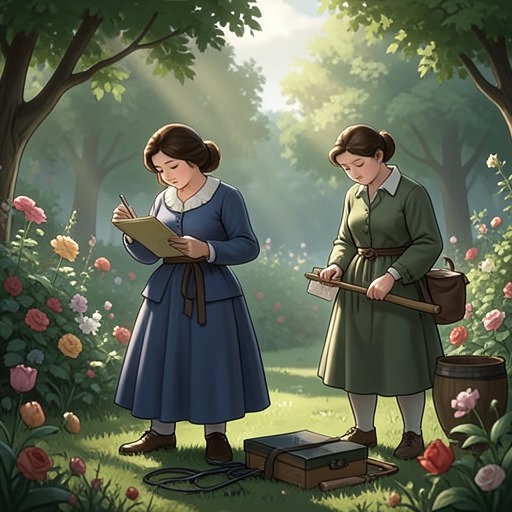
Dovecote is a tiny brown house with a little garden behind and a front lawn scarcely larger than a pocket handkerchief. Margaret March imagines a fountain, shrubbery, and abundant flowers, although the fountain is initially only a weather-beaten urn, the shrubbery consists of young larches uncertain of survival, and rows of sticks merely mark where seeds have been planted. Its modest scale sharply distinguishes it from the more spacious and luxurious Laurence mansion, yet the house is not presented as a failure. Its physical smallness becomes part of its intimacy and makes its transformation by human effort especially visible.
Inside, the house is charming because it has been furnished with good sense and good taste rather than ostentation. There are no marble-topped tables, long mirrors, or lace curtains. Instead, the parlor contains simple furniture, plenty of books, a few fine pictures, flowers in the bay window, and gifts carrying the affectionate messages of the people who supplied them. The narrow hall could barely admit a piano, the dining room can seat six only with difficulty, and the kitchen stairs threaten to send servants and china tumbling into the coalbin. These defects remain concrete reminders of poverty and limitation, but they do not prevent the house from becoming complete in the emotional sense.
A House Made by Loving Hands
The preparation of Dovecote is a collective act. James Laurence gives a Parian Psyche, John Brooke installs the bracket for it, and Amy Curtis March arranges the plain muslin curtains with artistic care. Josephine March and Mrs. March put away Margaret's boxes, barrels, and bundles while Hannah Mullet arranges the kitchen so thoroughly that every pot and pan is moved repeatedly and the fire is ready to light when Margaret returns. Elizabeth March supplies a generous stock of dusters, holders, and piece bags, even inventing three kinds of dishcloths for the bridal china. By the time the work is finished, Amy has matched differently colored soaps to the rooms and Beth has set the table for the first meal.
The house therefore records a network of relationships as materially as it shelters a married couple. Its objects are not anonymous purchases: the Parian Psyche, curtains, kitchen utensils, sewing supplies, and household bundles carry the labor, taste, practical knowledge, and good wishes of particular people. When Mrs. March asks Margaret whether the house feels like home and whether she expects to be happy there, Margaret answers that she is perfectly satisfied because of what everyone has done for her. Dovecote's domestic meaning is produced through cooperation, not through wealth.
Married Life and Domestic Difficulty
Margaret enters Dovecote determined to be a model housekeeper. She wants John Brooke to find home a paradise, to see a smiling face, eat sumptuously, and never lose a button. Her love and energy are genuine, but her ideal produces anxiety rather than peace. She fusses, overworks herself, and becomes too tired to smile; John grows dyspeptic after a succession of delicate dishes and asks for plain food. The missing buttons become a comic emblem of the gap between Margaret's perfect household fantasy and the disorder of ordinary life.
The house changes from a romantic “glorified bower” into a practical home when Margaret and John discover that they cannot live on love alone. At first they play at housekeeping like children, but John gradually assumes the responsibilities of a family head while Margaret exchanges her cambric wrappers for a large apron and works with more energy than discretion. Their affection survives the loss of theatrical romance: even domestic partings remain tender when John follows a kiss with a question about whether dinner should include veal or mutton. Dovecote makes marriage visible as an arrangement in which devotion must accommodate food, work, money, clothing, and exhaustion.
The house also becomes the setting for a sharp conflict over money and status. John unexpectedly brings a friend home to dinner on a day when the jelly is failing, and the Dovecote appears closed, silent, muddy, and unprepared. Inside, one batch of jelly has been transferred from pot to pot, another lies on the floor, and a third burns on the stove while Margaret sits sobbing with her apron over her head. Her distress is not merely comic: she has tried to convert love into flawless service and has worn herself out in the attempt. The crisis forces the couple to recognize that mutual expectations, not affection itself, have created the strain.
Margaret later struggles with the desire for a silk dress and with embarrassment about John's inability to provide it. After a long conversation, she comes to value him more deeply because poverty has made him courageous, patient, and capable of bearing the failures and longings of those he loves. She tells Sallie Gardiner Moffat the truth and asks her to buy the silk as a favor rather than accepting it as a direct gift. This resolution preserves Margaret's dignity while allowing affection to replace pride and concealment. The greatcoat John receives and the silk gown Margaret wears become paired signs of a marriage restored through honesty and generosity.
Family Life and Restoration
After Margaret has children, Dovecote becomes the center of an even more demanding domestic world. She is absorbed in the babies day and night, neglecting John, the house, and her own health; the kitchen is now run by an Irish helper, and John's domestic comfort declines while he waits for the household to regain its balance. Margaret grows worn and nervous, while the babies consume every minute. The house thus exposes another danger in domestic ideals: maternal devotion can become another form of exhausting total self-sacrifice.
With advice from Mrs. March, Margaret agrees to divide the work. Hannah Mullet helps with the children, while Margaret returns some attention to the house, takes occasional pleasure, and makes time for confidential conversation with John. The arrangement does not create a perfect paradise, but it improves everyone. John brings order and obedience to the children, Margaret recovers her spirits and steadies her nerves through exercise and recreation, and the household becomes homelike again. Friends begin visiting Dovecote because it feels quiet, pleasant, and full of family love, a quality Sallie Moffat envies in contrast with the splendid loneliness of her own great house.
Narrative Significance
Dovecote stands as a domestic counterpoint to the grander houses and imaginative spaces elsewhere in the story. The Laurence mansion first appears to Josephine March as an enchanted palace filled with books, pictures, statues, curiosities, and comfort, but it is lonely and lifeless because children and motherly warmth are absent. Dovecote possesses none of that luxury. Its narrow rooms, imperfect garden, modest furnishings, and constant household labor make it materially poorer, yet those limitations allow its emotional wealth to be seen in the hands that prepare it and the people who gather there.
The house also extends the novel's recurring transformation of boundaries into channels of fellowship. The March garden is separated from the Laurence grounds by a low hedge, and Josephine March later establishes the hedge post office in an old martin house so that letters, manuscripts, books, and bundles can pass between the neighboring “nations.” Dovecote is a later and more permanent form of the same social work: a private dwelling made hospitable through exchange, practical assistance, and affectionate visitation.
By the end of Margaret's domestic development, Dovecote embodies the lesson that household happiness is learned gradually. John Brooke and Margaret discover how to use the “key” to mutual helpfulness, opening what the narrative describes as stores of real home love available to the poor and beyond the purchasing power of the rich. The house is therefore not simply a bridal setting or a record of married poverty. It is a material argument that Margaret's happiest kingdom is home, provided that home is ruled not through perfection or authority but through wise partnership, shared labor, and enduring family affection.