Friedrich Bhaer
Little WomenFriedrich Bhaer is a learned German professor whose decisive significance lies in the union of moral judgment and ordinary kindness. He is poor, supports himself by teaching, and helps educate his two orphan nephews, Franz and Emil; yet poverty never narrows his generosity. Through his influence on Jo, the novel tests whether ambition can remain humane, whether independence can coexist with responsibility, and whether love may be founded on character rather than glamour, wealth, or conventional romantic display.
Identity and Introduction
Friedrich Bhaer enters Jo's life in New York, where she has gone to teach children and sew at Mrs. Kirke's boarding house. Before Jo knows who he is, she sees him carrying a heavy hod of coal upstairs for a very young servant girl. He removes the burden from her hand, carries it to a nearby door, and explains in a foreign accent that the child's back is too young for such weight. The action is small, anonymous, and physically useful, but it immediately reveals the principle by which he lives: strength exists to lighten another person's load.
Mrs. Kirke identifies the stranger as Professor Bhaer and tells Jo that he is from Berlin, highly learned, and poor enough to give lessons in order to support himself and educate Franz and Emil according to their late mother's wishes. He is allowed to use Mrs. Kirke's parlor for some of his pupils, placing his intellectual work within the same domestic, crowded environment in which Jo earns her living. His poverty is therefore not presented as helplessness. He possesses cultural knowledge and professional competence, but converts them into practical service for a family entrusted to him.
Jo's first visual impression resists conventional romantic ideals. She sees a stout German man with brown hair, a bushy beard, a large nose, kind eyes, a great voice, rusty clothes, large hands, a patched shoe, and missing coat buttons. He is not handsome in the ordinary sense, yet his linen is neat and he looks like a gentleman. His humanity appears most vividly when he turns hyacinth bulbs toward the sun and strokes a cat that welcomes him as an old friend. The contrast between worn clothing and careful conduct makes his character legible through habits rather than appearance.
Moral Influence and Literary Judgment
Friedrich Bhaer becomes important to Jo partly because he gives her a standard by which to judge her own imagination. He has advised her to study simple, true, and lovely characters wherever she finds them as training for a writer. Jo follows this advice by studying him, discovering a living hero whose appeal survives his imperfections. People gather around him although he is neither rich nor great, young nor conventionally handsome. His attractiveness comes from benevolence: even while carrying private sorrow, he presents a sunny side to the world, and his friendly words, cheerful laughter, warm grasp, and lack of coldness draw others toward him.
His ethical seriousness directly challenges Jo's work with sensational stories. When he realizes that she has been reading and perhaps writing material filled with lurid crime and dangerous excitement, he tells her that good young girls should not consume such trash, comparing it unfavorably with gunpowder given to children. Jo argues that demand and respectable livelihoods may justify supplying sensation stories, but Friedrich answers through the moral consequences of what writers place before the young. His image of poison hidden in a sugarplum makes artistic responsibility concrete: entertainment cannot excuse harm when the writer knowingly disguises it as sweetness.
The rebuke matters because Friedrich does not condemn Jo as a person. He remembers that she is young, poor, and far from her parents' care, and his impulse is to help rather than to assert superiority. His criticism thus combines authority with solicitude. Jo's independence is not rejected; instead, the direction of her independence is questioned. Her ambition to write and support herself can become honorable only when it is joined to thoughtfulness about readers and to a willingness to abandon work that feeds on moral degradation.
Relationship with Jo
Jo's attraction to Friedrich develops through observation, argument, and gradual recognition rather than sudden idealization. She first notices his kindness to the servant girl, then studies his appearance and habits, and finally understands why people respond to him. He becomes the genuine character who unsettles the perfection of her imaginary heroes. His plainness, poverty, age, foreignness, and eccentricities remain visible, but they are absorbed into a fuller moral portrait rather than erased by romantic fantasy.
Their relationship is also shaped by his willingness to correct Jo when correction may cost him her approval. He sees that she is ashamed of the sensational material associated with her writing and speaks gravely because he believes her gifts should serve better purposes. This creates an intellectual and ethical bond: Jo is not merely admired by him, but taken seriously enough to be challenged. His influence helps redirect her from an immature fascination with artificial passion toward a more truthful study of character.
The emotional turning point comes when Friedrich is preparing to leave New York. Jo tries to conceal her tears, but he notices them and asks why she is crying. She answers plainly that she is crying because he is going away. He then declares that he has much love to give her and asks whether she can make a little place in her heart for old Fritz. The scene reverses the guardedness that had defined Jo's earlier independence. Her honesty, rather than a calculated feminine performance, permits their mutual feeling to become explicit.
Work, Responsibility, and Future
Friedrich's love is inseparable from responsibility. When Jo asks about his affairs, he explains that friends have found him a position at a college where he can teach as he has taught at home and earn enough to make life easier for Franz and Emil. The opportunity is valuable not simply because it advances his career, but because it allows him to continue caring for the boys. His professional future is measured by the dependents it can sustain.
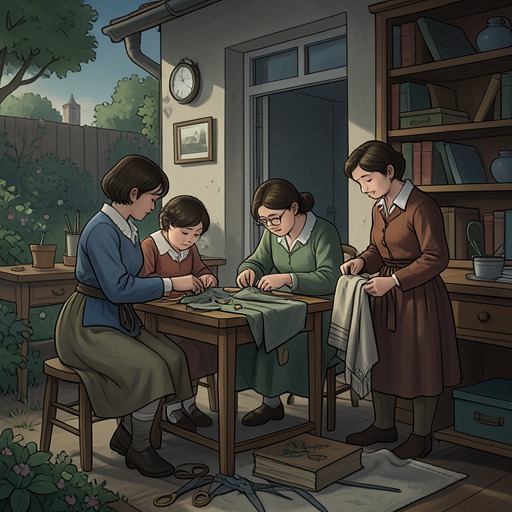
This practical orientation complements Jo's own history of labor. Margaret works as a nursery governess because the March family must live with reduced means; Jo accepts service with Aunt March; Meg must defend the dignity of supporting herself when Miss Kate treats her occupation as shameful; and Jo later goes to New York because teaching children and sewing are honest work of which she is not ashamed. Friedrich belongs to the same moral economy. Learning, teaching, domestic care, and economic independence are not separate worlds in his life, and his example confirms that useful labor can be both dignified and affectionate.
His partnership with Jo eventually takes institutional form. When the family discusses the future, Jo announces her plan to open a school for little boys: a good, happy, homelike place in which she will care for them and Fritz will teach them. The plan transforms their personal qualities into a shared vocation. Jo's energy, imagination, and maternal protectiveness meet Friedrich's learning, discipline, and experience with children, producing an education founded on warmth rather than mere instruction.
Narrative Role and Significance
Friedrich Bhaer is a rounded character because the narrative permits his appeal to emerge through apparently unheroic details: a patched shoe, large hands, a loud voice, hyacinth bulbs, a cat, a load of coal, and the burdens of two orphaned boys. None of these details makes him glamorous by itself. Together they create a consistent but richly human identity in which tenderness is enacted rather than announced.
He also functions as a moral counterweight to Jo's restless imagination. Jo's temperament repeatedly requires emotional discipline: her mother admits that anger must be checked, Meg learns to repair marital conflict through humility and apology, and grief after Elizabeth's death teaches Jo that duty can become bearable through patient love. Friedrich's own conduct belongs to this larger pattern of self-command. He does not seek power through display; he makes his values visible in service, truthful speech, and care for the vulnerable.
For Jo, Friedrich represents neither a surrender of independence nor a reward for giving up intellectual ambition. He helps her distinguish independence from isolation and artistic freedom from moral irresponsibility. Their future school, imagined as both happy and homelike, is the clearest expression of that synthesis. His lasting importance is therefore larger than his role as Jo's beloved: Friedrich Bhaer embodies the possibility that teaching, ethical criticism, economic responsibility, and love can reinforce one another in a shared life.