Grief
Little WomenGrief in Little Women is not confined to mourning after death. It begins as the ache of absence, deepens through fear and helpless waiting, and finally becomes a way for the March family to recognize the value of care, labor, health, and love. The novel places private sorrow within the pressures of war, poverty, disease, and family responsibility, but it does not treat grief as passive despair: again and again, the bereaved answer it by working, nursing, sacrificing, remembering, and remaining present.
War, Poverty, and the First Shape of Loss
The earliest grief in the March family is shaped by the absence of Mr. March. The four sisters understand that their father is far away where the fighting is, and when Jo says that they have not got Father and will not have him for a long time, the cheerful firelit mood darkens. The girls’ Christmas deprivation therefore carries more than economic disappointment. Their mother has proposed giving up presents because the winter will be hard for everyone and the men in the army are suffering; the sisters are asked to make small sacrifices gladly, even though Jo longs to buy Undine and Sintran and Amy resents the unequal distribution of pretty things.
Mr. March’s earlier loss of property intensifies the family’s insecurity. Because he has sacrificed his property while helping an unfortunate friend, Margaret and Jo ask to contribute to their own support. Their parents accept this effort as a means of cultivating energy, industry, and independence. Poverty consequently produces a daily form of grief: the sisters must relinquish ease and confront the distance between former comfort and present want. Margaret feels this most sharply because she remembers when the family home was beautiful and life was full of luxury. As a nursery governess at the Kings’, she sees ball dresses, bouquets, entertainments, and money spent on trifles that would be precious to her; her restrained bitterness comes from mourning a social life she once expected to possess.
The family’s response to deprivation establishes the pattern that later governs its response to illness and death. Margaret works despite envy, Jo seeks employment with Aunt March, and the household treats effort as an answer to helplessness. The sisters cannot control the war or restore their lost property, but they can convert sorrow into service. Grief thus enters the novel as an economic and historical condition before it becomes a crisis at the sickbed.
The Telegraph and the Shock of Anticipated Bereavement
The telegram announcing that Mr. March is very ill transforms vague wartime anxiety into immediate crisis. When Hannah brings the paper and Mrs. March reads the two lines, she becomes as white as though the message had sent a bullet into her heart. The brevity of the communication makes the shock more severe: the household receives no explanation, only an urgent command to travel. The family’s fear is therefore joined to incomplete knowledge, a condition that forces everyone into hurried action.
Mrs. March responds by organizing care before she leaves. She directs Jo to obtain supplies, asks Beth to request bottles of old wine from James Laurence, tells Amy to prepare the black trunk, and calls Meg to help find her belongings. Her actions show grief becoming practical labor. She will not accept inferior hospital stores for Mr. March and insists that he receive the best possible care. James Laurence offers comforts, protection, and even an escort, while Laurie rides away at dangerous speed to assist the family. The crisis widens the circle of responsibility beyond the March household, revealing how friendship can become a material defense against bereavement.
Before departing, Mrs. March gives the sisters a rule for surviving uncertainty: they must continue their ordinary work rather than become idle in an attempt to forget. She places them under Hannah’s care and James Laurence’s protection, but her deeper instruction is moral and temporal. They must remain active while waiting for news, because work is a blessed solace; they must also remember that they are never fatherless. The principle later rendered as “Hope and keep busy” does not deny grief. It gives grief a structure in which fear can be endured without allowing the household to collapse.
Disease, Witnessing, and the Household Under Threat
Beth’s encounter with the Hummel family introduces another form of grief, one rooted in poverty and unequal access to medical care. After learning that the baby has died in her lap, Beth recounts how she held the child until Mrs. Hummel returned with the doctor. The doctor identifies Scarlet fever in the household, explaining that the family had delayed calling him because Mrs. Hummel was poor and had tried to cure the baby herself. Beth’s compassion brings her into direct contact with a death that wealthier households might have kept at a distance, but it also exposes her to the disease.
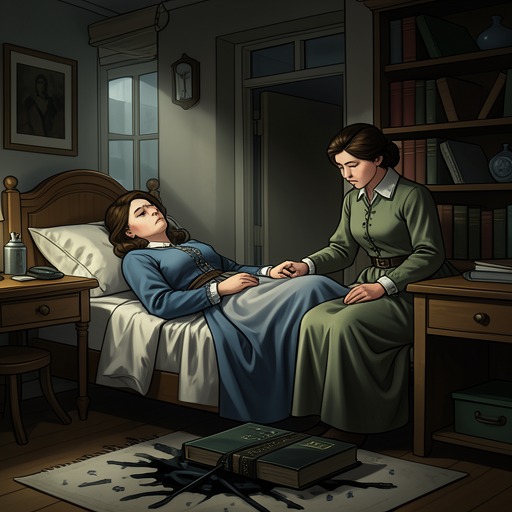
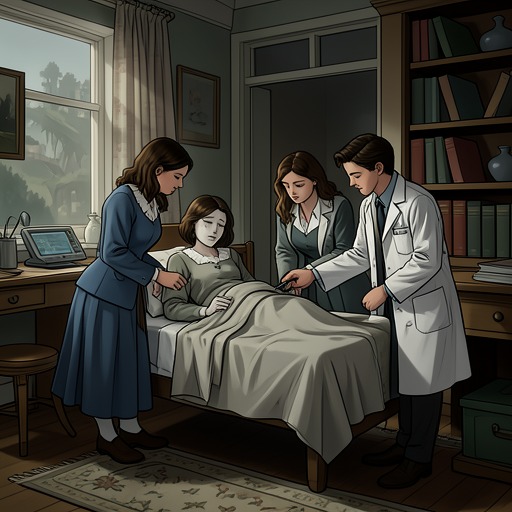
Beth contracts Scarlet fever and becomes much sicker than the family initially understands. Hannah and the doctor control access to information, while Margaret remains at home rather than risk infecting the Kings and feels guilty because her letters to Mrs. March omit Beth’s illness. Jo devotes herself to nursing Beth day and night. As the fever worsens, Beth speaks in a hoarse, broken voice, plays on the coverlet as though it were her beloved piano, fails to recognize familiar faces, and calls for her mother. These symptoms alter the household’s experience of time: ordinary duties continue, but every task is organized around watching, waiting, and the possibility of death.
The crisis produces moral recognitions in each sister. Margaret, sitting alone with tears falling onto her work, understands that love, protection, peace, and health are more valuable than luxuries money can buy. Jo, living in the darkened room beside Beth, recognizes the beauty of Beth’s unselfish effort to make home happy through simple virtues rather than talent, wealth, or beauty. Amy, away from home, longs to return and regrets the tasks Beth’s willing hands had performed for her. Even the neighbors reveal the breadth of Beth’s quiet influence: tradespeople inquire after her, neighbors send comforts, and James Laurence locks his grand piano because its music recalls her. Grief makes invisible relationships visible by showing how many lives have been gently touched by the person now endangered.
When Dr. Bangs finally says that Mrs. March should be sent for, fear becomes nearly unbearable. Jo finds that Beth no longer knows the family or speaks of the “flocks of green doves” she once called the vine leaves on the wall. With both parents absent, Jo feels that even God is far away, but Laurie takes her hand and offers the immediate comfort of human presence. The gesture does not remove the threat; it gives her something to hold while confronting it.
Recovery, Relief, and the Return of the Family
Beth’s recovery does not erase the grief that preceded it, but it reverses the household’s immediate movement toward bereavement. When Mrs. March and the daughters are reunited, Beth wakes from a long healing sleep and sees the little rose and her mother’s face. Too weak to wonder, she smiles and nestles into the loving arms around her. Mrs. March refuses to unclasp Beth’s thin hand even while sleeping, making physical contact the proof that the feared separation has been suspended.
The family’s relief is shared through acts of service. Hannah prepares an elaborate breakfast for the traveler; Margaret and Jo feed their exhausted mother; Mrs. March recounts Mr. March’s condition, John Brooke’s promise to nurse him, the delays caused by the storm, and Laurie’s hopeful presence during her journey. The house becomes quiet after the strain of watching, with the family sleeping as though storm-beaten boats had reached a safe harbor. This recovery scene establishes that grief can be interrupted without being forgotten: fear has taught the family what Beth’s presence means, and the return of health feels like the recovery of a treasure.
Yet the novel later shows that recovery may be temporary. Three years after the war, Mr. March is safely home and serves as a minister, household conscience, anchor, and comforter. His return confirms the family’s endurance, but it also throws the losses and fears of the earlier period into relief. The household’s stability has been preserved not by escaping hardship but by repeatedly adapting to it.
Beth’s Death and the Transformation of Sorrow
When Jo returns in spring, absence has sharpened her perception of Beth’s decline. Daily companions had not been startled because the change came gradually, but Jo sees that Beth’s face has acquired a transparent quality, as though the mortal body were being slowly refined away. Beth appears happy, and for a time this apparent improvement allows others to hope, but Jo’s anxiety returns after Laurie leaves. Beth refuses a distant mountain trip and prefers the seashore, where the sisters live quietly for each other, unconsciously watched by sympathetic strangers who sense that a long separation is approaching.
Beth’s final disclosure gives grief a language before death occurs. She reads Jo’s blurred and faulty verses, which assure her that her life has not been useless. Her deepest fear is not simply dying but having done too little, and the poem’s comfort helps her understand that her quiet service has had lasting meaning. She asks Jo whether she has truly been all that the poem describes, and Jo’s answer confirms the magnitude of Beth’s influence within the family.
Beth then asks Jo to take her place as the person who will care for Father and Mother. She contrasts that responsibility with Jo’s ambitions to write splendid books or see the world, telling her that love is the only thing that can be carried when one goes and that love makes the end easier. Jo accepts the charge and renounces her old ambition in favor of a new one grounded in family responsibility. Grief here becomes an occasion for reordering desire: Beth’s approaching death does not merely wound Jo; it changes what Jo believes a worthwhile life should contain.
Beth dies quietly in the dark hour before dawn, in the room where she first drew breath. The narrator deliberately rejects theatrical expectations about dying, presenting the end as natural and simple, like sleep: Beth gives one loving look and one little sigh. Spring surrounds the death with renewal rather than sentimental denial. Father and Mother guide her through the Valley of the Shadow and give her up to God; afterward, the bird, snowdrops, and sunlight continue outside while her face rests in painless peace. The family’s tears remain, but they are joined by gratitude that Beth is well at last.
Grief as Memory, Witness, and Moral Continuity
The novel treats mourning as a continuing relation rather than a single emotional climax. Before Beth’s death, the sisters learn through illness how much ordinary care had depended on her. Afterward, the meaning of those unnoticed tasks persists in memory, allowing her influence to continue even when her body is absent. Grief therefore exposes the hidden labor that sustains a household and gives moral importance to actions that public ambition might overlook.
The emotional movement also depends on delayed recognition. Margaret does not fully understand the richness of love, health, and protection until illness makes their loss imaginable. Jo does not fully acknowledge Beth’s place in every heart until she must watch her suffer. Beth herself needs the evidence of Jo’s writing to believe that her modest life has mattered. In each case, sorrow brings knowledge belatedly, after the valued person, condition, or future has become vulnerable.
Ultimately, Grief in Little Women is neither romanticized as beautiful nor treated as meaningless pain. It includes the shock of a telegraph, the terror of fever, the helplessness of separation, the poverty that makes disease deadlier, the discipline of nursing, and the silence after death. Against these forces, the March family uses work, faith, sacrifice, friendship, and touch. Beth’s death is irreversible, but the love formed through her life becomes a continuing obligation and source of strength, enabling the survivors to carry her values into the future.