Into Each Life Some Rain Must Fall
Little Women“Into Each Life Some Rain Must Fall” names the novel’s mature understanding that happiness does not exclude pain. The expression appears beside Amy’s fear for her frail little daughter, transforming a family’s private anxiety into a general principle: even lives blessed by beauty, youth, prosperity, and love must endure care, loss, and sorrow.
Definition and Context
Into Each Life Some Rain Must Fall is presented in the form of a brief poetic reflection: “Into each life some rain must fall, / Some days must be dark and sad and dreary.” The rain is figurative rather than a description of weather. It represents the inevitable troubles that interrupt otherwise happy lives, while the repeated movement from “each life” to “some days” gives the statement both universal scope and limited duration. Sorrow belongs to every life, but darkness does not constitute every day.
The expression follows Amy’s admission that her life has not developed according to her earlier plans, though she would not exchange the reality she has received. Her artistic hopes remain alive: she has begun modeling a figure of her baby and intends to preserve the image in marble. Yet the child in her arms is frail, and the possibility of losing her casts a shadow over Amy’s sunshine. The contrast between creative fulfillment and parental dread gives the expression its emotional setting: joy and fear occupy the same scene rather than canceling one another.
The Family Scene
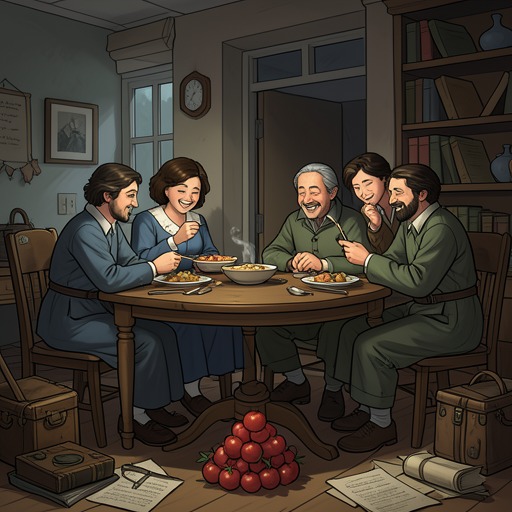
The immediate context is a gathering in which the March family considers the “castles” each sister once imagined for herself. Amy’s altered dream is not rejected; she values the life she has, even as it contains an unrelieved source of anxiety. As she speaks, a tear falls on the golden hair of her sleeping child. That physical gesture makes the metaphor concrete. The “rain” is not an abstract philosophical difficulty but the tear of a mother who loves a vulnerable child and cannot secure the future through affection or good fortune.
The narration broadens Amy’s experience into a reflection on human limits. Beauty, youth, good fortune, and love are all acknowledged as blessings, but none can prevent care and pain, loss and sorrow, from reaching even “the most blessed.” The sentence therefore resists the idea that suffering is simply the punishment of the unhappy or the consequence of personal failure. Amy and Laurie are not deprived of love; their love becomes more serious because it must live alongside fear.
Love, Sorrow, and Maturity
The expression marks a change in both Amy and Laurie. Amy’s nature is becoming “sweeter, deeper, and more tender” under the pressure of threatened loss. Laurie, in turn, is becoming more serious, strong, and firm. Their suffering does not merely darken their marriage; it deepens their capacity to bear responsibility together. The narrative presents sorrow as formative without making it desirable. The pain remains pain, but it produces a more capacious form of love.
Amy’s later words clarify how that shared burden operates. Laurie does not display his anxiety to her; instead, he remains patient, devoted to Beth, and a constant stay and comfort. Amy therefore understands happiness not as freedom from distress but as the presence of someone who helps carry it. Her “one cross” remains real, yet she can still affirm that she is a happy woman. The expression’s central paradox lies here: rain falls on a life that is genuinely sunny, and the existence of the rain does not make the sunshine false.
Narrative and Thematic Significance
Placed near the close of the family narrative, Into Each Life Some Rain Must Fall gathers the book’s earlier experiences of illness, bereavement, disappointment, and altered ambition into a final ethic of endurance. It does not promise that care will vanish or that every threatened loss will be reversed. Instead, it places suffering within a continuing structure of family affection, patience, work, and hope. The phrase works as a refrain for a world in which domestic happiness is valuable precisely because it must be practiced under imperfect conditions.
Its paired lines also provide a compact pattern for the novel’s emotional rhythm. Darkness is acknowledged directly, but the statement does not end with darkness; it moves from rain to the recognition that every life contains only “some days” that are sad and dreary. The wording thus holds grief and continuity together. In the final scene, Amy’s tear, Laurie’s steadiness, and the family’s surrounding tenderness embody the expression’s meaning: suffering cannot be excluded from blessed lives, but love can make its burdens shareable and leave happiness intact.