Jo March–Amy March relationship
Little WomenThe Jo March–Amy March relationship is one of the most testing and consequential bonds among the March sisters. Jo March is impatient with Amy March’s prim manners, social ambition, and self-conscious refinement, while Amy resents Jo’s dismissive treatment and longs to be recognized as more than a younger child. Their quarrels are not merely domestic interruptions: each forces the sisters to confront a particular moral weakness—Jo’s uncontrolled anger and Amy’s vanity, selfishness, and desire for revenge—and each reconciliation marks a step toward a more mature form of love.
Identity and Early Tension
The sisters begin from sharply contrasting temperaments. Margaret March calls Amy March “altogether too particular and prim,” warning that her affected airs could turn her into “an affected little goose,” even while admitting that her manners and refined speech are attractive when she does not strain after elegance. Jo March, by contrast, is associated with slang, boyishness, and the rough energy of a tomboy. Amy’s refinement and Jo’s rebellious independence therefore become reciprocal sources of irritation: Amy sees Jo as careless and overbearing, while Jo sees Amy’s social polish as pretension.
Their age difference intensifies the imbalance. When Amy March enters a room and asks where her sisters are going, Jo March sharply tells her that little girls should not ask questions and orders her to go away. Amy’s humiliation is not passive; she determines to discover the secret and presses Margaret March for inclusion. The scene establishes a recurring pattern in which Jo uses seniority and forceful personality to exclude Amy, while Amy responds through persistence, wounded pride, or retaliatory action rather than open submission.
The Lime-School Conflict
Amy March’s school punishment reveals how quickly vanity and resentment can turn a small possession into a social contest. After obtaining twenty-four limes, eating one on the way, and hiding the remaining parcel in her desk, she becomes the center of attention among her classmates. Katy Brown invites her to a party, Mary Kingsley offers her a watch, and Jenny Snow, who had mocked Amy’s lack of limes, suddenly offers assistance. Amy remembers the earlier insult, however, and refuses to reward Jenny’s change of attitude, telling her, “You needn't be so polite all of a sudden, for you won't get any.”
The episode combines Amy’s pleasure in display with her sensitivity to social humiliation. Praise for her maps further encourages her self-importance, and she assumes the airs of “a studious young peacock.” Jenny Snow then informs Mr. Davis that Amy has pickled limes in her desk. Because Mr. Davis has declared that rules will not be infringed, he orders Amy to hold out her hand and strikes her several times. The blows are neither many nor heavy, but Amy experiences the public disgrace as a profound injury because it is the first time she has been physically punished.
The sisters’ relationship is indirectly shaped by the moral interpretation that follows. Mrs. March refuses to offer Amy simple sympathy: she says Amy broke the rules and deserved punishment for disobedience, although she would not have chosen public corporal punishment as the method of correction. Mrs. March identifies conceit as the deeper fault, explaining that even genuine talent is spoiled when it is paraded and that the greatest charm of power is modesty. This judgment gives Amy a standard more demanding than obedience to an external authority. The issue is no longer merely whether she has been treated unfairly, but whether she has allowed pride to govern her conduct.
The Burned Manuscript and the Ice
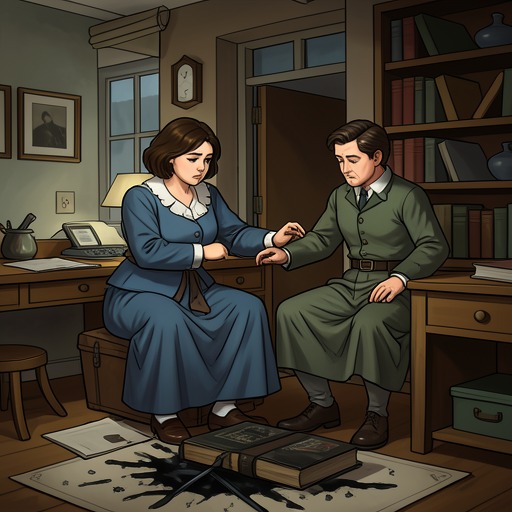
The central rupture between the sisters follows Amy’s deliberate destruction of Jo March’s manuscript. After Jo refuses to tell Amy where the older girls are going, Amy threatens retaliation for being treated as a child. She carries out that threat by burning the little book Jo had patiently written and intended to finish before Mr. March returned. Jo’s response makes the value of the manuscript unmistakable: it contained only a half-dozen fairy tales, but Jo had worked over them for years, copied them carefully, and invested them with hopes of publication. Amy’s fire destroys not merely paper but the physical record of Jo’s labor and ambition.
Jo March’s grief immediately becomes violence. She turns pale, shakes Amy until her teeth chatter, declares that she will never forgive her, and strikes her before fleeing to the garret. Margaret March rescues Amy while Elizabeth March tries to calm Jo, but the family refuses to minimize the offense. Mrs. March brings Amy to recognize the wrong she has done; Elizabeth March mourns the manuscript, Margaret March will not defend Amy, and Amy realizes that pardon must be requested because no one can simply treat the act as a childish prank. The family’s response turns private anger into moral accountability, while Jo’s reaction exposes the danger of a temperament that converts hurt into cruelty.
The conflict reaches its decisive crisis when Amy follows the others onto unsafe ice. Jo March hears a warning to keep near the shore, but Amy struggles toward smoother ice in the middle of the river. Jo briefly allows resentment to silence her concern, then turns back just in time to see Amy fall through rotten ice. Amy’s blue hood remains visible above the black water while Jo is paralyzed by terror; Theodore Laurence takes command, calls for a rail, and holds Amy up with his arm and hockey stick until Jo drags the rail from the fence. Together they pull Amy out, more frightened than injured.
The rescue changes the moral meaning of the quarrel. Jo confesses to Mrs. March that she had let Amy go and fears that Amy’s death would have been her fault. She identifies her temper as the enemy she repeatedly tries and fails to conquer, admitting that in rage she feels capable of hurting someone and taking pleasure in the injury. Mrs. March answers not with condemnation but with a confession of her own lifelong struggle: she has spent forty years learning to control anger, though she still hopes eventually not to feel it. Her example gives Jo a practical ethic of self-command rather than the fantasy of instant perfection.
The sisters’ reconciliation comes without argument or explanation. As Amy sleeps, Jo recognizes that she had allowed anger to last through the night and might have lost her sister because of it. Amy opens her eyes, holds out her arms, and the two embrace; a single hearty kiss makes the quarrel disappear. The scene does not erase the violence or the manuscript’s destruction, but it replaces revenge with mutual recognition and makes forgiveness an active decision rather than a sentimental reflex.
Reciprocity, Rivalry, and Moral Growth
Their later disagreements remain real because Jo March and Amy March want different forms of life. When Amy plans a social fair, Margaret March offers help immediately, but Jo initially refuses to participate. Jo objects that Amy is spending family money and effort on girls who may care only for fashion and status, while Amy insists that she values friendship, manners, tastes, and the opportunity to enter good society. Jo’s independence appears to Amy as arrogance with its elbows out; Amy’s cultivation appears to Jo as submission to women who possess fashionable boots and carriages. Their argument is therefore also a dispute over what kind of woman one should become.
Amy’s conduct at the fair revises Jo’s judgment. After working for the event and setting her heart on selling her own attractive possessions, Amy nevertheless responds generously when circumstances make forgiveness necessary. The fair is declared a success, May Chester gives Amy an affectionate kiss and an expression of reconciliation, and the vases Amy has helped produce are displayed at home as a reward for her magnanimity. Jo then acknowledges that Amy has more principle, generosity, and nobility than Jo had credited her with. Elizabeth March adds that Amy’s willingness to forgive was difficult precisely because she had sacrificed things she valued.
Amy explains that her ideal is not mere external elegance. When she says that she wants to be a lady, she means a true gentlewoman in mind and manners, someone above the small meannesses and follies that spoil many lives. She admits that she is far from this ideal but hopes to become like Mrs. March. This self-definition gives their relationship a new balance. Jo’s roughness is no longer automatically identified with moral superiority, and Amy’s refinement is no longer reducible to vanity; both sisters must distinguish appearance from character.
Amy’s moral education also becomes increasingly self-directed. During Elizabeth March’s illness, Amy reflects on her “bundle of naughties” and identifies selfishness as the largest fault within it. She wishes to become more like Elizabeth March, whom everyone loves because she is unselfish, and chooses to wear a ring as a continual reminder of her resolution. The gesture transforms moral improvement from an external punishment into an inward practice of memory and intention. Mr. March later observes Amy serving her mother, giving Margaret March her place, waiting on everyone patiently, avoiding the mirror, and not boasting about her pretty ring. He concludes that she is learning to think of other people more and of herself less, and values this lovable capacity above the production of a graceful statue.
Love, Loss, and the Relationship’s Lasting Meaning
Jo March and Amy March are bound together not because conflict disappears but because love repeatedly survives conflict and compels each sister to revise her self-image. Mrs. March teaches Jo that anger must be watched, resisted, and managed through withdrawal before harsh words escape. Her parting counsel to the family likewise directs them to continue their work during separation, treating labor as a solace rather than an excuse for idle grief. These principles become part of the sisters’ shared moral world: feeling is powerful, but it must be shaped into conduct that protects others.
Elizabeth March’s approaching death deepens the bond between Jo and Amy even when the immediate scene centers on Jo and Elizabeth. Elizabeth faces death with a faith expressed through patience and acts rather than speeches, while Jo resists the loss passionately and tries to fight against it. The sisters’ shared attachment to Elizabeth makes their earlier rivalry appear within a larger structure of familial dependence: the sister who was once mocked, excluded, or punished is also part of the emotional community through which grief is endured.
After Elizabeth March’s death, Jo March’s sorrow becomes almost unmanageable. She cries for Elizabeth to come back and finds comfort when Mrs. March answers her grief with touch, tears, and patient presence. The loss alters Jo’s relation to duty and to the family’s ordinary life, making work sweeter and existence more bearable. In this broader aftermath, Amy’s earlier movement from selfishness toward consideration provides a counterpoint to Jo’s continuing struggle: both sisters remain imperfect, but each learns that character is formed through repeated acts of restraint, service, repentance, and forgiveness.
The Jo March–Amy March relationship therefore functions as a moral laboratory within the March family. External penalties first expose Amy’s pride; personal catastrophe exposes Jo’s anger; deliberate reflection, service, and forgiveness transform both. Their sisterhood moves from an unequal contest between the older tomboy and the younger “goose” toward a reciprocal recognition of distinct strengths. Jo learns that independence without self-command can become destructive, while Amy demonstrates that refinement has value only when it is joined to generosity. Their reconciliations do not make them alike. They make difference inhabitable, turning rivalry into one of the chief means by which both sisters grow into fuller, more self-aware forms of love.