Jo March–Beth March relationship
Little WomenThe Jo March–Beth March relationship is one of the central emotional structures of Little Women: a bond in which opposites become indispensable to one another. Jo March is energetic, outspoken, and vulnerable to anger, while Beth March is shy, patient, and quietly devoted to home. Their intimacy does not erase those differences. Instead, Beth’s gentleness gives Jo a moral counterweight, and Jo’s passionate attachment gives Beth companionship, protection, and assurance that her quiet life has mattered.
Identity and Early Bond
Jo March and Beth March are joined by a form of sisterly guardianship that resembles the older sisters’ care for the younger girls. The March sisters divide themselves into affectionate pairs: Margaret March watches over Amy Curtis March, while Jo becomes Beth’s protector and closest companion. The relationship is reciprocal rather than merely supervisory. Beth’s shyness makes ordinary society difficult for her, and Jo’s strong personality might seem naturally opposed to hers, yet Jo is precisely the sister to whom Beth can remain close without being forced into public confidence. In turn, Beth exercises more influence over the headstrong Jo than anyone else in the family, often without consciously attempting to do so.
Their attachment is also shaped by the security of the March family home. When Theodore Laurence confesses that he watches the March household from the neighboring Laurence mansion because he has no mother, Jo immediately recognizes the loneliness in his face and invites him into the family’s warmth. Her response reveals the emotional abundance she shares with Beth: she imagines Beth singing for Laurie, Amy Curtis March dancing, and the sisters making him laugh. Jo’s instinct is to extend the home outward, but Beth remains one of the experiences of tenderness that makes that home worth sharing.
Care, Anger, and Emotional Discipline
The relationship becomes most revealing when Jo’s temper threatens to overwhelm her better impulses. After Amy Curtis March falls through the ice, Jo admits that Laurie acted while she merely allowed Amy to go, and she condemns herself for the hardness of heart that preceded the accident. She fears that her anger may become so violent that she will hurt someone, ruin her life, and make everyone hate her. Mrs. March teaches her that self-control is a lifelong practice: anger must be checked, and sometimes the only immediate remedy is to leave the room before destructive words escape.
Beth’s place in Jo’s moral life is implicit in this lesson. Jo does not become gentle by ceasing to be Jo March; she learns to measure her force against the vulnerability of those she loves. Beth’s quiet goodness gives that effort a living standard. Her influence is not delivered through arguments or commands. It works through affection, presence, and the shame Jo feels at the prospect of failing someone so trusting. The relationship therefore turns emotional care into moral labor: Jo must learn not merely to feel love for Beth, but to make her own conduct safe for the person she loves.
The same principle appears in the family’s responses to the sisters’ faults. When Amy Curtis March is punished at school for bringing twenty-four pickled limes in violation of Mr. Davis’s rule, Mrs. March refuses to offer simple sympathy. She acknowledges that Amy broke the rule and deserved punishment, while warning that conceit can spoil genuine talent. Beth’s example later gives Amy a more inward reason to change: Amy recognizes that Beth is loved because she is unselfish and resolves to think less of herself and more of others. Jo and Beth thus influence the moral development of the whole family, even when neither is deliberately instructing anyone.
Illness and Shared Vulnerability
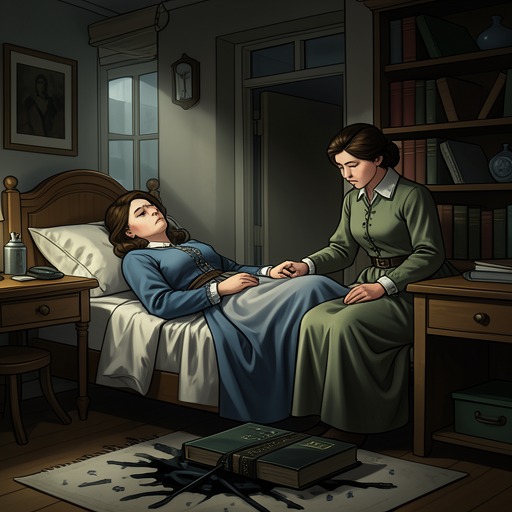
When Beth becomes seriously ill, Jo’s protective attachment is tested by knowledge she cannot control. Beth no longer recognizes the family, does not speak normally, and appears unlike herself; Jo tells Theodore Laurence that even her parents are away and that God seems distant. In this moment Jo’s usual energy collapses into helpless grief. Laurie takes her hand and tells her to hold on to him, offering the human support that Jo cannot generate alone. The scene shows how thoroughly Beth’s condition has displaced Jo’s ordinary confidence: the strong sister must be held because the person she has always watched over cannot yet return her love in familiar form.
Later, Jo learns to care for Beth with patience rather than interrogation. When Beth is troubled, Jo strokes her forehead and waits, understanding that a heart cannot be forced open. She asks gently whether anything is wrong and offers Beth the chance to speak, but does not impose her own interpretation. This restraint marks a significant development in Jo’s conduct. Her love is no longer only passionate or protective; it has become attentive. She learns that care may require silence, timing, and the acceptance that another person must disclose pain in her own way.
During the family’s separation and anxiety, Mrs. March instructs the daughters to continue their work, because work is a blessed solace, and tells Jo not to become despondent or rash. The instruction applies especially to Jo’s tendency to turn grief into action or rebellion. Her relationship with Beth is sustained not by dramatic rescue but by constancy: writing, waiting, tending, and remaining emotionally present while the family’s ordinary routines continue under the pressure of illness.
Beth’s Revelation and Jo’s Transformation
The relationship reaches its clearest crisis when Beth tells Jo that she is slowly losing strength and will not recover it. Beth compares the process to a tide that turns and cannot be stopped. Jo rejects this acceptance. She insists that nineteen is too young, promises to work, pray, and fight, and refuses to let Beth go. Her protest is loving but rebellious, while Beth’s faith is patient and surrendered. The sisters therefore confront death from opposite moral positions: Jo tries to defeat it through will, whereas Beth tries to meet it with trust.
Beth does not answer Jo with a sermon. Her faith appears in conduct rather than explanation, and she tries to be willing even though life remains sweet to her. She loves Jo more because of Jo’s passionate resistance, not less. Their exchange preserves both human attachment and religious surrender: Beth cannot say that she is glad to die, but she can trust that love will not be destroyed by death. The scene transforms their relationship from an ordinary sisterly closeness into a final exchange of roles, knowledge, and responsibility.
Before her death, Beth asks Jo to take her place with their parents. She tells Jo that Father and Mother will turn to her and that she must not fail them; if working alone becomes difficult, Jo is to remember that Beth will not forget her. Most decisively, Beth contrasts Jo’s old ambitions—writing splendid books and seeing the world—with the duty of love. Jo accepts the charge and renounces the idea that artistic achievement is the highest purpose available to her. Beth’s influence therefore changes Jo’s narrative of herself: Jo remains a writer and an ambitious woman, but her ambition is no longer allowed to eclipse familial responsibility.
Death, Grief, and Continuing Presence
Beth’s death is quiet rather than theatrical. As spring returns and the earth grows green, Father and Mother guide her through the Valley of the Shadow and give her up to God. She dies in the dark hour before dawn, on the breast where she first drew breath, with only a loving look and a little sigh. The simplicity of the death intensifies its effect. There is no spectacular farewell to make loss manageable; the family must receive the fact of absence through ordinary gestures, tears, prayers, and tender hands.
Before that final moment, Beth finds Jo’s written lines and is comforted because they assure her that her life has not been useless. She asks whether she has truly been as important to Jo as Jo’s words suggest. Jo answers with an intensity that confirms Beth’s deepest fear and hope: Beth has not wasted her life because she has been loved and has helped shape another person. The evidence of Jo’s transformation gives Beth a final form of recognition. Her influence is no longer merely private; it has become part of Jo’s future conduct.
After Beth’s death, Jo experiences grief as an ongoing attachment rather than a clean separation. She wakes at night thinking Beth has called her and cries for her to come back. The empty bed makes the loss physical, but Jo’s mother comforts her through touch, tears, and shared sorrow. In that maternal shelter, grief gradually becomes a source of strengthened love and a more bearable sense of duty. Jo’s promise to take Beth’s place is not a replacement of Beth’s identity; it is an attempt to carry Beth’s values forward.
Narrative and Thematic Significance
The Jo March–Beth March relationship joins two forms of strength. Jo possesses force, ambition, and the capacity for public action; Beth possesses patience, sympathy, and a quiet power to alter the people around her. The novel does not present Beth’s gentleness as mere passivity. Her example changes Amy Curtis March’s understanding of selfishness, disciplines Jo’s anger, and ultimately redirects Jo’s ambitions. Beth’s influence operates through emotional presence and moral credibility rather than authority.
Their bond also makes love an active form of emotional labor. Jo must learn to control anger, listen without forcing disclosure, endure medical uncertainty, and continue caring when rescue is impossible. Beth, meanwhile, must accept help while protecting Jo from being consumed by despair. Their final exchange confirms that the relationship has not been one-sided: Jo has defended and accompanied Beth, but Beth has given Jo a durable purpose. Even after death, Beth remains present as an inward standard by which Jo measures work, family duty, and the value of a life.
The relationship’s decisive significance lies in this transformation from companionship into inheritance. Beth cannot remain physically with Jo, yet her love becomes a principle Jo carries into adulthood. Jo’s grief does not end the relationship; it changes its form, turning Beth from a sister who needs protection into a moral presence who continues to guide Jo’s choices. In that sense, Beth’s quiet life achieves the very influence she feared it had lacked, while Jo’s future becomes the living continuation of their bond.