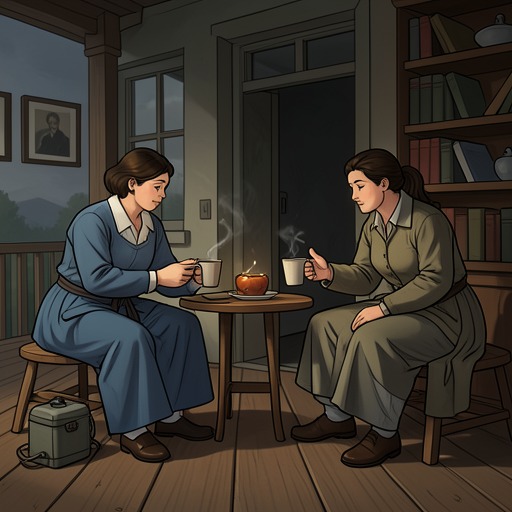
Jo visits the Laurence mansion
Little WomenJo visits the Laurence mansion because she sees Theodore Laurence as a lonely boy in need of companionship, and the visit changes the social and emotional geography of both families. The low hedge between the March home and the Laurence estate initially marks a boundary of class, habit, and mystery, but Jo crosses it with the conviction that friendship matters more than ceremony. Her boldness draws Laurie out of isolation and introduces the March sisters to the household that will become one of the central sources of their companionship, protection, and enlargement of experience.
Setting and Motive
The visit grows out of Jo’s fascination with the neighboring Laurence mansion. The March house stands in a suburb that remains countrylike, with groves, lawns, large gardens, and quiet streets; the March property is old, brown, bare, and shabby after the summer vines and flowers have disappeared. Across the garden, the Laurence estate presents a sharp contrast: a stately stone mansion, a large coach house, carefully maintained grounds, a conservatory, and glimpses of beautiful objects behind rich curtains. Yet wealth has not made the house lively. No children play on its lawn, no motherly face appears at the windows, and almost nobody enters or leaves except James Laurence and his grandson.
To Jo’s imagination, the mansion resembles an enchanted palace whose splendors are unused. Her interest is not merely acquisitive. She wants to see the hidden rooms and, more urgently, to know Laurie, who seems willing to be known but unable to begin the acquaintance himself. When she notices his brown face at an upper window as Elizabeth March and Amy Curtis March play in the snow, his apparent solitude converts curiosity into action. Jo concludes that he needs society and amusement, and she decides that someone must do something about it.
Crossing the Boundary
Jo waits until James Laurence has driven away, then digs through the snow toward the hedge. The scene is quiet: the lower curtains are drawn, the servants are out of sight, and the only visible human presence is Laurie’s curly black head resting on a thin hand at the upper window. Jo’s first gesture is playful but purposeful. She throws up a handful of soft snow, and Laurie immediately looks out; his listless expression gives way to bright eyes and a smile. Jo nods, laughs, waves her broom, and asks, "How do you do? Are you sick?"
The exchange quickly exposes the difference between Laurie’s confinement and Jo’s restless energy. He admits that he is lonely and has no acquaintances in the neighborhood. When Jo challenges him to recognize the March family, he realizes that he does know them and calls to her, "So I do! Will you come, please?" Jo agrees on the condition that her mother permits it, telling him to close the window and wait. She then shoulders her broom and marches home to ask permission, turning what might have remained a distant window friendship into a formal visit.
Laurie’s excitement reveals how much the invitation means to him. He rushes to prepare, brushes his curly hair, puts on fresh color, and tries to make his room presentable. Mrs. March’s description of him as a little gentleman frames his preparation as courtesy rather than mere vanity: he wants to honor the first young visitor admitted into his lonely routine. Jo’s arrival is announced by a loud ring and a decisive young woman’s voice asking for Mr. Laurie, a contrast that makes her entrance as conspicuous and unconventional as her approach across the snow.
The Mansion and Its Host
Theodore Laurence leads Jo through the house, allowing her to examine whatever catches her attention. The interior is summerlike and richly furnished, culminating in a library lined with books and filled with pictures, statues, cabinets of coins and curiosities, velour chairs, unusual tables, bronzes, and a large open fireplace surrounded by quaint tiles. Jo responds with unrestrained delight, clapping her hands and prancing as she does whenever she is especially pleased. She sinks into a velour chair and declares the house’s richness, then tells Laurie that he ought to be the happiest boy in the world.
Laurie’s answer complicates Jo’s assumption that comfort guarantees happiness: he points out that a person cannot live on books alone. The library therefore becomes more than a display of privilege. It is a beautiful room that cannot by itself cure loneliness, and Jo’s presence supplies what its abundance lacks. She is comfortable there almost immediately, announcing that she is happy while Laurie leaves briefly to see James Laurence.
Left alone, Jo studies a portrait of the old gentleman and speaks freely about it, deciding that she should not be afraid of him because his painted eyes appear kind, even though his mouth is grim and his will seems formidable. When James Laurence enters behind her, she is horrified to discover that he has heard her judgment. Her first impulse is to flee, but she rejects flight as cowardly and stays to manage the embarrassment. A second look at his living eyes reveals more kindness and a sly twinkle beneath the bushy eyebrows, reducing the threat posed by his gruff voice and abrupt question about whether she is afraid of him.
From Daring Visit to Neighborly Friendship
Jo’s courage does not depend on pretending to be polished or timid. She meets James Laurence through the same directness that brought her across the garden, and the encounter becomes a test of whether his severity is real or merely a surface manner. The old gentleman’s courtesy, including his offering Jo his arm, confirms that the household’s apparent inaccessibility can be penetrated by sincerity. His invitation to continue being neighborly turns a single act of daring into an ongoing relationship.
Jo also speaks about the Hummel family, whose poverty has concerned Mrs. March and whose needs have led her mother to interest richer friends. James Laurence recognizes this charitable concern as part of Mr. March’s way of doing good and says that he will visit Mrs. March. The visit thus connects the families not only through Laurie’s need for companionship but also through a shared ethic of practical benevolence. Jo’s account of the Hummels gives James Laurence a concrete reason to respect the March household, while his response confirms that generosity can cross the same social boundary represented by the hedge.
The mansion visit establishes a pattern that recurs throughout the novel: Jo acts first, often rashly by conventional standards, but her apparent impropriety opens a space for genuine human contact. Her broom, snowball, and unceremonious entrance are not decorative details; they are the tools by which a closed household becomes accessible. The Laurence estate remains materially richer than the March home, but after Jo’s visit its isolation is no longer absolute.
Place in Jo’s Development
The visit is an early expression of Jo’s characteristic objectives: adventure, movement, frank speech, and friendship unconstrained by social formality. She refuses Meg’s advice to remain warm by the fire, insisting that she cannot keep still and wants adventures. That restlessness can produce conflict elsewhere, especially when her temper overwhelms her, but here it becomes a moral and relational strength. She perceives another person’s loneliness, accepts personal embarrassment as the price of helping him, and uses action rather than speculation to answer the problem.
The scene also anticipates Jo’s later work of emotional self-government. When she confesses her fear that anger may make her do something dreadful, Mrs. March teaches her that a temper is not conquered in a single victory: even an adult who has spent forty years trying to control anger may still struggle with it. Mrs. March’s practice of checking hasty words and leaving the room briefly when anger rises gives Jo a model of disciplined feeling. Against that background, the mansion visit shows the more constructive side of Jo’s intensity. She does not suppress her energy; she directs it toward companionship, hospitality, and care.
Its consequences extend far beyond the afternoon itself. The March and Laurence families become neighbors in the fullest sense, bound by friendship rather than proximity alone. Later family life gives Jo a durable image of happiness, and after Beth’s death her mother’s patient presence helps turn grief into a deeper capacity for love and duty. Jo eventually marries and settles at Plumfield, where she and Friedrich Bhaer create a household and school filled with boys, including poor children whom James Laurence helps place there. The journey from the lonely mansion to the flourishing community at Plumfield gives the original visit its retrospective force: Jo’s first crossing of the hedge is an early instance of the same impulse that later turns space, wealth, and affection into shared family life.