Jo’s first publication, “The Rival Painters”
Little WomenJo’s first publication, “The Rival Painters,” is the decisive early step in Josephine March’s career as a writer. More than a household amusement, the story transforms her garret labor into a printed achievement: “Miss Josephine March” appears in the newspaper, her family celebrates the event, and Jo discovers that authorship may eventually give her both independence and the means to help the March family.
Writing in the Garret
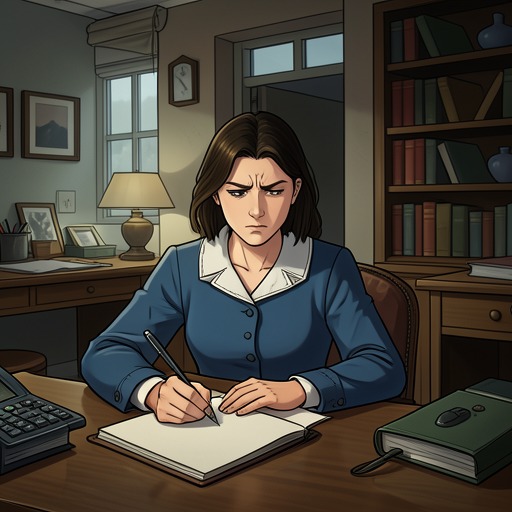
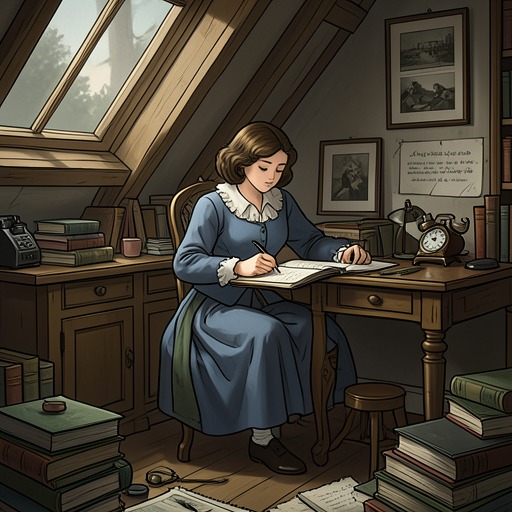
The publication grows out of a disciplined, private routine rather than a sudden gift. In the garret, Jo works for two or three hours while the October sun falls through the high window, seated on an old sofa with her papers spread over a trunk. Scrabble, her pet rat, moves along the beams above her, and Jo protects her manuscripts in an old tin kitchen because the animal has a literary appetite of its own and eats the leaves of books left within reach. When the final page is filled, she signs her name with a flourish and declares, “There, I've done my best! If this won't suit I shall have to wait till I can do better.”
The manuscript is treated as both a product of labor and an object of hope. Jo reads it over carefully, marks it with dashes and exclamation points, ties it with a smart red ribbon, and then studies it with a sober, wistful expression. The care given to these physical details shows that publication is not merely a fantasy for her. She has made an artifact, revised it, concealed it, and prepared to place it before an external judgment.
From Private Manuscript to Printed Story
Jo tells Theodore Laurence that she has left two stories with a newspaperman and is waiting for an answer. She has kept the attempt quiet because she does not want anyone else to be disappointed if it fails. Theodore responds with exuberant encouragement, calling for a celebration of “Miss March, the celebrated American authoress,” while Jo remains cautious about claiming a success before it exists.
When the family hears the story, the sisters initially encounter it as a romantic and somewhat tragic tale. Jo reads quickly, and the listeners respond to its splendid picture and its “lovering part,” especially because Viola and Angelo are among Margaret March’s favorite names. Beth, however, notices Jo’s face and asks who wrote it. Jo throws aside the paper, visibly flushed, and answers, “Your sister.” The revelation changes the reading from an impersonal newspaper story into a family triumph: Margaret drops her work in surprise, Amy offers a critical judgment, and Elizabeth runs to embrace Jo in pride.
The printed name is the concrete proof that makes the achievement real. Margaret will not believe the claim until she sees “Miss Josephine March” in the paper. Amy analyzes the artistic portions and proposes a sequel, although the deaths of the hero and heroine make that sequel impossible. Elizabeth skips and sings with excitement, Hannah Mullet arrives in astonishment, and Mrs. March feels proud when she learns what Jo has done. Jo laughs through tears and compares herself to a peacock, while the newspaper is passed from hand to hand as though the whole March household has received a public distinction.
Publication, Payment, and Independence
The first publication is encouraging but not yet financially secure. Jo explains that the newspaperman liked both stories but did not pay beginners. He allowed them to appear in his paper, promised to notice their progress, and described the arrangement as practice. Jo accepts this beginning because it may lead to payment later. Her immediate happiness comes from the possibility that continued writing will allow her to support herself and help her sisters.
That hope is shaped by the March family’s economic circumstances. After Mr. March lost his property while trying to help an unfortunate friend, Margaret and Jo asked to contribute to their own support. Margaret became a nursery governess, a position that exposed her daily to the luxuries she could no longer afford, while Jo accepted work with Aunt March. Their parents valued energy, industry, and independence, and the family refused to separate even when Aunt March’s wealth might have offered financial security. Against that background, Jo’s printed story represents a form of labor that belongs to her personally: a manuscript can become money without requiring her to surrender her family or her self-respect.
Jo’s later success confirms the significance of this first appearance. She pursues the hundred-dollar prize offered for a sensational story, and the resulting prize money helps provide comforts for the household. Her stories pay specific expenses: “The Duke's Daughter” covers the butcher’s bill, “A Phantom Hand” pays for a new carpet, and “The Curse of the Coventrys” supplies groceries and gowns. The first publication therefore becomes the opening movement in a larger economic transformation, in which her “rubbish,” as others may call it, can be converted by the pen into practical help.
The Limits of the First Victory
The publication gives Jo recognition, but it does not settle the question of what kind of writing can sustain her. Later, she attempts a sensational story for the hundred-dollar prize, drawing on dramatic plots, costumes, and emotional effects rather than the mild romances she had previously sent to The Spread Eagle. She also writes a novel, copies it four times, reads it to trusted friends, and submits it to three publishers. A publisher accepts it only if she cuts it by one third and removes the passages she especially admires.
The editorial encounter reveals the commercial pressure surrounding authorship. The editor says, “We'll take this (editors never say I), if you don't object to a few alterations.” Jo discovers that the marked passages are the moral reflections she had deliberately included as ballast for the romance. Her first publication has taught her that printing is possible; the later negotiations teach her that entering the market may require compromise between her moral and artistic purposes and what editors believe readers will buy.
Even so, “The Rival Painters” remains the emotional foundation of Jo’s professional ambition. It is the first occasion on which private effort returns to her as public acknowledgment. The newspaper’s limited payment does not diminish its importance, because the printed story demonstrates that she has learned to do something that can be offered to the world, praised by those she loves, and eventually exchanged for money.
Lasting Narrative Significance
The event establishes a recurring pattern in Jo’s life: work begins in solitude, passes through uncertainty and embarrassment, and becomes meaningful when it serves both selfhood and family. Jo does not seek publication only for vanity. She wants fame and fortune, but more urgently she wants to be independent, to earn the praise of the people she loves, and to need no one’s penny for her own wants.
Her later choices preserve this practical ideal of authorship. She is willing to leave home for New York to teach children and sew because it is honest work and she is not ashamed of it. Eventually she imagines opening a school for boys, a “good, happy, homelike school” in which she will care for the pupils and Friedrich Bhaer will teach them. The first printed story thus points beyond literary fame toward a broader conception of vocation: Jo’s intelligence, labor, and imagination are valuable because they can create a livelihood while remaining connected to a chosen community of care.