Josephine March
Little WomenJosephine March, usually called Jo, is the March family’s energetic, literary, and temperamentally rebellious daughter. Her decisive significance lies in the way she turns frustration with gender expectations, poverty, and dependence into a difficult but productive search for work, authorship, independence, and service. She begins by longing to be free of the narrow role assigned to a young woman, yet her eventual maturity does not erase her forceful personality; it gives that force a wider purpose.
Identity and Early Conflict
Jo’s earliest self-definition is a protest against conventional femininity. When Margaret March urges her to behave like a young lady because she is tall and wears her hair up, Jo tears off her hairnet and shakes down her chestnut hair, declaring that she will wear it in two tails rather than become “Miss March” in long gowns and prim manners. She dislikes being a girl because she prefers boys’ games, work, and manners, and she bitterly regrets not being a boy, especially while her father is away with the army. Her wish is not merely cosmetic: she wants the freedom to act, labor, and serve in the world rather than remain at home knitting while others fight.
The wartime setting gives this resistance a concrete emotional cause. Jo is distressed that Mr. March is far away and may not return for a long time, and she wishes she could accompany him as a drummer or nurse. While Margaret March struggles with the family’s loss of former comfort, Jo experiences deprivation through blocked action: she cannot fight, travel, or do as much reading, running, and riding as she desires. Her anger therefore combines patriotism, impatience, and a sense that female dependence has made her powerless at the moment when she most wants to help.
Work, Discipline, and Authorship
Jo’s restlessness repeatedly gets her into trouble. She has a quick temper, a sharp tongue, and a spirit that resists restraint, producing a life of comic and painful reversals. Yet work begins to discipline rather than suppress her. After Mr. March loses his property while helping an unfortunate friend, the family accepts the need for the older girls to contribute to their own support. Jo becomes companion to Aunt March, an irascible and childless old woman who had once offered to adopt one of the girls. The March family refuses to separate its daughters for the sake of a fortune, but Jo accepts the position when no better opportunity appears.
The arrangement is difficult, though Jo unexpectedly gets on well with Aunt March. Their conflicts sometimes become tempests, and on one occasion Jo marches home announcing that she can endure the position no longer. Aunt March soon sends for her with such urgency that Jo returns, partly because she has grown fond of the peppery old woman. More important, the position gives Jo access to a large neglected library. Whenever Aunt March naps or receives visitors, Jo escapes into the dusty room, where books of poetry, romance, history, travel, and pictures offer her a private world of intellectual freedom. The same work that interrupts her reading by requiring her to wind yarn, wash the poodle, or read Belsham’s Essays also teaches her endurance and makes her glad that she is helping to support herself.
Jo’s ambition is initially vague but immense: she wants to do something “very splendid,” though she does not yet know what it will be. Writing supplies the first definite form for that desire. When a newspaper prints her story, “The Rival Painters,” the March household turns the publication into a family celebration. Margaret March is astonished to see “Miss Josephine March” in print, Beth is overcome with joy, and even Amy offers artistic criticism. Jo explains that the editor liked her stories but did not pay beginners, allowing them to print in the paper as practice; he promises that later work may be paid for. The prospect matters because Jo hopes eventually to support herself and help her sisters. Authorship is therefore both artistic recognition and an economic claim to independence.
Family Duty and Emotional Labor
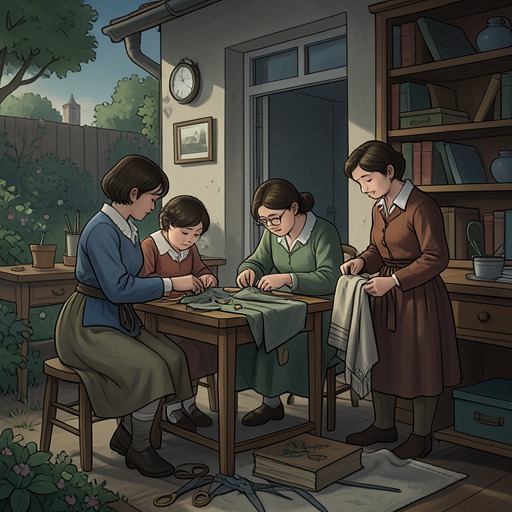
Jo’s independence never develops apart from family loyalty. When a telegraph announces that Mr. March is very ill, the household’s cheerful routine collapses. Mrs. March prepares to leave for Washington, and Jo immediately becomes one of the organizers of the crisis. Her mother sends her to tell Mrs. King that she cannot come, gather supplies for nursing, and help prepare for the journey. The work is practical and urgent: hospital stores may be inadequate, so Mrs. March insists on carrying what Mr. March needs, while the girls seek wine and bring down the black trunk.
Mrs. March leaves the daughters in Hannah Mullet’s care and under James Laurence’s protection, urging them to continue their work rather than retreat into idleness or despair. Jo receives a particularly pointed charge: she must not become despondent or act rashly, but must write often and remain ready to help and cheer others. This instruction recognizes both her usefulness and her danger. Jo’s energy can sustain the family, but unchecked feeling can turn it into impulsiveness. Work becomes the household’s shared method of managing fear, and Jo’s growth is repeatedly measured by how she converts emotion into responsible action.
Jo’s bond with Elizabeth March is the deepest emotional test of that growth. As Elizabeth March approaches death, she asks Jo to take her place and become everything Mr. and Mrs. March will need when she is gone. Elizabeth March tells Jo that she will be happier in doing this than in writing splendid books or seeing the whole world, because “love is the only thing that we can carry with us when we go.” Jo promises to try, and at that moment renounces her old ambition in favor of a new one. The renunciation is not presented as the discovery that writing was worthless; rather, Elizabeth March teaches Jo that achievement without love cannot answer the obligations of intimate life.
Change, Marriage, and New Purpose
Jo’s maturity includes movement rather than simple submission. After Elizabeth March’s illness, Jo tells Mrs. March that she wants to go to New York because she feels restless and anxious to see, do, and learn more. She admits that she broods over her small affairs and needs to be stirred up, then proposes teaching Mrs. Kirke’s children and sewing. Jo rejects the shame sometimes attached to women’s paid work, insisting that it is honest work and that she is not ashamed of it. New York thus becomes an experiment in widening her life while retaining economic dignity.
Her later development joins intellectual companionship with domestic and communal purpose. As Mrs. Bhaer, Jo does not simply abandon her earlier identity; the woman who once fought the demand to become a prim young lady remains recognizable in her directness, ambition, and preference for useful activity. Elizabeth March’s death has redirected her desires toward love, but it has not made her passive. Jo continues to seek a form of life in which affection and work reinforce one another.
That principle becomes clearest after Aunt March’s sudden death. During the preceding year Jo and her Professor have worked, waited, hoped, and loved while meeting occasionally and exchanging so many letters that Laurie jokes about the rise in the price of paper. When Aunt March leaves Plumfield to Jo, Laurie assumes that Jo will sell the valuable property. Jo refuses. Instead, she announces that the profitable crop she intends to raise will consist of boys: she wants to open a good, happy, homelike school for little lads, with herself caring for them and Fritz teaching them. Inheriting property could have secured private wealth, but Jo transforms it into an institution of education, affection, and useful labor.
Narrative Role and Significance
Jo is the novel’s most conspicuous challenge to the idea that a woman’s fulfillment must be defined by prettiness, marriageability, or dependence. Her early rebellion exposes the pressure exerted by gendered manners: she is told that hair, dress, and posture should make her a young lady, while she experiences those signs as limits on movement and conduct. Her work as Aunt March’s companion, her public authorship, her willingness to earn money, and her plan for Plumfield all enlarge the range of socially meaningful activity available to her.
At the same time, the narrative does not treat independence as isolation. Jo’s family accepts hardship rather than surrendering one of its daughters for a fortune, and Jo’s own ambitions are gradually tested against the needs of the people she loves. Her movement from “something very splendid” toward responsibility, love, and teaching is consequently a transformation of scale: private fame gives way to a household and school in which her energy can nurture others. By the end, Jo has not become less unconventional. She has learned to make her unconventionality durable, generous, and institution-building.