Louvre
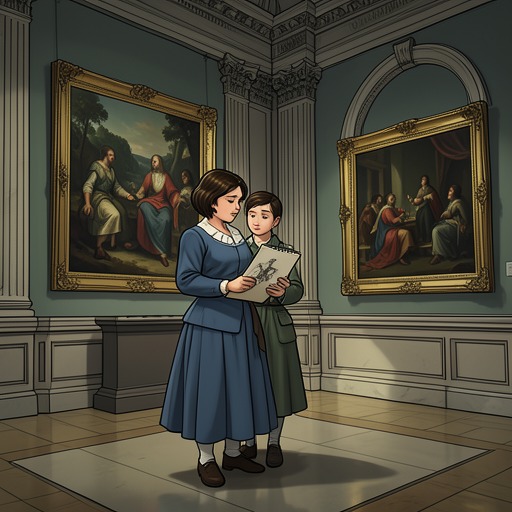
Little WomenThe Louvre is the Paris museum where Amy Curtis March spends rainy days studying pictures during her European travels. More than a sightseeing stop, it represents her deliberate education in art: amid the pleasures of Paris, she chooses the museum as a place to cultivate her eye and taste, while contrasting her own response to art with Josephine March’s preference for historical relics and personal curiosities.
Setting and Access
The museum appears within the cosmopolitan world Amy encounters in Paris. Her days include sightseeing, lunches in lively cafes, and unexpected adventures, but the Louvre provides a different rhythm, particularly when the weather keeps her indoors. The contrast makes the museum a place of concentrated attention within a broader holiday shaped by movement and spectacle.
Amy’s visit also belongs to a journey made possible by family connections and travel abroad. In Paris she is accompanied by relatives and benefits from Fred Vaughn’s command of French, while she herself discovers that the knowledge she thought she possessed is less extensive than expected. The Louvre therefore becomes part of an education in which travel exposes both the richness of the world and the limits of her previous training.
Amy’s Artistic Education
Amy spends rainy days in the Louvre, delighting in its pictures and consciously working to develop her visual judgment. She presents this effort as cultivation: taste is not merely an ornament she possesses, but a capacity she is actively trying to form. The museum gives her a disciplined setting in which looking becomes a kind of labor, complementing the social polish and fashionable experiences of her European tour.
Her response is also selective rather than passive. Amy recognizes that Josephine March would dismiss some of the museum’s finest works because Josephine has little feeling for art, whereas Amy believes she does possess that feeling and is determined to strengthen it. This contrast defines the Louvre through two different modes of attention: Amy seeks artistic refinement, while Josephine is more attracted to the tangible remains associated with famous people.
Contrast with Historical Relics
Amy’s Paris letter places the Louvre beside a vivid catalogue of objects connected with history, including Napoleon’s cocked hat and gray coat, his baby’s cradle and old toothbrush, Marie Antoinette’s little shoe, the ring of Saint Denis, and Charlemagne’s sword. These items fascinate her because they preserve contact with individual lives and memorable figures. Yet she distinguishes such relics from the museum’s pictures, which demand a different kind of appreciation.
The distinction is revealing rather than merely comic. Amy’s interest in paintings signals an aspiration toward trained aesthetic judgment, while her list of relics shows that she remains drawn to objects whose significance can be narrated through famous owners and dramatic histories. The Louvre thus stands at the meeting point of inherited culture and personal ambition: it offers the standards of cultivated taste, while Amy’s excited account keeps those standards connected to curiosity, possession, and wonder.
Narrative Significance
The Louvre gives material form to Amy’s movement toward a more worldly identity. Her European experience includes beautiful places, fashionable streets, imperial spectacles, and the frustration of seeing attractive jewelry that she cannot buy, but the museum marks a less possessive form of enrichment. She cannot simply acquire its contents; she must learn how to see them. That effort broadens the meaning of her journey beyond display and luxury.
At the same time, the Louvre participates in the novel’s recurring geography of houses, gardens, libraries, roads, and institutions. The March family home and the Laurence mansion define neighboring but unequal domestic spaces; the hedge and its post office turn a boundary into a channel of exchange; the library at the Laurence mansion makes books and collections available to Jo; and Plumfield eventually becomes a living educational household for boys. Against these spaces, the Louvre is a public cultural institution encountered through travel, a place where Amy’s private ambition meets a larger world of art and judgment.
The museum’s importance therefore lies less in any single picture than in the change it enables Amy to describe and pursue. In the Louvre she is not only sightseeing. She is practicing a form of attention, measuring herself against cultural standards, and imagining the cultivated woman she wishes to become. Its presence in her account of Paris makes the journey part of her formation rather than a decorative interlude.