Margaret March
Little WomenMargaret March, usually called Meg, is the eldest of the four March sisters and the first to enter adult domestic life. At sixteen, she combines conventional prettiness and social self-consciousness with an emerging capacity for work, sacrifice, and responsibility. Her decisive arc is not a rejection of beauty or comfort, but a gradual revaluation of them: exposed to fashionable abundance, she learns how easily material elegance can make home seem poor, while illness, separation, and family duty teach her that affection, protection, peace, and health are the richer possessions.
Identity and Family Position
Margaret is described as sixteen, plump and fair, with large eyes, soft brown hair, a sweet mouth, and white hands of which she is rather vain. As the eldest sister, she occupies a mediating position among the March girls. She can lecture her younger sisters, yet she is also the one whose sense of propriety and responsibility is repeatedly tested by circumstances beyond her control. The family’s affection gives her the pet name “Daisy,” while her later identity as Mrs. John Brooke marks the transition from daughter and sister to wife and head of a new household.
Her position is shaped by wartime absence and reduced family resources. The March sisters lack their father, who is far away where the fighting is, and Margaret understands that their mother has proposed giving up Christmas presents because the winter will be difficult and men in the army are suffering. The family can make only small sacrifices, but she recognizes that those sacrifices should be made gladly, even while admitting that she does not find the discipline easy. Her attachment to comfort is therefore established not as simple selfishness, but as a conflict between gratitude, patriotic duty, and memories of an easier past.
Work, Poverty, and the Seduction of Luxury
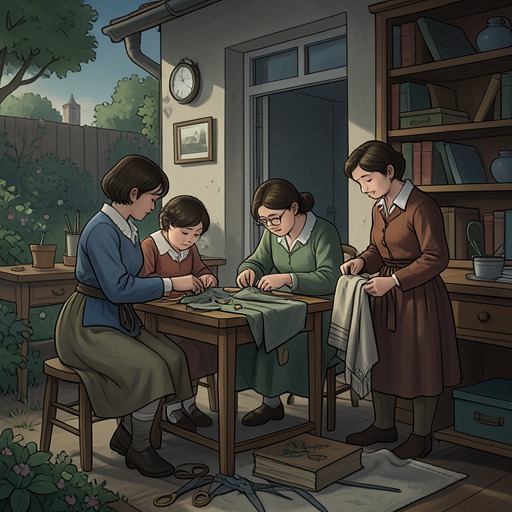
After Mr. March lost his property while trying to help an unfortunate friend, the two oldest girls asked permission to contribute to their own support. Their parents accepted because they believed energy, industry, and independence could be cultivated early. Margaret became a nursery governess and felt comparatively rich when she received her small salary, yet poverty remained her chief trouble. Unlike her sisters, she could remember a time when the family home had been beautiful and life had been full of ease and pleasure; want consequently appeared to her not merely as an abstract hardship but as a painful fall from an earlier standard.
At the Kings’ household she continually encountered reminders of what she lacked. The children’s older sisters wore delicate ball dresses and carried bouquets; conversations concerned theaters, concerts, sleighing parties, and other amusements; money was spent on trifles that would have been precious to Margaret. She seldom complained, but the contrast produced envy and sometimes bitterness. Her emotional difficulty lies in the fact that she sees the injustice clearly while still lacking the inner resources to judge her own abundance accurately.
That weakness becomes more pronounced when Margaret visits Annie Moffat for a fortnight. Mrs. March agrees reluctantly, fearing that fashionable pleasure will leave her daughter more discontented, but Margaret longs for novelty after a winter of irksome work. At the Moffats’ she is initially daunted by the elegance of the house, then enjoys sumptuous meals, carriage rides, daily changes into her best dress, and freedom from labor. She begins imitating the people around her by adopting small airs and graces, using French phrases, arranging her hair, altering her dresses, and discussing fashion. The more she sees Annie Moffat’s possessions, the more she envies them; even home looks bare and work feels harder, despite new gloves and silk stockings.
The visit exposes the instability of a happiness founded on comparison. Margaret can recognize that the Moffats’ gilding does not necessarily signify superior cultivation or intelligence, yet she remains susceptible to the social power of their display. Her experience gives material form to one of the novel’s recurring tensions: poverty limits women’s choices and pleasures, but the desire to appear fashionable can also deepen dissatisfaction rather than relieve it.
Sisters, Social Life, and Emotional Maturity
Margaret’s relationships with her sisters reveal different aspects of her character. She is more conventionally feminine and socially cautious than Jo, whose tall, awkward independence often embarrasses her, and more worldly than Beth, whose quiet contentment makes her seem almost untouched by ambition. Amy’s concern with manners and appearance also reflects desires Margaret understands, even when Amy’s vanity becomes comic or unkind. Margaret’s own struggle is thus both personal and representative: she wants refinement and pleasure, but must learn to distinguish genuine cultivation from expensive display.
Her social education continues through the family’s connection with Theodore Laurence and his friends. At the summer gathering, she notices that Miss Kate’s simplicity is more admirable than ostentation and observes the different manners of the young people around her. Margaret’s sisters respond to the gathering according to their distinct temperaments: Beth shows kindness toward the lame Frank, Jo feels unusually at home among boys, and Amy enjoys the attention of fashionable young men. Margaret stands between these extremes, alert to decorum and social judgment while still capable of appreciating warmth and simplicity.
She is also part of the family’s emotional labor. When a telegraph announces that Mr. March is seriously ill, Mrs. March is so shocked that she turns pale and collapses back into her chair. Margaret helps support her mother and assists in the frantic preparations for travel. Mrs. March directs each daughter to a task, and Margaret is told to come and help find the necessary things because her mother is bewildered. Later, when Mrs. March departs, she entrusts Margaret with prudence and oversight: she must watch over her sisters, consult Hannah, and seek James Laurence’s help in difficulty. This responsibility confirms Margaret’s practical reliability, but it also places adult burdens on a girl still learning how to manage her own discontent.
Illness, Insight, and Marriage
The crisis of Elizabeth March’s scarlet fever changes Margaret’s understanding of her life. While Beth is dangerously ill, Margaret remains at home rather than risk infecting the Kings. She keeps house anxiously and feels guilty because the letters sent to her mother do not mention Beth’s illness; obedience to Hannah conflicts with her sense that concealment is wrong. The household’s uncertainty, together with news that Mr. March has suffered a relapse and cannot return soon, strips away the glamour of fashionable comparison.
In the dark days of Beth’s illness, Margaret sits with tears falling onto her work and recognizes that she has been rich in things more precious than anything money could buy: love, protection, peace, and health. This realization does not deny her former longing for pretty things, gay friends, accomplishments, or ease. Instead, it places those desires within a larger hierarchy of value. Her maturity comes through an altered scale of judgment, produced by proximity to loss rather than by a sudden moral conversion.
Margaret’s marriage to John Brooke brings her first adult romance and establishes the household later called the Dovecote. The wedding is presented as the first wedding of the sisters, and the small brown house prepared by John becomes the setting for her new domestic life. It is modest rather than fashionable: the hall is narrow, the dining room cramped, and the garden’s fountain and shrubbery exist more as hopes than finished ornaments. Yet its simple furniture, books, pictures, flowers, and friendly gifts make it satisfying. Margaret sees completeness where a purely material standard would see inadequacy, a sign that her earlier education in envy has begun to bear fruit.
Later Life and Narrative Significance
Three years after the early struggles, the war is over and Mr. March has returned safely home. Margaret is now part of a wider family network that includes the Marches, the Laurences, the Brookes, and the Bhaers. Her marriage does not detach her from the original household; instead, it enlarges the domestic community that the sisters have learned to sustain through labor, loyalty, and mutual care. The family remains poor by worldly standards, but its emotional and moral resources have become increasingly visible.
Margaret’s later social position also contrasts with Amy’s success among college men. Amy becomes a belle and knows how to use her gift of fascination, while Margaret is absorbed in her “private and particular John.” The contrast is not simply between a virtuous woman and a vain one. It shows how the sisters enter different forms of femininity: Margaret’s desire is gathered into marriage and household, whereas Amy turns social charm into a public accomplishment. Margaret’s development therefore remains both empowering and historically bounded by the domestic ideals available to her.
As a character, Margaret is more rounded than the single trait of “pretty eldest sister” might suggest. She is vain yet self-aware, dutiful yet vulnerable to resentment, capable of sacrifice yet genuinely attracted to luxury. Her experiences with paid work, fashionable society, family illness, and marriage make the novel’s moral vocabulary concrete. Through her, domestic virtue is shown not as effortless goodness but as a discipline learned amid economic limitation, social comparison, emotional strain, and the repeated need to choose what kind of wealth matters most.