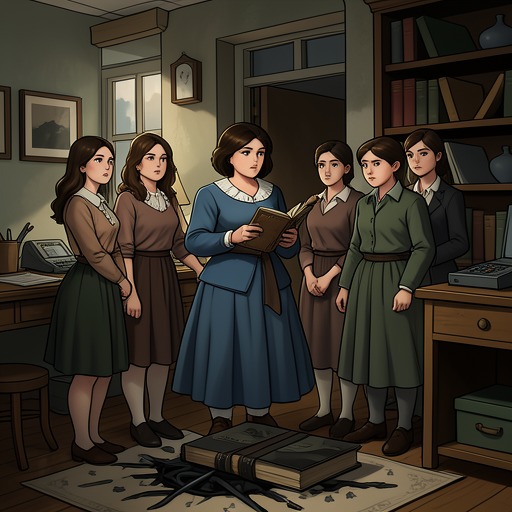
May Chester
Little WomenMay Chester is a young woman in the neighborhood whose importance arises from the social world surrounding Mrs. Chester's elegant charity fair. She is not a member of the March family, but her jealousy toward Amy Curtis March turns a fashionable public occasion into a test of manners and character. Through May, the fair becomes more than a gathering for charitable sales: it exposes how popularity, artistic distinction, romantic attention, gossip, and family pride can shape conduct among young women.
Identity and Social Position
May belongs to the circle of young ladies for whom an invitation to Mrs. Chester's fair is considered a significant honor. The event is described as elegant and selective, and the young women compete for the privilege of taking prominent tables. Amy is invited to manage the art table, while Josephine March is not invited, a circumstance presented as fortunate because Josephine March is still learning how to move easily within polite society. May therefore occupies a social setting in which public approval matters, and her resentment is connected less to any single injury than to her sense that Amy is receiving the admiration that ought to belong to her.
May's jealousy has several immediate causes. Amy's delicate pen-and-ink work completely eclipses May's painted vases, giving Amy a clear artistic advantage at the fair. At a recent party, Tudor danced with Amy four times but with May only once, another slight that deepens her dissatisfaction. The chief grievance, however, is a rumor that the March girls had mocked her at the Lambs' gathering. The joke had actually originated in Josephine March's lifelike imitation, but May does not know the full circumstances, and the rumor reaches her as evidence that the March family has treated her with contempt.
Conflict at the Fair
On the evening before the fair, May's jealousy helps produce Amy's sudden loss of the art table. Mrs. Chester tells Amy that some young ladies object to her occupying the most prominent table and that the table should instead go to Mrs. Chester's daughters. The explanation is framed as expediency, but May's presence makes the personal motive visible. When Amy asks whether Mrs. Chester would prefer her to take no table at all, May adds that the flower table is especially attractive to gentlemen. Her remark reveals that Amy's supposed fall from favor is connected not only with the organization of the fair but also with competition for male attention.
May's comment is a girlish sarcasm, yet it has practical consequences. Amy has invested considerable labor and taste in the art table, arranging pretty racks, painted shells, and quaint illuminations. May later looks at the incomplete replacement table and feels some conscience about the damage, but Amy misunderstands her attempted kindness and does not immediately restore the work. The conflict thus operates through indirect speech, social implication, and wounded pride rather than open confrontation. Both girls are constrained by the etiquette of the occasion, so resentment travels through hints and arrangements instead of direct accusation.
Recognition and Reconciliation
Amy's response changes the moral direction of the episode. After reading words on a page that rebuke heartburn and an uncharitable spirit, she understands that she has received a moral lesson and decides to act on it. When a group of girls discusses the altered tables and May sorrowfully observes that the table has been spoiled and cannot be completed in time, Amy hears the conversation. Although the talk is unpleasant and the surrounding girls have heard only one side of the story, Amy chooses generosity over retaliation.
Amy returns her own carefully made objects so that May's table can be completed. This sacrifice is meaningful because she has worked for the fair and hoped to sell her own attractive contributions. Her action removes the immediate cause of May's embarrassment and refuses to answer jealousy with jealousy. The fair then succeeds, and when May says goodnight, she gives Amy an affectionate kiss and a look expressing a desire to forgive and forget. May does not offer an elaborate public apology, but the gesture marks a genuine restoration of good will.
Consequences and Character Function
The reconciliation also alters how the March sisters understand Amy. At home, Amy finds May's vases displayed on the parlor mantelpiece with a large bouquet in each, after James Laurence has bought them. Josephine March praises Amy's principle, generosity, and nobility, admitting that she had not credited her sister with such qualities. Elizabeth March likewise emphasizes how difficult it must have been for Amy to surrender the chance to sell objects on which she had spent so much time. May's earlier hostility therefore becomes the occasion for Amy's moral recognition by her family.
May remains a minor character, and the evidence does not present a long personal history or an independent plot beyond the fair. Her narrative function is nevertheless precise. She embodies the volatile social pressures of the young women's world: comparison, popularity, artistic competition, gossip, and the desire to attract gentlemen. Her jealousy creates the obstacle, but her final affectionate response allows the episode to end not in permanent exclusion but in restored fellowship. The fair's charitable purpose is consequently mirrored in a smaller exchange of moral generosity, in which Amy gives up a personal advantage and May answers with reconciliation.