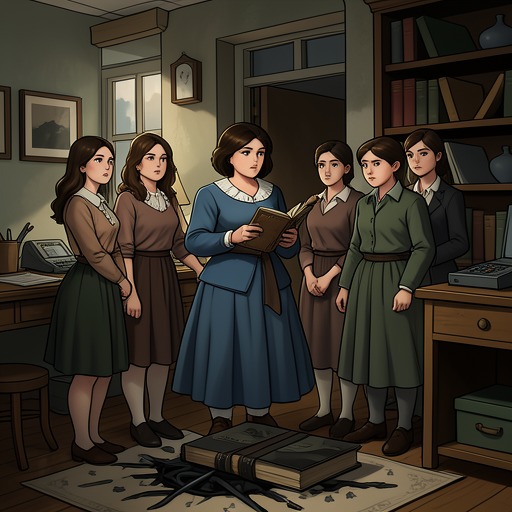
Mrs. Chester
Little WomenMrs. Chester is the organizer and social gatekeeper of an elegant neighborhood fair, a woman whose authority rests less on formal power than on her ability to distribute recognition. Her treatment of Amy March reveals how charity, gentility, rivalry, and reputation operate together: the fair is presented as a benevolent public cause, yet access to its most prestigious places remains controlled by family standing and fashionable opinion.
Identity and Social Position
Mrs. Chester presides over a fair regarded as so elegant and select that young women in the neighborhood consider an invitation to take a table a considerable honor. She belongs to a social world in which taste and usefulness are publicly displayed, but in which the arrangement of that display is also a contest for rank. Her daughters are among the chief organizers, and the most prominent table is understood to be naturally theirs, even when another participant has been invited to prepare it.
Her influence is exercised through manners rather than open force. When she speaks to Amy March, she uses a bland, conciliatory tone and presents exclusion as a practical necessity. This polished manner does not erase the unequal decision; instead, it makes the decision harder to challenge without appearing ill-tempered or insufficiently devoted to the charitable cause.
The Art Table and Amy March’s Displacement
Amy March is initially asked to take the art table because her talent and taste are admired. Her delicate pen-and-ink work has eclipsed May Chester’s painted vases, and Amy has worked energetically to gather suitable and valuable contributions. Her position is therefore earned through visible ability, even though the fair’s social environment remains sensitive to competition and personal jealousy.
May Chester resents Amy’s popularity, her artistic superiority, and the attention she receives at parties. A rumor that the March sisters mocked May at the Lambs’ further intensifies the hostility. The original joke was chiefly Jo’s responsibility, but Amy becomes the person who bears its social consequences. Mrs. Chester, defending her daughter and responding to the surrounding feeling, tells Amy that some young ladies object to her occupying the most attractive table. She says that her own daughters should take it because they organized the fair, while offering Amy another place instead.
The alternative she proposes is the flower table, which has been assigned to little girls who are discouraged and need assistance. Mrs. Chester describes it as appropriate to Amy and assures her that it will be attractive, but the suggestion carries a clear reduction in status. May’s added remark that the flower table is especially attractive to gentlemen makes the social insult unmistakable: Amy’s artistic contribution is displaced, and her appeal is recast as a matter of feminine display and male attention.
Amy understands that the stated reason is not the whole reason. She feels hurt, yet she does not openly retaliate. She agrees to leave the art table and take charge of the flowers, accepting the practical burden rather than creating a public quarrel. Mrs. Chester’s decision thus produces a moral and emotional test that she does not herself resolve; the consequences fall upon Amy, whose response becomes more important than the hostess’s justification.
Reputation, Rivalry, and Emotional Discipline
The conflict exposes the unstable boundary between communal service and social competition. The fair is nominally organized for a cause larger than any individual, but the placement of tables becomes a means of rewarding insiders, protecting a daughter’s prestige, and managing rumors. Mrs. Chester’s language of expediency disguises the fact that public generosity is being governed by private feeling.
At home, Amy’s family regards the treatment as shameful. Her mother says that the decision was wrong, while still affirming that Amy did right to remain involved. Beth March declares that she will not attend the fair, and Jo urges Amy to remove her beautiful contributions and leave the unkind organizers to manage without her. Their reactions emphasize the injury to personal dignity and the temptation to answer exclusion with withdrawal or anger.
Amy chooses another path. She explains that the meanness of others is no reason for her to become mean, and that although she has a right to feel hurt, she does not intend to show resentment. Her mother approves this principle, describing a kiss returned for a blow as the best response, while acknowledging that such restraint is difficult to practice. Mrs. Chester therefore functions as the agent of a social wound, but Amy’s controlled answer transforms that wound into evidence of developing character.
Narrative Significance
Mrs. Chester is a relatively limited figure, but her brief appearance crystallizes one of the book’s recurring contrasts: outward refinement can coexist with narrowness, while true gentility is measured by conduct under humiliation. Her fair creates an arena in which artistic talent, class position, family loyalty, gossip, and gendered expectations collide.
The episode also distinguishes formal civility from moral generosity. Mrs. Chester does not insult Amy crudely; she softens the exclusion with gratitude, alternatives, and assurances that the decision is merely practical. Yet the polite form makes the social mechanism more visible, because Amy is expected to absorb the loss without disturbing the atmosphere of elegance. The scene’s decisive shift is from Amy’s honored public position to her threatened dignity, followed by her recovery of self-command through service to the younger girls.
In this way, Mrs. Chester’s conduct helps define the standard by which the March family judges society. A charitable event is not automatically charitable in spirit, and a graceful manner is not identical with kindness. The fair’s social slight gives Amy an opportunity to practice the principle that personal injury does not justify retaliation, while Mrs. Chester remains associated with the polished exclusions that make such moral growth necessary.