Pickwick Club
Little WomenThe Pickwick Club is the March sisters’ home-made literary society and one of the clearest examples of how their imaginative play turns domestic space into a social institution. Meeting in the big garret every Saturday evening, the club gives four girls a shared language of ceremony, authorship, criticism, and mutual obligation. What begins as a secret-society game modeled on Dickens’s Pickwickian world becomes a durable network of exchange, and, after Theodore Laurence is admitted, a practical means of drawing an isolated neighbor into the sisters’ circle.
Formation and Setting
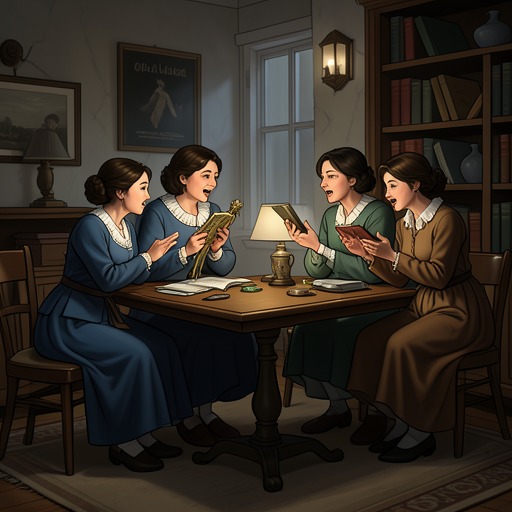
With secret societies fashionable, the sisters decided that they too should have one, choosing the name Pickwick Club because all four admired Dickens. They had maintained it for about a year, with only a few interruptions, before the recorded admission of Laurie. The club met in the March family home’s large garret, a private upper room removed from the ordinary circulation of the household. There, an attic associated with papers, pets, and youthful invention became a formal meeting place with its own offices, insignia, newspaper, and rules. The weekly arrangement was deliberately theatrical. Three chairs stood in a row before a table bearing a lamp, four white badges marked with a large colored “P.C.” identified the members, and The Pickwick Portfolio supplied the meeting’s central text. At seven o’clock, the girls climbed to the room, tied the badges around their heads, and took their seats with great solemnity. The ritual gave their domestic lives a public shape: the children were not merely pretending to meet, but practicing orderly participation in a world of roles, speech, judgment, and collective decisions.
Members, Roles, and Publications
The four sisters assigned themselves Pickwickian identities according to age, temperament, and talent. Margaret March, the eldest, served as Samuel Pickwick and presided over the meetings. Josephine March, whose literary interests made her the natural editor, took the part of Augustus Snodgrass. Elizabeth March, round and rosy, became Tracy Tupman, while Amy Curtis March, who was always attempting things beyond her abilities, was assigned Nathaniel Winkle. These roles converted differences among the sisters into a comic structure that nevertheless depended on recognizing each person’s characteristic strengths. The Pickwick Portfolio was the club’s weekly newspaper, to which every member contributed. Its contents included original tales, poetry, local news, funny advertisements, and hints that gently reminded the sisters of one another’s faults and shortcomings. The publication therefore served two functions at once. It encouraged literary invention, especially Josephine March’s delight in pens and ink, while also making the club a forum for affectionate criticism. The sisters could tease, evaluate, and correct one another without surrendering the underlying bond that made the criticism safe. The meetings were performed with mock parliamentary seriousness. When the president finished reading the paper, applause followed, and Josephine March, speaking as Snodgrass, proposed Theodore Laurence for honorary membership. The motion was not accepted immediately. Margaret March and Amy Curtis March opposed admitting a boy because they feared that boys would joke, disturb the proceedings, or make the private ladies’ club less proper. Another concern was that Laurie might laugh at their writing and make fun of it afterward. The debate shows that the club’s privacy mattered: it protected a female creative space even as the sisters wondered whether friendship required opening it.
Laurie’s Admission and the Expansion of the Club
Josephine March argued passionately that Laurie would not mock the paper. He liked to write, she maintained, and could give the contributions “a tone” while preventing them from becoming too sentimental. She also framed the invitation as a reciprocal duty: the sisters could do little for Laurie, while he had already done much for them, so offering him a place and a welcome was the least they could do. Elizabeth March then supported admission even though the sisters were afraid, and her decisive intervention shifted the vote. The club accepted Laurie as “our Laurie,” turning private affection into an explicit institutional welcome. The admission itself was a piece of Josephine March’s characteristic theatrical mischief. She opened the closet door and revealed Laurie sitting on a rag bag, flushed and struggling to suppress his laughter. Though the other sisters protested that Josephine March had betrayed them, she brought out a chair and a badge and installed him immediately. Laurie responded in the club’s own language, introducing himself as Sam Weller, the humble servant of the club. His acceptance of the invented identity mattered because he did not merely enter the girls’ game as an amused outsider; he learned its conventions and answered them on their terms. Laurie’s first contribution was the hedge post office, which he established as a token of gratitude and as a means of promoting “friendly relations between adjoining nations.” He converted the old martin house in the lower corner of the garden by stopping up its door and leaving the roof open, creating a small locked structure through which letters, manuscripts, books, and bundles could pass. Each side received a key. The post office thus made the physical boundary between the March family home and the Laurence mansion into a point of communication rather than separation. A hedge that divided neighboring estates became an infrastructure of friendship. The new institution quickly exceeded its original purpose. The post office carried tragedies and cravats, poetry and pickles, garden seeds and long letters, music and gingerbread, rubbers, invitations, scoldings, and puppies. James Laurence enjoyed the amusement and sent odd bundles, mysterious messages, and funny telegrams; even the gardener’s concealed love letter to Josephine March passed through the system. The range of objects made the post office a comic miniature of adult society, where information, affection, quarrels, gifts, and secrets circulate through material channels. The club’s imaginative structure had become a living social network.
Influence on Members and Later Meaning
Laurie’s membership altered the character of the meetings without destroying their intimacy. The narrative records that he was devoted, well-behaved, and jovial, and that he added both spirit to the gatherings and a distinctive tone to the newspaper. His contributions could be patriotic, classical, comical, or dramatic, but they were never sentimental. Josephine March admired them as worthy of Bacon, Milton, or Shakespeare and revised her own work under their influence. The club therefore becomes a place where writing is not only produced but tested, sharpened, and transformed through exchange. The Pickwick Club also anticipates the larger pattern of the March sisters’ lives: private feeling repeatedly becomes organized activity. Their garret play rehearses editorial labor; their badges turn family identities into chosen public roles; their newspaper makes domestic observation into literature; and their post office turns a garden boundary into a channel of mutual dependence. The contrast between the shabby March house and the luxurious but lonely Laurence mansion makes this transformation especially significant. Laurie possesses books, comfort, and a rich library, yet he suffers from isolation; the club offers what material luxury cannot, a place in a lively circle that recognizes and expects his participation. The club’s endurance also foreshadows later communities in the story. Years afterward, Josephine March’s life at Plumfield is organized around a school for boys who need teaching, care, and kindness. The scale and purpose are different, but the underlying impulse is continuous: she creates a structured, affectionate community in which writing, conversation, discipline, and belonging can coexist. The Pickwick Club is the earliest miniature of that work. Its garret ceremonies and hedge post office show Josephine March learning that imagination is most powerful when it builds relationships rather than merely escaping from reality.