Plumfield
Little WomenPlumfield is the estate that Jo ultimately inherits from Aunt March and converts into a school and home for boys. Its decisive significance lies in this transformation: the place that once represented an intimidating adult authority becomes a lively community shaped by Jo’s imagination, Friedrich Bhaer’s teaching, the March family’s support, and the needs of children who might otherwise be neglected. By the end, Plumfield is not merely a residence or a source of wealth but the material expression of Jo’s long-held desire to make care, education, and belonging available to boys from different circumstances.
An Estate of Authority and Possibility
Plumfield first appears as the place associated with Aunt March, whose departure fills Jo with relief. When Aunt March leaves for the seashore, Jo is delighted that she will not have to accompany her and describes Plumfield as being about as gay as a churchyard. Her comic dread establishes the estate as a space of constraint in Jo’s imagination, a place governed by an older woman’s sharp temper and strict order rather than by youthful freedom.
The estate’s later value is prepared by the contrast between the March family home and the Laurence mansion. The March house is old, brown, bare, and shabby, while James Laurence’s stone mansion advertises comfort and luxury through its coach house, carefully kept grounds, conservatory, and glimpses of beautiful objects. Plumfield belongs to the world of substantial property, yet its importance ultimately comes from the uses Jo gives it rather than from its inherited prestige. The contrast also makes Jo’s later decision consequential: she refuses to treat the estate simply as a valuable asset to be sold.
Jo Claims Plumfield
After Aunt March dies, the family learns that she has left Plumfield to Jo. The inheritance arrives after a period in which Jo and her Professor have worked, waited, hoped, and loved while their prospects remained uncertain. Their first grief over Aunt March’s death is therefore joined by unexpected possibility. Laurie assumes that Jo will sell the estate because it would bring a handsome sum, but Jo answers decisively that she intends to live there.
This refusal to sell turns property into vocation. Jo acknowledges that the immense house will be expensive to maintain, that the garden and orchard require several workers, and that farming will be difficult for Friedrich Bhaer. She nevertheless imagines that he will try his hand at it, and she treats the labor involved as part of the plan rather than as a reason to abandon it. The inheritance gives Jo economic security, but she measures its value by what it can support, not by the money it might produce.
The School Jo Has Long Imagined
Jo announces that she wants to open a school for little boys, with herself caring for them and Friedrich Bhaer teaching them. The plan is not a sudden response to the inheritance. Before Friedrich Bhaer entered her life, Jo had imagined that after making a fortune and no longer being needed at home, she would rent a large house, gather poor and motherless boys, and make life happier for them before neglect ruined their prospects. She says that she sees many boys going wrong because they lack help at the right moment and that she wants to feel their needs, sympathize with their troubles, and act as a mother to them.
Friedrich Bhaer had already approved the idea and had spent his own life helping poor boys, even though he never accumulated wealth because money did not remain in his pocket long enough for him to save it. Aunt March’s bequest makes the shared project possible. Jo believes that Plumfield is suited to the school because the house is large, its furnishings are strong and plain, and there is room for many children indoors and extensive garden and orchard space outside. The boys can help with healthy outdoor work, while Friedrich Bhaer can teach and train them in his own way; Jo will feed, nurse, comfort, discipline, and encourage them, and Mrs. March will serve as her support.
Plumfield therefore embodies a practical theory of moral education. Its children are not to be isolated from work, affection, or ordinary life. The estate’s rooms, garden, and orchard become instruments of formation, while the adults’ distinct abilities create a shared domestic and educational structure. Jo’s expansive wish to fill the house with boys is playful in expression, but it rests on a serious conviction that kindness offered at the right time can alter a child’s future.
From Estate to Bhaer-Garten
The school grows rapidly after Jo marries Friedrich Bhaer and settles at Plumfield. A household of six or seven boys appears and flourishes, including both poor and wealthy children. James Laurence repeatedly finds children in distress and persuades the Bhaers to take them in, offering to pay something toward their support. His intervention quietly enlarges the school and ensures that it receives the sort of needy boys Jo most wants to help.
The beginning is difficult. Jo makes mistakes, and Friedrich Bhaer guides her toward steadier methods; even the most unruly boy is eventually won over. The formerly prim estate is transformed into a boys’ paradise. The children eat forbidden plums, kick gravel with muddy boots, and play cricket in the large field where Aunt March’s irritable cow once discouraged trespassers. Laurie suggests calling the place the Bhaer-garten, a playful name that honors its master while announcing that its inhabitants have changed the character of the property.
This comic reversal carries social meaning. The estate’s old order depended on exclusion, fear, and careful control, whereas the new Plumfield welcomes energetic, disorderly, and imperfect children. The boys’ liberties are not presented as the absence of discipline; rather, discipline is recast as patient guidance within a home. The property becomes more fully itself by being used, inhabited, and shared.
A Diverse and Homelike Community
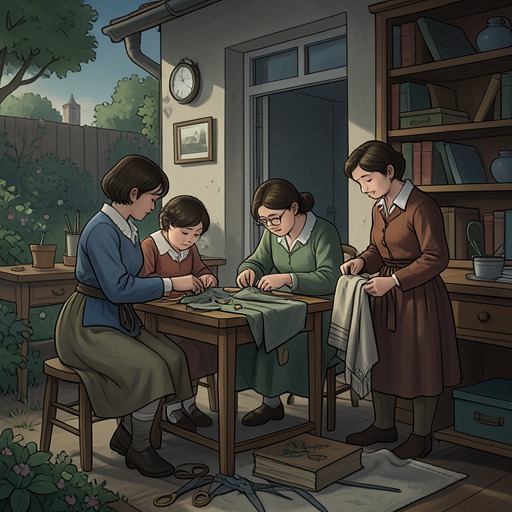
Plumfield never becomes a fashionable school, and Friedrich Bhaer does not make a fortune from it. Its success is measured by fidelity to Jo’s purpose: it is a happy, homelike place for boys who need teaching, care, and kindness. Every room soon fills, each small garden plot acquires an owner, and a menagerie occupies the barn and shed because the children are allowed to keep pets.
The boys differ widely in ability, temperament, and physical condition. Some are slow or shy, some weak or riotous, some lisp or stutter, and one or two are lame. A merry little quadroon boy, whom other institutions would not accept, is welcomed at the Bhaer-garten despite predictions that his admission will ruin the school. Plumfield’s openness thus challenges the narrow standards that determine which children are considered acceptable or educable. The school’s household identity depends precisely on making room for boys whose differences might otherwise become grounds for exclusion.
Jo’s authority grows through relationship rather than distance. Three times a day she sits at the head of a long table beside Friedrich Bhaer, facing rows of affectionate young faces that address her as Mother Bhaer. The boys’ confessions after wrongdoing, their whispered apologies, enthusiasms, hopes, plans, and misfortunes deepen her attachment to them. She believes that even the naughtiest boy possesses a good spot in his heart, and this faith gives her the patience and skill to persist until change becomes possible. Friedrich Bhaer’s benevolence and Jo’s readiness to forgive reinforce one another, making the school’s moral atmosphere both firm and tender.
Plumfield as Jo’s Fulfillment
Jo becomes a very happy woman at Plumfield despite hard work, anxiety, and constant noise. The applause of her boys satisfies her more than worldly praise, and she now tells stories chiefly to her own enthusiastic listeners. Her achievement is not a retreat from ambition but a redirection of it: literary recognition is replaced by the durable influence of daily care, teaching, and companionship.
The estate also expands into a family home. Two sons, Rob and Teddy, are born to Jo and Friedrich Bhaer, and they grow up among the larger community of boys, whose rough affection and service help care for them. Plumfield thus combines school, household, workplace, and extended family. Its original inheritance is absorbed into a living network in which adults and children contribute to one another.
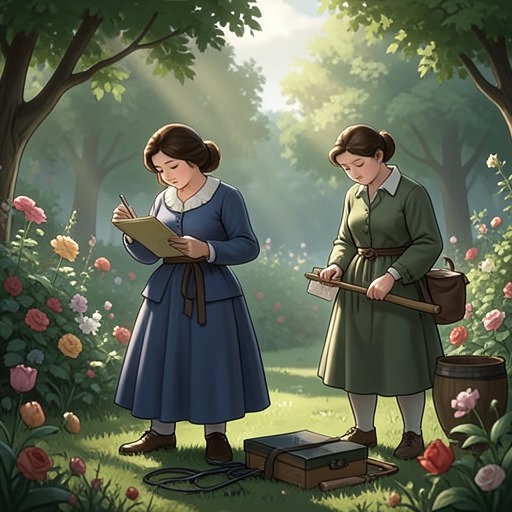
Five years after Jo’s wedding, the March, Laurence, Brooke, and Bhaer families gather at Plumfield for the annual apple-picking festival. The orchard, filled with goldenrod, asters, squirrels, birds, and ripening red and yellow apples, becomes the setting for shared labor and celebration. Everyone climbs, laughs, sings, and gives themselves to the day’s simple pleasures. The harvest scene completes the estate’s transformation: Plumfield now gathers several families and generations in an atmosphere of abundance created not by luxury alone but by work, hospitality, affection, and the successful cultivation of human lives.