Plumfield School
Little WomenPlumfield School is the institutional culmination of Jo's long movement from dependent daughter and aspiring writer to economically capable educator and founder. Established at Plumfield after Aunt March's death left the estate to Jo, it turns inherited property into a living experiment in care: a large house, garden, orchard, and surrounding grounds become a school for boys who need not merely instruction but a stable home, sympathy, discipline, and affection. Its decisive principle is practical rather than prestigious. Plumfield is meant to make children flourish, and its emotional center is the conviction that education can rescue a boy at the moment when neglect might otherwise send him to ruin.
Foundation and Purpose
Plumfield becomes available to Jo and Friedrich Bhaer during the second year of their courtship, after Aunt March dies suddenly. The inheritance changes their prospects, but Jo refuses the obvious financial solution of selling the estate. When it is suggested that Plumfield would bring a handsome sum, she answers decisively that she intends to keep it and live there. The choice converts an inheritance into a social responsibility and gives material form to a plan Jo had cherished long before she possessed the means to carry it out.
Jo explains that, before Friedrich Bhaer entered her life, she had imagined earning enough money to hire a large house, gather poor and motherless boys, and care for them before it was too late. Her concern is directed toward children whose needs are visible but insufficiently answered: she sees boys going to ruin for want of help at the right moment and wants to be a mother to them. The school therefore grows from an earlier habit of sympathy, not from a sudden business calculation. Inheritance supplies the building, but Jo's purpose supplies the institution's identity.
Friedrich Bhaer had already expressed sympathy with this plan, and Jo understands his own lifelong practice as helping poor boys rather than accumulating money. Plumfield allows their complementary abilities to meet. Jo will feed, nurse, comfort, correct, and encourage the pupils; Friedrich will teach and train them; Mr. March will assist him intellectually, while Mrs. March remains Jo's support. The proposed school is thus a family enterprise whose educational authority is distributed through teaching, domestic labor, moral guidance, and practical care.
Structure and Daily Life
The physical scale of Plumfield makes the plan possible. Jo points to the strong, plain furniture, the ample rooms, the garden and orchard, and the open grounds as resources suited to boys rather than to a fashionable establishment. The pupils can work in the garden and orchard, turning labor into healthy activity and making the estate itself part of their education. Farming is acknowledged as difficult, but the work is treated as a shared undertaking rather than as a decorative feature of the property.
The school expands rapidly after Jo and Friedrich marry and settle at Plumfield. A family of six or seven boys appears first, with Mr. Laurence repeatedly discovering cases of destitution and persuading the Bhaers to take in another child, sometimes offering to pay a small amount toward his support. His interventions help widen the school's social reach while preserving Jo's particular delight in caring for boys who need a chance. What begins as a planned household becomes an expanding community.
Plumfield is never fashionable, and Friedrich does not accumulate a fortune from it. Those facts mark the institution's distance from conventional measures of educational success. Every room in the large house eventually fills, every small garden plot acquires an owner, and a menagerie develops in the barn and shed because the children are permitted to keep pets. Three times a day, Jo sits at the head of a long table beside Friedrich, facing rows of young faces whose affectionate looks, confidences, and gratitude make the school resemble an enlarged family dining room as much as a formal academy.
The nickname “Bhaer-garten,” suggested by Theodore Laurence, captures both the institution's association with its master and the unruly energy of its inhabitants. The once prim grounds of Plumfield are overrun by boys who eat forbidden plums, kick gravel with muddy or profane boots, and play cricket in the big field. The transformation carries a comic justice: Aunt March had once been a terror to the boys of the neighborhood, while after her death the same grounds become a boys' paradise. The school preserves the estate while reversing its old emotional atmosphere.
Methods, Discipline, and Inclusion
The school does not assume that its pupils are naturally obedient or idealized. Jo makes strange mistakes during the difficult first year, and the most unruly ragamuffins cause both her and Friedrich anxiety. Friedrich's wisdom helps guide her toward calmer methods, while Jo's patience rests on her faith that even the naughtiest and most tantalizing boy possesses a good spot in his heart. That faith is not passive indulgence: it gives her the patience and skill to persist until a boy changes.
Friedrich's benevolence and Jo's readiness to forgive provide the school's characteristic moral atmosphere. No boy can resist indefinitely when Friedrich treats him with steady kindness and Jo forgives him repeatedly after wrongdoing. The institution's discipline therefore works through relationship as much as command. The boys' penitence, whispered confessions, enthusiasms, hopes, plans, and even misfortunes become occasions for attachment rather than reasons for expulsion. Misbehavior is acknowledged, but the child is not reduced to it.
The pupils form a notably varied group: slow and bashful boys, feeble and riotous boys, boys who lisp or stutter, and one or two who are lame. A merry little quadroon, unable to gain admission elsewhere, is welcomed at the school despite predictions that his presence will ruin it. Plumfield's inclusiveness is therefore concrete rather than abstract. It appears in the admission of children whom other institutions reject and in the refusal to make physical difference, speech difficulty, weakness, poverty, or social prejudice decisive grounds for exclusion.
Jo's Work and the School's Development
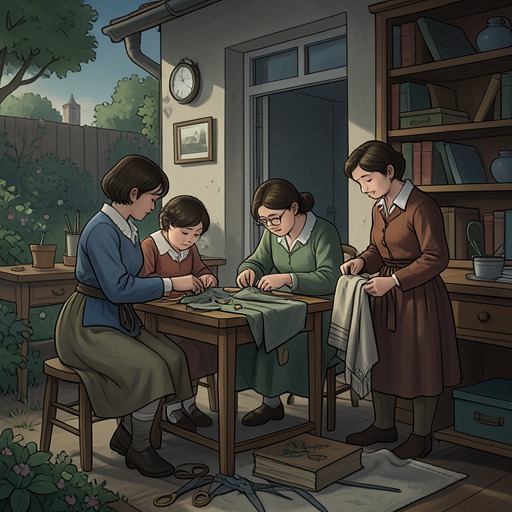
Plumfield also resolves a tension in Jo's earlier working life. She had begun supporting herself through occupations that tested the boundaries of feminine respectability: she worked as Aunt March's companion, later taught children and sewed in New York, and pursued paid writing through newspaper publication, prize competitions, editorial revision, and the sale of stories. Her first published story, “The Rival Painters,” gave her the hope that writing might eventually support herself and help her family. A sensational story later won a hundred-dollar prize, and subsequent stories turned household bills and necessities into the tangible results of her pen.
Yet the school does not represent a rejection of labor or ambition. It absorbs the lessons of Jo's earlier work: independence matters, honest work is not shameful, and usefulness can be measured by the lives made more secure through one's effort. The difference is that Plumfield gives her a form of labor in which economic activity, emotional commitment, and social purpose coincide. Her authority no longer depends on a publisher's payment or an editor's approval. She becomes the founder and daily worker of a community whose members recognize her as “Mother Bhaer.”
The institution also redistributes domestic labor across a larger social unit. Jo's feeding, nursing, petting, scolding, and emotional attention are not ornamental acts surrounding education; they are the conditions that allow education to succeed. Friedrich's teaching, Mr. March's assistance, Mrs. March's support, the boys' garden work, and Mr. Laurence's financial and practical interventions together sustain the school. Plumfield makes visible how a home can function as an educational institution and how care, when organized collectively, can become a durable public service.
Community, Family, and Significance
Jo finds at Plumfield a happiness deeper than literary fame. She writes no stories for the wider public except for the boys, who remain enthusiastic believers and admirers, and their applause satisfies her more than praise from the world. The change is not that creativity disappears, but that its audience and purpose become intimate. Her earlier stories had helped pay butcher's bills, provide a carpet, and supply groceries and gowns; at Plumfield, her central creative work is the making of a humane environment in which difficult children can grow.
The school eventually becomes a multigenerational family network. Jo and Friedrich's two sons, Rob and Teddy, grow up amid the larger crowd of boys, flourishing despite the noise and disorder that astonish their grandmother and aunts. The children of the March, Laurence, Brooke, and Bhaer families gather at Plumfield for holidays, including an annual apple-picking festival five years after Jo's wedding. The orchard, once part of the estate's property, becomes a recurring setting for collective pleasure, linking work, harvest, kinship, and memory.
Plumfield's success is deliberately defined against wealth and fashion. It does not become a fashionable school, and Friedrich does not become rich, but it achieves exactly what Jo intended: a happy, homelike place for boys who need teaching, care, and kindness. Its full rooms, occupied garden plots, pets, noisy games, and long communal meals are signs of institutional vitality rather than disorder to be corrected. The school is valuable because it enlarges the moral meaning of family, making room for children beyond biological kinship and treating patience and affection as serious educational powers.
For Jo, Plumfield is the final transformation of independence into belonging. She once sought money so that no one would need to support her; she ultimately uses inherited wealth, professional experience, and domestic skill to support others. The estate becomes neither a monument to Aunt March nor a source of private luxury. It becomes a boys' paradise, a working household, and a school whose governing faith is that care given at the right moment can alter a child's future.