The Pilgrim's Progress
Little WomenThe Pilgrim's Progress is the central literary and spiritual object through which the March sisters interpret their lives. Its importance lies not merely in the pleasure of reading it, but in the way Mrs. March turns its pilgrimage from a childhood pastime into an earnest discipline: the girls learn to regard poverty, temper, selfishness, illness, separation, and grief as burdens on a road toward goodness and happiness. The book therefore joins domestic action to moral and religious practice, giving the family's sacrifices a shared imaginative form.
From Childhood Game to Moral Guide
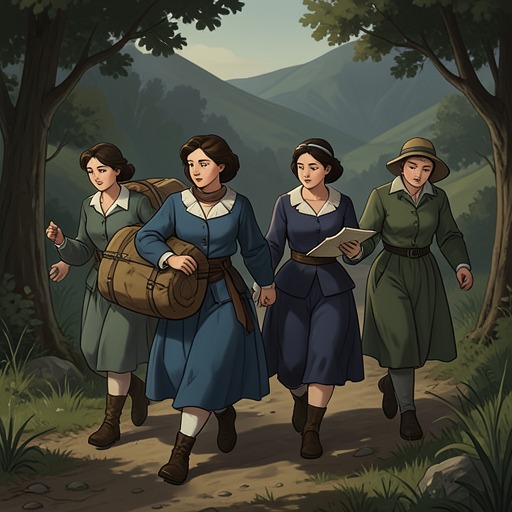
Mrs. March first recalls how the girls used to play Pilgrims Progress throughout the house. Their piece bags became burdens, their hats and sticks made them travelers, the cellar represented the City of Destruction, and the housetop became a Celestial City filled with the lovely things they gathered. The sisters remember the game through its successive obstacles: passing the lions, fighting Apollyon, and crossing the valley haunted by hob-goblins. Even their different recollections reveal their characters. Jo remembers the adventure, Meg remembers the bundles falling away, and Amy remembers being frightened by the cellar and dark entry while longing for the cake and milk at the top.
Mrs. March insists that the game has never become irrelevant with age. The girls are still playing it, she explains, though now their burdens are real, their road lies ahead, and the desire for goodness and happiness must guide them through troubles and mistakes toward a true Celestial City. She consequently asks them to begin again in earnest and to see how far they can progress before Mr. March returns. Meg recognizes the plan as another name for trying to be good: a necessary effort that is difficult because the girls forget their intentions and fail to do their best. Jo, delighted by the romance that the book lends to duty, names their present condition the Slough of Despond and imagines Mrs. March as the Help who pulls them out.
The book thus supplies more than an analogy after the fact. It changes the girls' perception of work. When they sew sheets for Aunt March, the long seams become four continents—Europe, Asia, Africa, and America—and the tedious labor becomes a stage in their imagined pilgrimage. The material burden is not removed, but it is made intelligible and shared. Through the book, obedience and usefulness acquire the shape of travel, while domestic routine becomes progress rather than mere confinement.
The Christmas Guidebook
The Pilgrim's Progress becomes especially tangible at Christmas. Because the family cannot afford ordinary presents and because the war has made the winter difficult for everyone, Mrs. March asks the girls to accept sacrifice rather than spend money on pleasure. Their father is far away where the fighting is, and the sisters can contribute little to the army beyond their small acts of self-denial. In this setting, the book arrives as a carefully chosen substitute for material abundance.
On Christmas morning, Jo finds a little crimson-covered copy beneath her pillow. She recognizes it as the beautiful old story of the best life ever lived and regards it as a true guidebook for any pilgrim beginning a long journey. Meg's copy is green-covered; Beth's is dove-colored; Amy's is blue. Each contains the same picture and a few words written by Mrs. March, making the books precious despite their modest physical form. The four volumes transform the absence of stockings and presents into a different kind of abundance: the sisters receive not luxury, but a common language for interpreting the duties and dangers ahead.
The object also binds the sisters to one another through repetition. Each girl owns an individual copy, yet all possess the same story, the same maternal instruction, and the same imagined route. The books are private possessions that create a collective identity. Their distinct colors mark the sisters as individuals, while the shared text keeps their separate struggles within the family pilgrimage.
A Recurrent Map for Trials
The sisters repeatedly return to the book when experience threatens to overwhelm them. Beth later describes how the girls got out of the Slough of Despond, passed through the Wicket Gate by resolving to be good, and climbed the steep hill by trying. She imagines the splendid house across the way as their Palace Beautiful, while Jo answers that they must first get past the lions. The exchange preserves the book's structure of danger followed by rest: improvement is possible, but it is neither automatic nor painless.
The same framework accompanies the family's wartime anxiety. Mr. March has gone as a chaplain even though he is too old to be drafted and not strong enough to serve as a soldier. Jo wishes she could go as a drummer or nurse to be near him, while Meg understands that the family must make its own sacrifices at home. The book helps convert this forced separation into a morally legible task. Jo resolves to become what her father calls a little woman and to fight her temper at home instead of seeking a battlefield. Beth silently knits an army sock, accepting the duty nearest to her while hoping to be worthy of what her father expects when he returns.
The pilgrimage metaphor also gives physical danger a moral afterlife. After Amy falls through the ice, Jo confesses that her own hardness of heart allowed Amy to go and fears that Amy's death would have been her fault. Her remorse turns the rescue into an inward crisis: the immediate danger has passed, but Jo discovers that her temper remains an enemy she has not conquered. Mrs. March's counsel to watch, pray, and never grow tired of trying turns the episode into a new ascent from despair toward self-control. Jo's later movement is not presented as a single victory, but as continued travel under the knowledge that the old fault may return.
The Book and Character Formation
The Pilgrim's Progress provides the March sisters with a vocabulary for naming the moral burdens they cannot otherwise describe. Amy eventually calls her collection of faults her bundle of naughties and identifies selfishness as the largest burden. During Beth's illness, she compares herself unfavorably with Beth, whom everyone loves because she is unselfish, and decides to try to become more like her. Amy even seeks a physical reminder for her resolution, asking to wear a ring so that she will not forget it. The book's burdens therefore become instruments of self-examination: character is something that can be recognized, carried, and deliberately reshaped.
Mr. March later confirms Amy's change by observing her conduct rather than merely praising her intention. She takes drumsticks at dinner, runs errands for her mother, gives Meg her place, serves everyone patiently and cheerfully, avoids fretting and looking in the glass, and does not mention the pretty ring she wears. He concludes that she has begun to think more of other people and less of herself, molding her character as carefully as she molds her clay figures. His contrast between a graceful statue and a lovable daughter extends the book's moral logic: the desired destination is not polished appearance, but a life that makes existence more beautiful for oneself and others.
The book also shapes Beth's relation to music, faith, and death. After surviving a grave illness, she reads of Christian and Hopeful reaching a pleasant green meadow where lilies bloom all year round and resting there before continuing toward the journey's end. She sees the family's reunion as a similar interval of peace, then returns to her old piano and sings the shepherd boy's song, having made the music for Mr. March because he likes the verses. The scene makes recovery feel like a temporary meadow rather than a final arrival, quietly preparing the book's language for Beth's later decline.
The Celestial City and the Journey's End
When Beth tells Jo that her strength is ebbing like a tide that cannot be stopped, the pilgrimage metaphor becomes the means by which the sisters face approaching death. Beth's faith is expressed less through argument than through conduct. She cannot claim that she is glad to leave life, because life is sweet to her; she can only say that she is trying to be willing. Her trust does not cancel her love for Jo. Instead, she clings more closely to human affection while accepting that such love may draw the living nearer to God.
Jo responds in the language of resistance. She insists that Beth is too young to go and vows to work, pray, and fight against the approaching loss. Yet Beth's example changes Jo's own destination. Jo eventually renounces her former ambition and pledges herself to a new one, discovering solace in the belief that love is immortal. The journey has therefore altered not only Beth's understanding of death but Jo's understanding of what makes a life worth pursuing.
Beth's death fulfills the book's imagery with quiet naturalness rather than theatrical revelation. Father and Mother guide her tenderly through the Valley of the Shadow and give her up to God. The tide goes out easily; in the dark hour before dawn, Beth dies on the bosom where she first drew breath, leaving no farewell beyond one loving look and a little sigh. In the morning, the extinguished fire, Jo's empty place, the budding bough, the snowdrops, and the spring sunshine surround her peaceful face. The Celestial City is not represented as a spectacle visible to the survivors, but as the serenity with which they understand that Beth is finally beyond pain.
The Pilgrim's Progress thus operates at once as a cherished book, a household ritual, a moral exercise, and an architecture of meaning. It lets the sisters connect sewing, sacrifice, apology, self-command, service, prayer, reunion, and mourning without pretending that hardship is easy. Its deepest function is to make development continuous: every temptation can become a swamp or a lion, every act of duty a step forward, every period of rest a meadow before the road resumes, and death the final passage toward the Celestial City.