
From Predation to Protection
Living with 7 vampiresThis flow traces the changing meaning of vampire instinct as the household moves from unchecked hunger toward restraint and care.
increasing Bearing strength in each event
 decreasing
Bearing strength in each eventdecreasingInstinct as Excuse
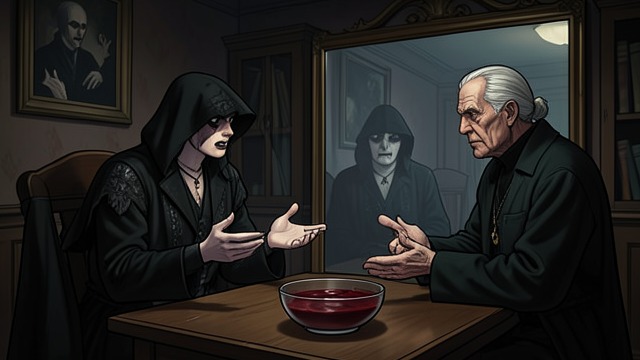
Instinct as Excuse
The younger vampires explain their attacks through youth, hunger, and development.
Naturalized Violence
Their language makes predation sound unavoidable. Y/N is expected to accommodate a biological condition that repeatedly injures her.
Ethical Challenge
The older vampires’ greater control proves that instinct is powerful but not absolute. The household’s conflict is therefore moral as well as biological.
Older Restraint

Older Restraint
Jin, RM, Suga, and J-Hope claim to have more control over their hunger than the younger vampires.
Uneven Responsibility
They criticize the younger members but still fail to establish a real consent-based system for Y/N’s blood.
Partial Reform
Their restraint protects Y/N in some scenes, yet it does not fully challenge the idea that she belongs to the household as a resource.
The Hunting Policy

The Hunting Policy
Jin explains that the castle once adopted a policy against hunting humans to avoid retaliation.
Collective Survival
The policy frames restraint as necessary for the survival of the vampire community, not merely as kindness toward humans.
Failed Enforcement
The imprisoned seven rejected the policy and killed other vampires. The resulting conflict shows how communal rules collapse when hunger and power go unchecked.
The Human Exception

The Human Exception
Y/N becomes the household’s tolerated human exception even while the vampires claim to reject human hunting.
Contradiction
The policy is applied selectively. The group will not hunt strangers, yet it accepts repeated feeding from the vulnerable girl living inside the castle.
Pressure for Change
Y/N’s resistance forces the vampires to see the difference between avoiding public slaughter and respecting an individual person.
Care as Discipline

Care as Discipline
After the reset, the household’s affection is expressed through food, school, work, and shared routines rather than blood attacks.
New Practice
Jin insists that Y/N eat breakfast, while the others occupy ordinary roles. Their behavior becomes structured around sustaining her life.
Uneasy Resolution
The old instincts have not necessarily vanished, but they are placed under discipline. The new household is an imperfect experiment in coexistence.
early in Y/N’s stay
during the first household conversations
revealed near the ending
during Y/N’s residence
the final new life
