BTS
Living with 7 vampiresBTS is the collective identity through which the novel presents its seven central supernatural men as both a dangerous household and a recurring community of mutual dependence. Their story is shaped by captivity, blood, mirrors, altered memories, rescue attempts, and the unstable boundary between supernatural crisis and everyday companionship. The group’s significance lies not only in its members’ powers but in the way their shared history is repeatedly hidden, recovered, damaged, and rewritten.
Collective Identity and Structure
BTS appears as a group rather than merely as a set of unrelated individuals. The narrative repeatedly shifts into a collective point of view, marking moments when the members respond together to danger or to one another. This shared perspective makes the group function as a social unit whose members can be frightened, divided, protective, playful, or trapped at the same time. Its internal structure is nevertheless differentiated: Jin explains that the other supernatural inhabitants possess powers, including hypnosis, while his own power has been used sacrificially for the group’s survival.
The group’s identity is also connected to its status as a household. In the later reconstructed life, Y/N describes the people who have moved in as a continuing presence in the neighborhood and observes that most of the men are no longer in college. Jin is mostly at home and is compared to a motherly domestic figure, while RM works without revealing where. These details do not erase the group’s supernatural history; instead, they show BTS being placed inside a recognizable social routine after the extraordinary events have been suppressed.
Conflict, Captivity, and Shared Vulnerability
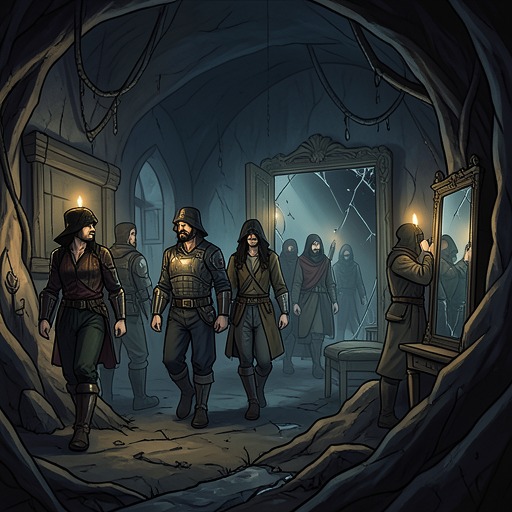
BTS’s collective existence develops within a world where bodies and memories are vulnerable to external control. Y/N is attacked for her blood, pulled through a mirror by a shadow, and injured by an enormous water snake or similar creature. The same supernatural environment threatens the members of BTS: they become involved in mirror imprisonment, bodily possession, confinement, and attempts to recover one another. Their group identity is therefore formed under pressure rather than in safety.
The narrative presents captivity as both physical and psychological. In one later sequence, Jin’s point of view describes all of them as trapped in a cell at the bottom of the castle, while the younger members repeatedly try and fail to break the cell open. The image turns BTS into a collective of prisoners whose strength is temporarily useless against the structure containing them. Their shared confinement contrasts with the group’s later domestic normality and emphasizes how radically their circumstances have been changed.
BTS also participates in the violence that makes the group threatening to Y/N. A member drinks her blood while restraining her, causing pain and terror and destroying her expectation that he can be trusted. This encounter establishes a fundamental contradiction in the group’s role: BTS may later become associated with protection and companionship, but its members are also capable of treating Y/N’s body as a source of sustenance. The group’s bond with her is consequently marked from the beginning by fear, dependence, and unequal physical power.
Powers, Sacrifice, and Memory Control
Jin’s explanation of the group’s powers reveals that BTS survives through acts of sacrifice and enforced forgetting. He states that he sacrificed his power, causing the other seven to be locked inside a mirror, and then used what remained of that power to make them forget that the other people had ever been there. This account makes memory a form of protection, but also a form of control: Jin preserves the group by removing knowledge of its traumatic history.
The same politics of memory later governs Y/N’s fate. After the supernatural conflict reaches its conclusion, Assiah tells the others that Y/N will be all right because her memory has been erased. The revelation provokes immediate shock from Jimin, Suga, and J-Hope, who ask what Assiah has done. The act separates physical survival from personal continuity. Y/N may be protected from the pain of the past, but she is also deprived of the knowledge that would allow her to understand BTS, the mirrors, and the supernatural events that shaped her life.
Memory loss therefore affects both sides of the group’s relationship with Y/N. Jin’s earlier intervention conceals a history from the members of BTS, while Assiah’s intervention conceals the same wider history from Y/N. The repeated pattern makes the group’s apparent peace inseparable from institutionalized forgetting. What looks like a new beginning is built on the removal of testimony, recognition, and shared knowledge.
Domestic Reformation and Narrative Function
The later return to ordinary life gives BTS a transformed social role. In the reconstructed setting, Y/N can wait for a bus, eat a sandwich, and observe the men as neighbors or housemates rather than as figures from a castle and mirror-bound conflict. The group is still present in her life, but the terms of that presence have changed: its members occupy familiar social positions, including student, worker, and caregiver-like housemate, instead of openly inhabiting the roles of supernatural captors or rescuers.
This ending does not resolve BTS by restoring an untouched past. It reorganizes the group around a life in which Y/N no longer consciously remembers the events that connected them. The collective survives, but its continuity is fractured between what the members know and what Y/N has been allowed to retain. BTS thus embodies the novel’s central tension between rescue and possession, community and confinement, and healing and erasure. Its final form is neither simply a family nor simply a supernatural threat: it is a group whose shared life depends on repeatedly deciding who may remember, who must forget, and what kind of ordinary future can be built afterward.