Castle Library
Living with 7 vampiresCastle Library is one of the most deceptive spaces in the vampire castle: a vast room filled with books that offers Y/N temporary refuge while repeatedly undermining any confidence that the castle can be mapped or safely understood. Its scale, maze-like arrangement, and connection with impossible passages make it both a physical location and a mechanism for disorientation, concealment, and supernatural transition.
Appearance and Internal Structure
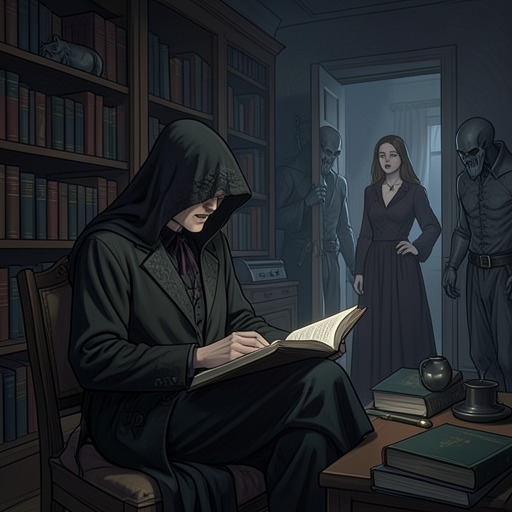
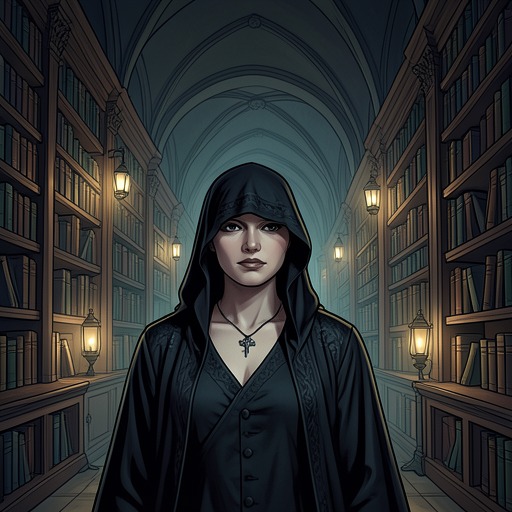
Castle Library first appears as a giant chamber behind an enormous door. Y/N reaches it after running through a hallway, closes the door, and finds a room so extensive that the initial impression is astonishment rather than safety. The library contains so many books and is arranged almost like a maze, making it possible to lose direction within the castle itself. The room’s size also changes the meaning of pursuit: even when footsteps approach the entrance, the shelves provide concealment, but they do not establish whether the pursuer has entered, since the vampires can move quietly and the door makes little sound.
The library’s apparent openness is therefore paired with practical confinement. Its many books create paths and hiding places, yet the same complexity prevents Y/N from finding a reliable route out. The space converts knowledge into obstruction: there is more to read and more territory to cross, but neither abundance supplies orientation. In this sense, Castle Library is not merely a room with books; it is a maze whose contents and architecture work together to delay escape.
Refuge, Pursuit, and Warning
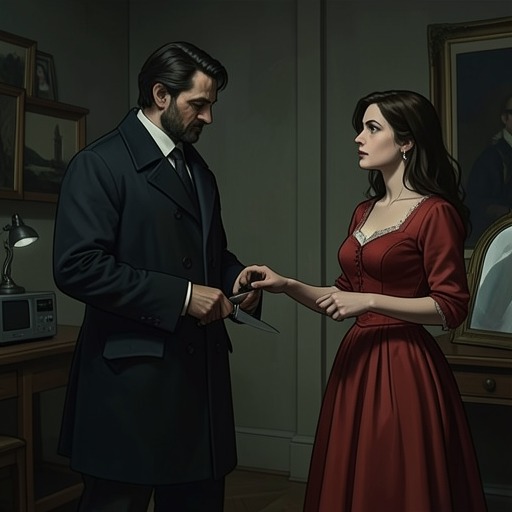
Y/N enters Castle Library while fleeing a vampire after being attacked and having blood taken. The library becomes an improvised refuge, but the pursuit remains present even when the pursuer is no longer visible. Y/N hides among the shelves without knowing whether the door has opened behind them, and the silence of the castle makes uncertainty more threatening than a clearly seen enemy. The room thus stages a recurring pattern in the narrative: escape produces only temporary distance, while every apparently protective space may also conceal the next danger.
The library also contains a direct supernatural warning. After Y/N reaches the last page of a book, a message appears: "I see you." The brief statement turns the act of reading into an act of exposure. Books, which might ordinarily promise explanation or control, become a medium through which an unseen presence demonstrates that hiding has failed. The warning is especially effective because it gives no identity, location, or route of approach; it confirms surveillance without making the threat legible.
The Library as a Repeating Threshold
Castle Library later returns through another door marked with Korean writing that Y/N cannot understand. Upon opening it, Y/N sees the library again and wonders whether the walk has led in circles. Looking back, Y/N finds that the door has already closed. The recurrence transforms the library from a single chamber into a spatial anomaly: it can be reached from different parts of the castle, and its doors do not guarantee a stable relationship between one corridor and another.
This later appearance deepens the earlier maze effect. The problem is no longer simply that Y/N cannot remember the route through a large room. The castle itself appears to fold back toward the same interior space, making movement circular and turning thresholds into unreliable instruments. Castle Library consequently occupies an ambiguous position between room and portal. It belongs to the castle’s architecture, yet its repeated appearance suggests that ordinary architectural rules do not govern it.
Connections with the Castle’s Supernatural Order
The library is connected to the wider network of transformations and crossings that defines the story. Y/N’s flight brings them into contact with the vampires’ concealed abilities: RM explains that the fastest way through the library would be flying and reveals that the owl Y/N encountered was actually RM in transformed form. The exchange links the library’s maze to vampire animal transformation, showing that its inhabitants possess forms of movement unavailable to Y/N and can navigate the space by means other than walking.
The library’s logic also anticipates later distortions of bodily and spatial identity. Elsewhere, a shadow pulls Y/N through a mirror, a mirror feels like water, and Y/N enters the mirror itself; later, a person inhabiting Jungkook’s body leads Y/N into a hallway, while Jungkook identifies the figure from the other world who changed into Jin. These events are not located in Castle Library, but they clarify the kind of threshold the library represents. In a story where bodies can be occupied, mirrors can become passages, and rooms can recur behind unexpected doors, the library is an early architectural expression of the same unstable world.
Narrative Significance
Castle Library concentrates the book’s Gothic use of space. It is grand enough to inspire wonder, enclosed enough to produce fear, and obscure enough to hold secrets that cannot be reached through ordinary searching. Its shelves promise records and answers, while its maze structure frustrates access; its door offers protection, while its silence leaves Y/N exposed; its books permit reading, while the message "I see you" reverses the direction of observation and makes the reader-like character the observed object.
The location also reflects the story’s repeated movement between refuge and captivity. Y/N reaches it by escaping pursuit, yet becomes lost inside it. The library can be entered from a corridor, revisited through a strangely labeled door, and potentially navigated by a vampire in animal form, but none of these routes grants Y/N mastery. Its decisive function is to teach that the vampire castle is not a stable shelter with hidden rooms; it is an active, disorienting environment in which knowledge, movement, and safety are continually compromised.