Destroying the Mirrors and Releasing the Green-eyed Ones
Living with 7 vampiresDestroying the Mirrors and Releasing the Green-eyed Ones is a decisive reversal in the supernatural conflict. What appears to be a successful attempt to eliminate the mirrors becomes, in Jimin’s interpretation, the act that releases the Green-eyed ones from their confinement. The event shifts the central value from apparent safety to renewed danger: the objects believed to contain the threat are destroyed, but destruction may have removed the barrier protecting the living world.
The Destructive Hypothesis
Jimin develops the theory after Y/N confirms that the mirrors are not the only way into the other realm. He first recalls that the group destroyed all the mirrors, then hesitantly suggests that this action may have set the Green-eyed ones free. His uncertainty is important because the release is not presented as a confirmed plan or witnessed mechanism at first; it emerges as a frightening deduction from the group’s own earlier actions.
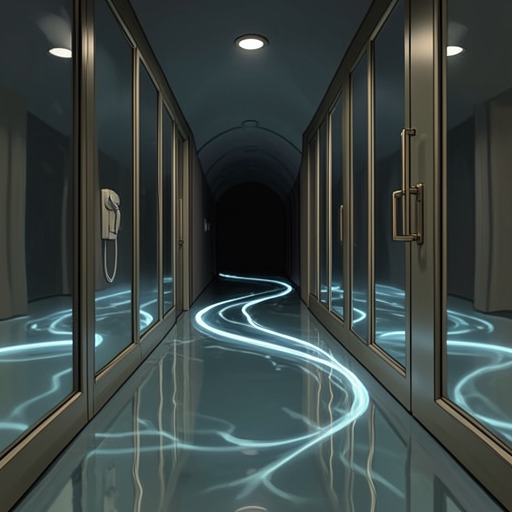
The theory turns the mirrors from passive objects into containment structures. Earlier, a shadow pulled Y/N through a mirror whose surface felt like water, carrying her inside it. That experience establishes that the mirrors function as entrances as well as boundaries. Jimin’s later reasoning extends that function: if the mirrors held the Green-eyed entities, destroying them may have broken the prison rather than erased the prisoners.
Recognition of the New Threat
Y/N immediately understands the consequence of Jimin’s theory. If destroying the mirrors released the Green-eyed ones, they could already be present in the castle or in the surrounding world. The danger therefore changes from a threat located behind a visible surface to an enemy whose location is no longer secure or identifiable. Jimin adds that V is probably still present as well, linking the release of the entities to the unresolved disappearance of one of the group’s members.
The scene produces a sharp value shift. The destruction of the mirrors initially promises liberation from the mirror-bound threat; Jimin’s explanation converts that apparent victory into exposure. The brief awkward silence before Y/N voices the implication marks the moment when action becomes knowledge. The characters are forced to confront the possibility that their attempt to protect themselves has widened the conflict.
Escalation Toward Gehenna
The consequences of the release extend into a larger cosmology. Later, Bambam identifies Gehan as the ruler of Gehenna itself, while Jinyoung explains that humans call Gehenna Hell. This revelation places the Green-eyed conflict within a hierarchy of supernatural power rather than treating it as an isolated haunting. The destroyed mirrors are consequently connected to forces whose reach includes possession, imprisonment, and control over passage between worlds.
The imagery that follows intensifies this escalation. A blood-red moon descends over Y/N while she is immobilized, transforming the sky into an apparent instrument of ritual power. Y/N then takes a glass ball from one of Gehan’s pockets, pushes him away, and concentrates on making the gates of Hell appear; the resulting rumbling signals a direct attempt to reopen or summon a passage to Gehenna. The event’s earlier uncertainty thus develops into an active struggle over gates, objects, bodies, and realms.
Release, Possession, and Recognition
The release is also associated with unstable transformations of identity. A blue bubble reappears and changes into a human form: Y/N’s mother. Her appearance connects the supernatural crisis with Y/N’s family history, while her worried question about what has happened confirms that the scene has crossed from hidden danger into visible manifestation. The mother is not simply remembered; she appears as part of the altered reality produced by the conflict.
Assiah later explains that Y/N had been possessed by her own power. This clarification complicates the event’s meaning. The danger is not only that the Green-eyed ones may leave the mirrors and possess others; Y/N herself can become the site where supernatural power takes control. The boundary between victim, vessel, and source is therefore unstable, and the release of external entities parallels the emergence of forces within Y/N.
Aftermath and Significance
The aftermath remains marked by injury and inherited control. Bambam has a hole through his chest from trying to stop Y/N, and Assiah discovers Gehan’s mark on his wrist. By touching the mark and concentrating on its energy, Assiah identifies the group’s condition as a curse that has lasted too long. The consequences of the mirror destruction are therefore bodily as well as spatial: escape from one form of imprisonment is followed by possession, wounds, markings, and renewed dependence on supernatural authority.
As a narrative event, Destroying the Mirrors and Releasing the Green-eyed Ones overturns the expected logic of victory. The mirrors are not merely doors to be closed or obstacles to be broken; they are material objects whose destruction changes the distribution of power. Their disappearance removes a visible boundary, frees an unseen enemy, and prepares the later confrontation involving Gehenna, the blood-red moon, Y/N’s uncontrolled power, and the effort to break Gehan’s curse. The event’s lasting significance lies in that reversal: the characters do not defeat the threat by destroying its container, but discover that the container was also the last protection against it.