Green-eyed ones
Living with 7 vampiresThe Green-eyed ones are a collective supernatural antagonistic force defined by concealment, possession, coercion, and a persistent interest in Y/N. They are not merely a recurring visual menace: they operate as a faction with a shared objective, use shadows and deceptive appearances to pursue it, and turn the boundaries between bodies and worlds into instruments of control. Their presence repeatedly converts spaces that should offer safety into sites of surveillance, pursuit, and uncertain identity.
Nature and Objectives
The clearest explanation of the Green-eyed ones comes from Jin, who tells Y/N that they want her to set them free and warns her never to trust them. This disclosure gives their attacks a concrete purpose. Their interest in Y/N is therefore not limited to feeding, revenge, or simple capture; she is valuable because she may provide access to their liberation. The warning also establishes that the vampires understand the Green-eyed ones as a distinct danger rather than as random creatures encountered in the supernatural worlds.
Their objective is connected to imprisonment. When one of their figures confronts Y/N, it condemns her for having denied them and reacts with fascination to the destruction that follows. The wording presents refusal as an obstacle in an ongoing negotiation or struggle, while the speaker’s interest in what Y/N has done suggests that the faction is studying her capacity as much as trying to overpower her. Their power is consequently both strategic and investigative: they pressure Y/N while learning what she can become.
Methods of Pursuit and Deception
The Green-eyed ones act through shadows and unidentified figures rather than through a stable, openly declared appearance. In one pursuit, voices order Jin to release Y/N and command her to come with them, after which shadows begin moving after the pair. The scene makes their threat collective. Even when only one presence speaks, the surrounding shadows imply that the encounter is backed by a larger group capable of surrounding and herding its targets.
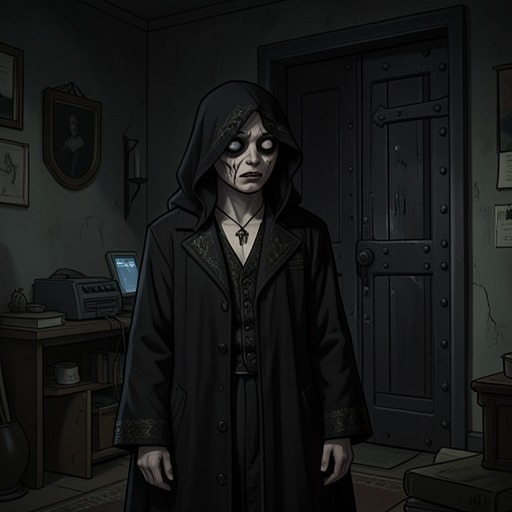
Their methods also undermine ordinary distinctions between a person and a supernatural manifestation. A figure appears to melt until it becomes a small puddle on the ground, and another presence immediately treats the result as evidence of Y/N’s dangerous potential. Such transformations make the faction difficult to read through human categories of body, death, or disappearance. The Green-eyed ones can present themselves as people, shadows, or unstable physical forms, and that uncertainty supports Jin’s insistence that they cannot be trusted.
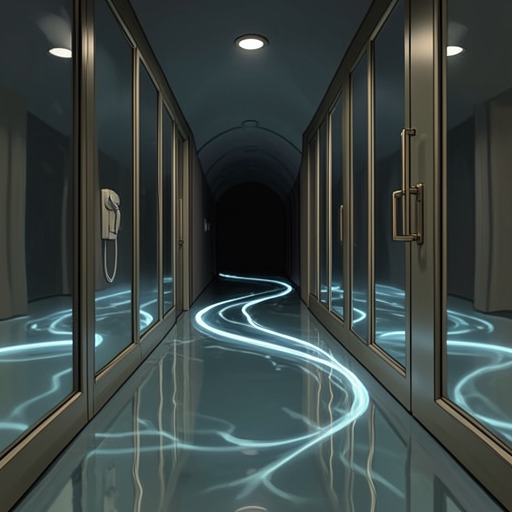
The mirror is one of their most important tools, but it is not their only route. Y/N reports that the Green-eyed ones told her the mirror is not the only entrance, a clue that expands the threat beyond a single portal or chamber. The statement changes the strategic meaning of every boundary in the story: sealing or watching a mirror cannot guarantee safety if the faction can enter by other means. Their knowledge of entrances also suggests that they possess a wider understanding of the interconnected worlds than Y/N and the vampires initially do.
Conflict with Y/N and the Vampires
The Green-eyed ones repeatedly make Y/N the center of conflict. A green-eyed shadow is seen among the trees while Y/N is with Jin and another version of herself. The shadow first appears to have fled as before, but Y/N then realizes that it is not watching the other Y/N; it is watching her. This moment turns observation into selection. The faction can distinguish the relevant Y/N from an apparent double, and its attention confirms that her identity, rather than merely her location, is the object of pursuit.
The vampires respond by investigating the Green-eyed ones and searching for clues in their territory. Jin explains that he and the others are there to learn more about them, while Jimin and V are allowed to help on the condition that they do not damage anything. The investigation gives the faction an institutional dimension: it possesses a hidden environment or body of evidence substantial enough to be examined, and the vampires must treat that environment as dangerous but intelligible. Y/N’s partial testimony becomes a crucial clue because it links the faction to entrances beyond the mirror and to the demand for release.
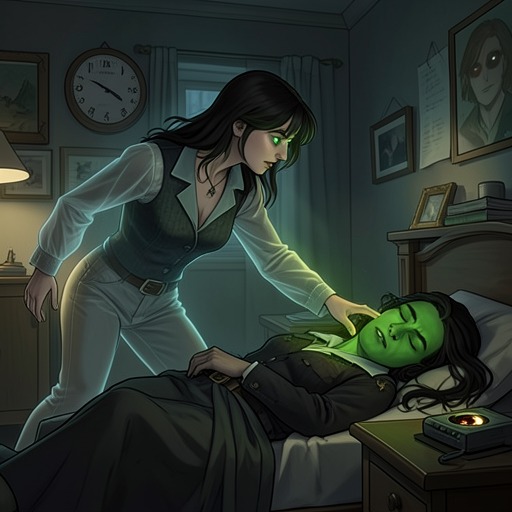
The faction’s pressure also exploits uncertainty within Y/N herself. She initially understands herself through the language of a human captive, while the Green-eyed ones and the vampires treat her as a blood vessel, a possible key, or a source of unusual power. Her decision to save the imprisoned companions rather than continue prioritizing the mystery of her parents marks a direct challenge to that logic. The Green-eyed ones attempt to make her body and origins serve their liberation; Y/N begins to define her own value through chosen action.
Recurrence and Narrative Function
The Green-eyed ones form a repeating pattern of absence and return. Y/N’s abandonment by her mother leaves her isolated before she understands the supernatural forces around her, and J-Hope later finds her after she has run away. The death of her adoptive mother then exposes the violence surrounding her, while the discovery that she may not be her mother’s biological daughter opens a deeper question about who abandoned her and why. Against this background, the Green-eyed ones give form to the story’s recurring crisis of origin: whenever Y/N seeks an answer about who she is, another power tries to possess or redirect that answer.
Their threat is especially effective because it overlaps with other structures of dependency. V reduces Y/N to the question of who is the only available human blood vessel, while Y/N rejects that label. The Green-eyed ones intensify the same objectifying pressure on a larger scale by treating her as the means of their release. Yet the plot does not leave her in that position. When she later breaks a chain with a simple movement of her right arm, her sudden strength frightens Gehan, and she challenges the attempt to claim her power. The scene suggests that the pattern established by the Green-eyed ones—capture, restraint, and instrumental use—can be reversed when Y/N recognizes and controls her own capacity.
The faction therefore functions as both antagonist and structural shadow. It follows Y/N through forests, mirrors, hidden rooms, and contested passages; it appears at the edge of scenes before its aims are fully explained; and it repeatedly turns knowledge into danger. Its partial revelation is more important than a complete catalog of its powers. The Green-eyed ones are defined by what they conceal, by the entrances they know, and by the freedom they seek, while Y/N’s developing resistance gradually prevents their desire for liberation from becoming the final definition of her identity.