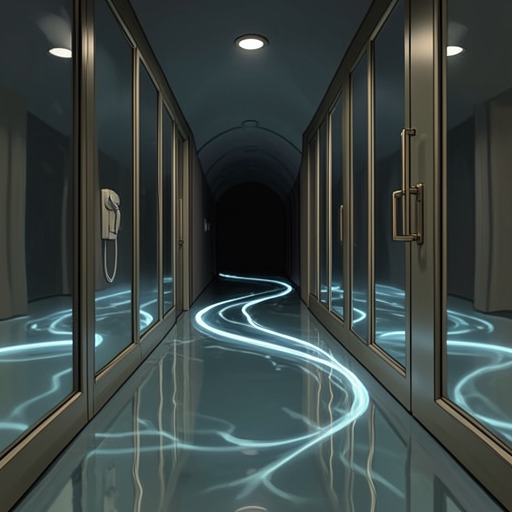
Human blood donation opens the mirror door rules
Living with 7 vampiresThe human-blood requirement for opening a mirror portal is one of the story's clearest supernatural mechanisms of control. A key may unlock the first door, but blood is needed to activate the next passage, making Y/N's body both the means of escape and the resource consumed by the system. The rule converts a route to freedom into repeated forced bleeding and places Y/N in an unequal exchange with the inhabitants of the house.
Definition and Operation
Y/N first uses the key to open a door whose room is completely black rather than glowing like the bird and the doorway. A luminous bird guides her toward another door with a small platform attached where a lock would ordinarily be. When Y/N asks whether that mechanism also needs to be opened, the bird confirms that it does. There is no handle to grasp, so the ordinary function of a key cannot complete the passage. The door instead requires a living blood offering.
The bird becomes the immediate instrument of the rule. After sitting on Y/N's wrist, it pierces her skin with its beak and enlarges the wound, causing pain when Y/N protests. She slaps it away, but the bird returns, takes one of her fingers in its mouth, and drags her toward the small bowl-like platform. It turns her wrist so that blood runs from her hand into the receptacle, then stops only after the bowl is full. The mechanism therefore has a precise threshold: a partial wound is insufficient, and the passage does not respond until the designated container has been filled.
Coercion and Repetition
The blood requirement is not a single sacrifice that permanently solves the problem. Jin warns Y/N that when the door closes again, she will have to fill the bowl with human blood once more. He identifies the rule's social consequence as well as its magical one: Y/N appears to be the only human in the house, so the burden falls exclusively on her. The inhabitants can hear her from outside, yet they cannot enter because breaking the door is impossible. Their awareness of her danger does not remove the mechanism's demand; it leaves Y/N isolated inside a sealed space with her blood as the only available key.
The later repetition confirms that the rule governs more than one passage. RM helps Y/N hold her wrist above another tiny bowl, while Suga watches the blood with hunger in his eyes. As with the bird, Y/N must continue until the bowl is full. This time there is no bandage, so the wound remains uncovered. The repeated procedure links the portal system to vampire appetite: the same blood that activates passage also exposes Y/N to predation, and the opening ritual can place her in danger even when another person is assisting her.
Consequences for Y/N
The rule makes movement inseparable from bodily injury. Y/N enters the dark room seeking a way forward, but the available route demands that she surrender control of her own body. The bird's actions show that the mechanism is enforced physically rather than explained through a voluntary ritual: it wounds her, enlarges the opening, and directs the blood into the bowl. Her cries and attempt to resist do not alter the requirement. The apparent promise of escape is thus reversed into another confinement, because access depends on compliance with a system that can be activated only through pain.
The danger also extends beyond the portal itself. Earlier, Y/N is attacked when a vampire drinks her blood, and elsewhere she is injured by an enormous water snake. These episodes establish blood as a recurring point of vulnerability, but the portal rule gives it an additional function. Blood is not merely something others consume; it is also a credential, payment, and living power source. That overlap makes every wound ambiguous. It may signal attack, enable passage, or attract a vampire, and Y/N cannot safely separate one consequence from another.
Narrative and Thematic Significance
The rule creates a harsh contrast between mechanical access and human freedom. The key suggests possession and choice: Y/N has an object capable of opening a door. The bowl overturns that expectation by revealing that the decisive key is not an object at all but a human body. The bird, the sealed door, and the impossible prospect of breaking through form a small ritual structure in which Y/N is first guided, then injured, then compelled to complete the offering. The resulting passage is less an act of exploration than an enforced exchange.
Its wider significance lies in the way the house organizes power. Because Y/N is the only human, the rule turns her into a uniquely valuable and exploitable resource. The vampires' hunger and the portal's operation converge around the same substance, so protection cannot be assumed to be benevolent: those who help her cross may also be tempted by what the crossing requires. The mechanism repeatedly returns the story to the question of whether safety can exist when survival depends on surrendering the very blood that makes Y/N vulnerable. In that sense, the human-blood requirement is not only a fantasy-world rule. It is the house's governing principle of access, making every threshold a negotiation between confinement, injury, and the possibility of escape.