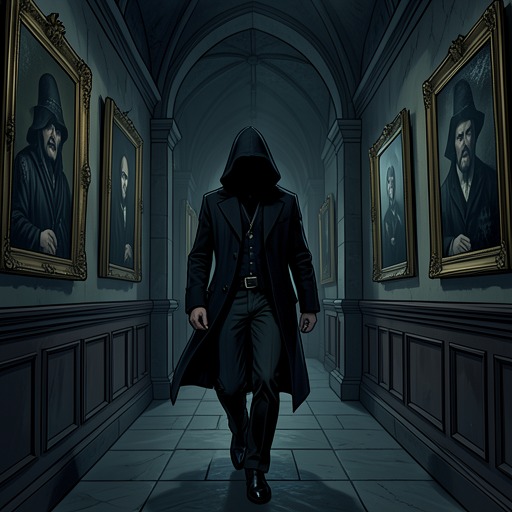
Jackson
Living with 7 vampiresJackson is a recurring green-eyed figure who functions as both captor and deceptively familiar intermediary in Y/N’s passage through the supernatural world. His first clear introduction comes after a giant bird carries Y/N away and sets her down: the person seated above her identifies himself as Jackson. From that moment, his name becomes associated with forced movement, concealed plans, and a dangerous friendliness that repeatedly masks the faction’s intentions.
Identity and Introduction
Jackson enters the narrative through transformation and disorientation rather than through an ordinary social meeting. Y/N has been taken into the mirror and transported through an unfamiliar environment when the giant bird carrying her finally lands. Only then does she see the figure on top and learn his name. The introduction establishes two aspects of his identity at once: Jackson can participate in the world’s animal-like forms, and he is already involved in moving Y/N for purposes she has not been told.
The secrecy surrounding that movement is immediately reinforced by the conversation that follows. Someone calls to Jackson and asks whether he has brought the “thing” with him; Jackson confirms that Y/N is there. The language reduces her to an object before she understands the situation, making his introduction inseparable from the faction’s habit of treating her as something to be delivered, possessed, or used. When Jackson later explains that he had been sent to pick her up because the others had not told him the reason, the exchange also presents him as embedded in a group whose members coordinate Y/N’s capture casually, even while they complain about his tendency to run off with Yugyeom.
Methods and Repeated Encounters
Jackson’s conduct combines playfulness with coercion. When he encounters the transformed V and other animals, he wonders aloud whether they are new animals, then recognizes V’s growl as a sign that the creature is not friendly. He also says that he can smell Y/N again, or that her scent may still be caught on the feathers. The remark shows that his pursuit is not accidental: Y/N’s presence is tracked through a bodily trace, and Jackson can connect that trace to the animal form used during her transportation.
His attitude remains flippant when the conflict becomes direct. During a confrontation in which J-Hope refuses to hand Y/N over, Jackson complains that J-Hope is making a scene. The line places him on the side demanding possession of Y/N, but his tone turns the threat into an apparently minor social inconvenience. That contrast is central to his characterization. Jackson does not need to announce himself as a solemn villain; he makes danger harder to read by treating abduction and resistance as routine interruptions.
Jackson’s reach also extends beyond immediate pursuit. When the green-eyed beings complain that Y/N has locked them in completely and had seemed capable of setting them free, the accusation places him within a larger history of imprisonment and frustrated liberation. The episode does not establish every detail of Jackson’s prior role, but it confirms that his group views Y/N as connected to their freedom and that Jackson belongs to the antagonistic network whose interests converge on her powers and choices.
Relationship with Y/N
Y/N repeatedly recognizes Jackson before she can safely interpret him. While hungry and isolated, she remembers his face, and Jackson appears smiling after hearing that someone wants food. His arrival can therefore resemble assistance, especially because hunger makes Y/N vulnerable to any offer of care. Yet the scene’s menace lies in the gap between the comfort suggested by his smile and the history of capture attached to his name.
Jackson also uses humor to control Y/N’s fear. During one escape or fall, Y/N believes she is going to die, but a giant leaf catches her. Jackson laughs and asks whether she really thought she would die. The rescue is thus made conditional on his presence and narrated as a joke at her expense. He can prevent immediate harm, but he remains part of the system that has placed her in danger, so even his apparent protection reinforces dependence rather than freedom.
The recurring morning encounters deepen this uneasy familiarity. Jackson greets Y/N cheerfully, smiling as usual, and grabs the chain around her neck. The gesture is more revealing than his greeting: the object associated with Y/N’s identity and movement is treated as something he may handle. His friendliness does not erase the physical claim implied by touching the chain; it makes that claim appear ordinary. Jackson’s relationship with Y/N is consequently structured by recognition without trust, repeated contact without consent, and care that never becomes unequivocal rescue.
Conflict, Transformation, and Narrative Function
Jackson’s animal transformation gives the green-eyed faction a mobile and unpredictable form. He can carry Y/N through spaces inaccessible to her and can return to the group after locating or identifying her. The transformation is not merely decorative: it changes the balance of power by making Y/N dependent on a creature capable of flight, while also obscuring the identity of the person controlling that movement.
His actions parallel the broader pattern of the story, in which Y/N is repeatedly transferred between groups that possess more knowledge and supernatural power than she does. Jackson helps convert that pattern into a cycle of apparent rescue followed by renewed confinement. He is present when Y/N is treated as a “thing,” when her scent is used to locate her, when the opposing vampires resist surrendering her, and when her chain is handled as though her freedom were negotiable.
Jackson’s presence also links personal scenes to the faction’s larger struggle. The calls for Y/N, the references to imprisonment and freedom, and the later insistence that the green-eyed beings have been sealed away all suggest that his behavior belongs to a conflict larger than an individual chase. In the climactic struggle, Y/N pushes Gehan away and summons the gates of hell, demonstrating that the power the green-eyed faction sought to control ultimately exceeds their ability to contain it. Jackson is not shown as the final defeated opponent in that moment, but his earlier role is recontextualized: the cheerful carrier and smiling visitor were agents of a system whose claims collapse when Y/N takes control of her own power.
Significance
Jackson is significant because he gives the green-eyed threat a recognizable, recurring face without making that threat straightforward. His name becomes familiar to Y/N before his motives become trustworthy, and that familiarity is repeatedly exploited through jokes, greetings, animal transformation, and the performance of casual concern. He embodies the story’s unstable boundary between aid and captivity: the same figure may carry Y/N, catch her with a leaf, track her scent, demand her surrender, or handle the chain at her neck.
Through Jackson, the narrative makes identity a matter of performance and recognition. Characters are encountered as humans, animals, shadows, or green-eyed possessors, while Y/N must continually revise what she thinks she is seeing. Jackson’s apparent warmth therefore operates as a mask rather than a moral transformation. His enduring narrative function is to keep the danger socially legible but emotionally confusing, ensuring that the threat does not arrive only through violence; it also arrives smiling, introducing itself, and asking whether someone has brought the girl.