Magic Mirror
Living with 7 vampiresMagic Mirror is one of the story’s decisive supernatural objects: a reflective surface that functions as a portal, a map, a barrier, and a stage for encounters with beings from beyond the ordinary world. Its importance lies in the way it converts an apparently familiar household object into an active force. Y/N does not simply look into it; the mirror pulls Y/N inside, opens routes that cannot be found by ordinary movement, and makes the boundary between observer and observed dangerously unstable.
Appearance and First Significance
Magic Mirror first emerges within a chain of clues involving a closed book and a key. Y/N sees a book on a desk, notices words on its cover, finds that the associated object is a key, and then places the book back on the table. These details establish a material network in which books, keys, and mirrors carry information and access rather than serving as ordinary possessions. The book later turns its own pages and opens to a map, reinforcing the sense that the objects are participating in the discovery of a hidden geography.
The mirror’s decisive property is revealed when it pulls Y/N inside. This action changes the object’s status completely. A surface that should return an image instead becomes an entrance capable of exerting force on a person. The event also gives physical form to one of the story’s central warnings: the mirror is not the only entrance. The statement means that the mirror belongs to a larger system of passages, but it does not make the mirror harmless or secondary. It remains the most visible and immediate point at which the ordinary world can open into the unknown.
Portals, Barriers, and Hidden Routes
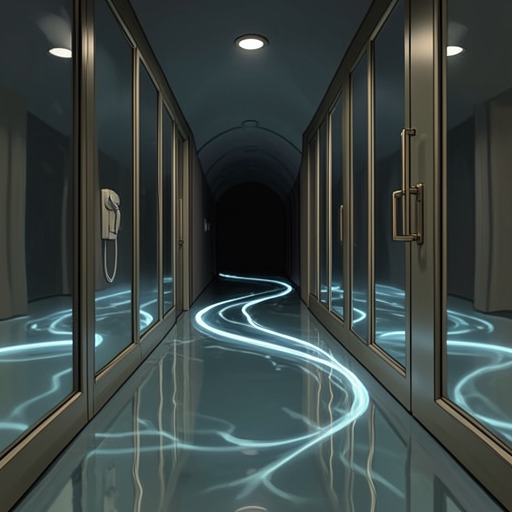
Magic Mirror governs movement through spaces that do not obey ordinary architectural logic. In one sequence, the door leading toward the bedrooms of the green-eyed beings is gone, while Jimin feels a doorknob where no visible door appears. The missing door and the sensed handle make the environment dependent on concealed thresholds: passage exists, but it is not always available to sight. The mirror therefore works in conjunction with absence. What disappears from the wall may survive as a sensation, a reflected possibility, or a route that must be discovered through another object.
The shifting architecture returns the characters to the place where the door to the hallway was supposed to be. At the same time, the book turns its pages without human assistance and reveals a map. The book supplies orientation, while the mirror supplies access; together they form a mechanism through which knowledge and movement are inseparable. A map does not merely describe the hidden world, and a mirror does not merely display it. Each changes what the characters can do.
The mirror is also linked to acts of observation. Someone points at it, Y/N’s eye falls upon it, and a woman walks out of the mirror. The sequence reverses the expected direction of vision and passage. The person who looks may become exposed, while the figure inside may become the one who crosses outward. Leah’s appeal to leave together follows this appearance and gives the mirror a further relational function: it is a site where escape can be proposed, endangered, or imagined, not merely a neutral doorway.
The White Room and Repeated Passage
Magic Mirror’s operation recurs in the white room, where Y/N stands before several mirrors and approaches one of them. Y/N touches the surface, first putting a hand through it. This gradual testing presents the mirror as materially deceptive: it looks solid enough to approach, yet yields when contact is attempted. The hand passing through marks a boundary crossing before the whole body necessarily follows, making the object’s supernatural operation visible through a small, concrete gesture.
Later, Y/N looks back at the mirrors, and all four suddenly turn completely white. The change from reflective surface to blank whiteness removes the visual information on which the characters depend. The mirrors are no longer showing a route, a figure, or a recognizable world; they become sealed or unreadable surfaces. Their whitening therefore carries a double consequence. It may interrupt access, but it also demonstrates that the mirror’s appearance is itself unstable and subject to forces beyond Y/N’s control.
The recurrence of the white room and the four mirrors gives the object a cyclical role in the narrative. Y/N repeatedly returns to a space of thresholds, tests the boundary with a hand, and confronts surfaces that may reveal or erase. The repetition does not make the crossings routine. Instead, it emphasizes that each encounter with the mirror reopens the question of whether perception provides knowledge or merely invites another danger.
Conflict, Power, and Gehenna
Magic Mirror’s passages connect the personal mystery surrounding Y/N to the larger conflict involving the green-eyed beings and Gehenna. The object is associated with hidden rooms, missing doors, unexpected arrivals, and movement between worlds, while the wider plot eventually identifies Bambam as the ruler of Gehenna itself. In this setting, the mirror is not simply a magical convenience. It is part of the infrastructure through which supernatural power reaches Y/N and through which characters attempt to escape confinement or pursue one another.
Its relation to power becomes especially clear when Gehan stands in the middle of a circle on the ground and stops. Y/N later pushes Gehan away and concentrates on making the gates of hell appear. Although the gates are summoned through Y/N’s will rather than described as a mirror opening, the scene places the mirror’s threshold logic beside a more direct command over portals and infernal space. The story repeatedly treats boundaries as things that can be opened, closed, removed, or forced. Magic Mirror is the most tangible expression of that system, but it is not the system’s only form.
Narrative and Thematic Function
Magic Mirror embodies the collapse of stable distinctions: inside and outside, image and body, object and agent, knowledge and danger. Its material presence is initially ordinary enough to be looked at, pointed toward, or approached, yet its behavior repeatedly exceeds the expectations attached to a household mirror. When it pulls Y/N inside, allows a person to walk outward, or turns entirely white, it makes its physicality impossible to ignore. The object becomes most visible precisely when it stops functioning as an ordinary object.
The mirror also organizes the story’s treatment of memory and identity. The closed book, the key, and the map suggest that hidden origins can be approached through objects, but the mirror complicates that search by refusing to offer a single stable view. A reflection might be an entrance, a person might emerge from it, and a blank surface might replace all available clues. In this way, the mirror does not merely symbolize uncertainty; it produces uncertainty through concrete operations that alter where characters can stand and what they can know.
Its most consequential rule is therefore also its most unsettling one: the mirror is not the only entrance. The warning prevents the object from being reduced to a single gateway and broadens the danger to the surrounding world. Doors can vanish, handles can be felt without being seen, books can reveal maps by themselves, and infernal gates can be summoned elsewhere. Magic Mirror remains the story’s clearest emblem of these unstable thresholds, a familiar surface transformed into an active participant in escape, pursuit, revelation, and supernatural conflict.