Middle Ages
Living with 7 vampiresMiddle Ages functions less as a continuously depicted historical setting than as a temporal reference point that gives the story’s bodily horror and supernatural history a recognizable human past. Its clearest association is the Black Plague, described as a disease from the Middle Ages that rots the body. At the same time, the narrative’s treatment of time is unstable: dates appear in a discovered diary, spaces collapse through mirrors, and memories can be sacrificed, erased, or restored. The period therefore becomes both a historical measure of physical suffering and a contrast to the story’s supernatural manipulation of chronology and remembrance.
Historical Reference and Bodily Horror
Middle Ages enters the narrative through Y/N’s recognition of the Black Plague. When a character’s legs are black and purple, covered with holes, and visibly deteriorating, Y/N identifies the condition as Black Plague and associates it with the medieval period. The accompanying explanation presents it as a disease from the Middle Ages that rots the body, making historical knowledge part of the scene’s immediate horror rather than distant background.
This reference gives the damaged body a double meaning. The illness is materially described through discoloration, open wounds, and the appearance of dying flesh, but it also carries the weight of an older historical catastrophe. The medieval association intensifies the sense that the characters are confronting something archaic and difficult to contain, even within a world already shaped by vampirism, transformation, and supernatural powers.
Time, Records, and Discovery
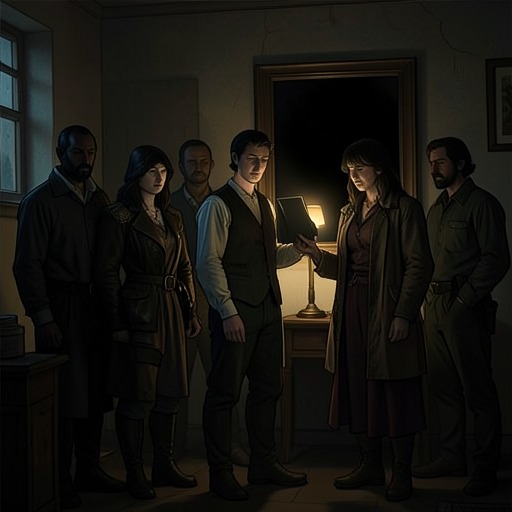
The narrative does not establish the Middle Ages through a sustained historical chronicle. Instead, its past is encountered in fragments and through objects. Y/N unlocks a book with a key, opens it, and begins reading an entry dated 14 April. The diary format turns time into something physically stored and later recovered: the past is not simply remembered by a narrator but accessed through a locked text whose contents can alter the reader’s understanding of events.
This recovered record contrasts with the abrupt shifts produced by the supernatural world. After a mirror disappears, Y/N closes and reopens their eyes and finds themself back in their room, where V is present. The sequence makes location and chronology feel provisional. A passage through the mirror can end without ordinary travel, while the diary fixes a date even as the broader history remains uncertain. The result is a layered temporal structure in which written time, lived time, and supernatural time do not fully coincide.
Memory and Temporal Control
Time in the story is also governed by the power to remember or forget. Jin explains that he sacrificed his power to lock the other seven figures inside a mirror. Because they had been badly wounded, he used the last of that power to make them forget what had happened and even forget that other people had ever been there. The past is consequently not merely hidden; it is actively rewritten by a character who treats memory as a protective and imprisoning force.
Later, the entire room turns white and Y/N returns to the place with four mirrors, reinforcing the recurring movement between present surroundings and an enclosed supernatural space. Assiah makes the politics of memory explicit by telling the others that she erased Y/N’s memory. This act changes the meaning of the preceding history: what appears to be resolution may instead be a controlled reset in which knowledge of the past is removed from the person most affected by it.
Bodies, Blood, and Historical Continuity
The medieval disease reference belongs to a wider pattern in which the body becomes the principal surface on which time and power are recorded. Y/N experiences blood being taken directly from the body, while an examination later reveals numerous holes that Jin falsely attributes to a biting cat. A water snake causes another sharp injury to Y/N’s leg, and a chain around a transformed figure’s neck remains visible even after the seal changes that figure into human form. These details connect supernatural history to physical marks that persist across states of transformation.
Jin’s own body also demonstrates the instability of apparent recovery. His face and eyes become normal, but he stands frozen, shakes, and discovers that his hands are covered in blood. The contrast between a restored-looking face and unmistakable evidence of violence makes the body an unreliable guide to the past: outward normality can conceal what has happened, just as erased memory can conceal an entire episode.
Narrative Significance
The Middle Ages is significant because it supplies the story with a historical vocabulary for decay while the plot questions whether any past can remain stable or fully knowable. The Black Plague represents a remembered human catastrophe whose effects are legible in the body; the diary represents a past preserved in writing; the mirrors represent passages that disrupt ordinary sequence; and Jin’s and Assiah’s powers represent memory as something that can be sealed, sacrificed, or erased.
That combination makes the medieval reference more than decorative period language. It anchors the narrative’s supernatural violence in a recognizable history of disease and mortality, then places that history inside a world where bodies change, identities are possessed, and recollection can be deliberately removed. The past remains consequential even when characters cannot access it directly, because wounds, blood, objects, and altered spaces continue to expose what memory has been forced to conceal.