Mirror Portals
Living with 7 vampiresMirror Portals are not merely reflective surfaces but unstable passages through which bodies, beings, and knowledge move between otherwise separate spaces. Their decisive significance lies in their double function: they offer access to the mirror world and other hidden locations, yet they also expose Y/N and the vampires to capture, deception, and imprisonment. Because the portals can appear as ordinary mirrors, concealed doors, or waterlike surfaces, the boundary between a safe room and an alien realm is never materially secure.
Definition and Physical Behavior
Mirror Portals are repeatedly described as having the appearance and resistance of water. When Y/N is pulled into one, the surface does not behave like solid glass; it yields as though it were liquid, and Y/N finds themself inside the mirror rather than merely looking through it. This fluidity gives the portals a bodily quality: passage requires contact, and the boundary can seize a person as readily as it can receive one.
The portals are also not limited to conventional wall-mounted mirrors. In one setting, a doorway leading toward the bedrooms associated with the green-eyed beings disappears, only for Jimin to discover a doorknob concealed within the wall. When the clicking mechanism is activated, the wall opens like a door and reveals the same hallway with the bedrooms. This hidden entrance expands the portal system beyond visible reflective objects. The castle’s architecture itself can conceal a passage, making access to the green-eyed domain a property of the building as much as of the mirrors.
Passage, Abduction, and Rescue
The most violent demonstration of a Mirror Portal occurs when Jin’s body falls to the ground while a shadow remains standing and holding Y/N’s wrist. The shadow pulls Y/N inside the mirror, and the waterlike surface carries Y/N into the mirror world. The portal therefore operates as an instrument of forced transport: the victim does not choose the crossing, and the mirror becomes an extension of the attacker’s grasp.
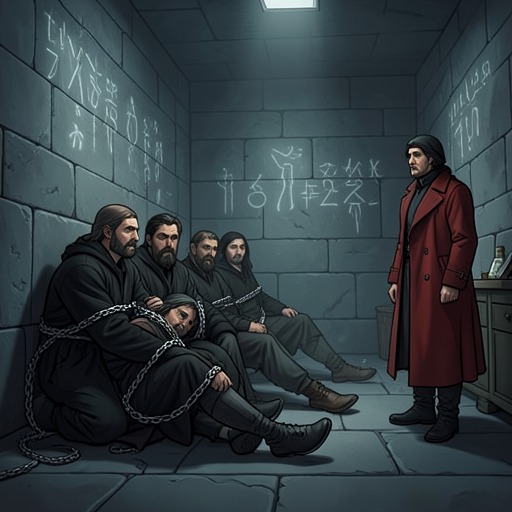
The same network also becomes central to attempts at retrieval. After Jimin reasons that the mirrors may not be the only entrances, the group searches a concealed hallway for V and later finds Jimin and V sitting inside a bubble. The portal-related spaces thus connect investigation with captivity. They allow the group to reach locations that ordinary movement cannot explain, but they do not guarantee that anyone found there can be freed safely.
Mirror Portals also introduce uncertain encounters. While Y/N is watching a mirror, Leah walks out of it and identifies herself after bowing slightly. Her emergence reverses the earlier pattern of Y/N being dragged inward: the reflective surface can release a person into the ordinary world as well as absorb one from it. Yet the reversal does not make the threshold trustworthy. A portal remains a point at which an unfamiliar being can cross without warning, and Y/N’s attention is repeatedly drawn back to the mirror even when companions are calling for Y/N to follow them.
Memory, History, and Alternative Access
Later, a series of objects that first resemble paintings are recognized as mirrors. Y/N approaches one and touches its surface, which again feels like water. The mirrors appear to contain or display scenes connected with the vampires’ past, prompting Y/N to wonder whether the selected surface represents their history. This use makes the portals archival as well as spatial: they do not only transport people, but also provide access to concealed memories and earlier states of the story.
Y/N tests the threshold cautiously by placing a hand through it before climbing inside. Unlike the earlier abduction, this crossing is deliberate, and Y/N does not enter a bubble before emerging on the other side. The destination is a street, showing that the portals can open onto ordinary exterior locations as well as supernatural interiors. Their geography is therefore discontinuous: a mirror may connect a room to the mirror world, a hidden corridor to the green-eyed bedrooms, or a reflective image to a street associated with the past.
The discovery that mirrors are not the only entrances changes the group’s understanding of the threat. Jimin identifies the possibility that destroying the visible mirrors may have had an unintended effect. His theory is that the destruction of all the mirrors may have set the green-eyed beings free. The portals are consequently linked to containment as well as movement: a mirror can function as a prison, but breaking the prison may remove the barrier that kept its inhabitants confined.
Consequences and Narrative Significance
Mirror Portals make spatial boundaries unreliable. A door can vanish and reappear as a concealed opening; a wall can become a doorway; a mirror can become water; and a person can emerge from a surface that appeared to be an object for looking rather than entering. This instability forces Y/N and the vampires to treat architecture as potentially active. Rooms cannot be understood solely by their visible entrances, and destruction cannot be assumed to equal victory.
The portals also organize the story’s tension between knowledge and danger. Y/N first encounters the mirror as a means of involuntary capture, later approaches mirrors to investigate the vampires’ past, and eventually enters one by choice to reach another location. Each crossing offers information or access while exposing Y/N to a new risk. The recurring waterlike surface makes the threshold recognizable, but recognition does not make it controllable.
At the broader level, Mirror Portals externalize the story’s instability of identity, memory, and allegiance. They are surfaces that appear to divide worlds while repeatedly proving that the worlds are permeable. Their presence permits the green-eyed beings, Leah, Y/N, and the vampires to cross positions that should remain separate; their hidden forms suggest that escape or invasion may come from places the characters have not learned to read. In this structure, the mirror is both object and agent: it preserves secrets, opens routes, receives prisoners, releases intruders, and turns the supposedly solid world into a negotiable boundary.