Mirror imprisonment
Living with 7 vampiresMirror imprisonment is the condition of being trapped inside a mirror after the reflective surface becomes a supernatural space rather than an ordinary object. It is both a literal confinement and a reversal of the mirror’s apparent function: what first seems to offer passage can close behind the traveler, isolate the captive, and conceal the rules governing return.
Definition and Operation
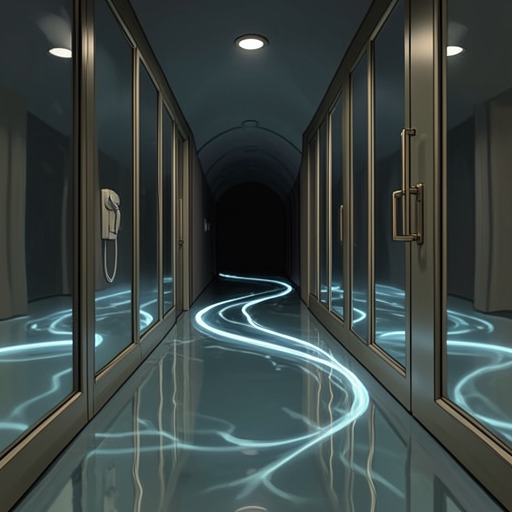
The state begins when a shadow pulls Y/N through a mirror after Jin’s body falls to the ground. The surface feels like water, and Y/N finds that the boundary has become permeable enough to admit a person. Once inside, however, the mirror is no longer simply a doorway. Y/N can still see the back of the place from which the passage began, but that view suddenly disappears, leaving Jin behind and prompting Y/N to call for him. The scene establishes the central danger of mirror imprisonment: visibility and access may survive only briefly, and the connection can vanish without warning.
The mirror therefore operates as an unstable threshold. It permits movement between spaces, but it does not guarantee a route back, and the disappearance of the visible opening turns travel into confinement. Later explanations complicate the apparent rule that mirrors are the only passages. A green-eyed entity tells Y/N that the mirrors are merely one entrance and that the green-eyed ones know another way between their world and this one without portals. Mirror imprisonment is consequently not a complete map of the worlds involved; it is one mechanism within a larger network of entrances whose limits are deliberately concealed from Y/N.
Causes and Participants
The immediate cause of the confinement is the shadow’s intervention, not a voluntary decision by Y/N to remain inside the mirror. The event follows Jin’s collapse and separates the two figures at the threshold: Jin’s body is left outside while Y/N is drawn inward. That division gives the state a relational dimension. The mirror does not merely hold an isolated prisoner; it interrupts an attempted movement with another person and converts rescue into a problem of locating, reopening, or surviving the passage.
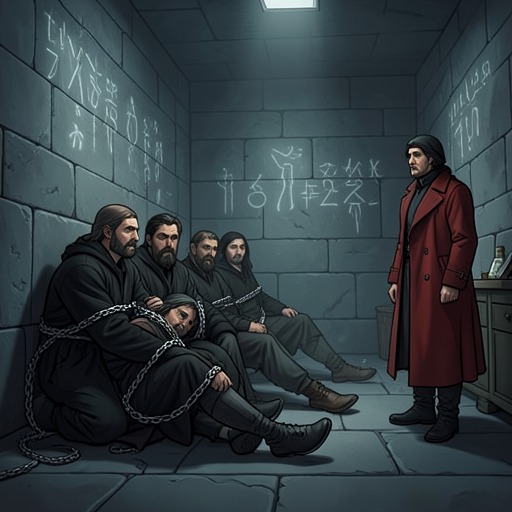
Jin later explains that his own sacrifice of power caused other beings to be locked in a mirror. He says that the group had failed to stop them, so he surrendered his power, and this act resulted in their imprisonment. The same account distinguishes the prison from its victims: the mirror contains the dangerous beings, while Jin’s remaining power is used to make the injured survivors forget that the other people had ever existed. Imprisonment is thus paired with memory control. The physical barrier hides the captives, and the erased knowledge of their presence protects the surrounding world from recognizing what has been sealed away.
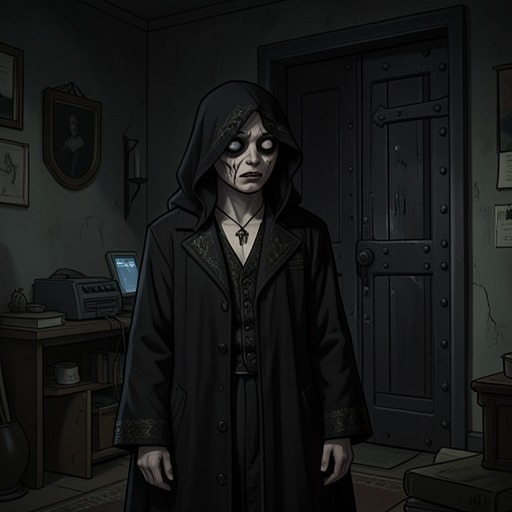
The green-eyed entities also reveal that they are chained to the house when they are in their present condition and need Y/N because Y/N is the only person they can talk to. Their statement connects confinement in the mirror-world system with bodily and spatial restriction elsewhere. They claim that killing humans is simply their instinct, so the possibility of release carries an immediate threat: freeing a captive could restore movement to beings who regard human blood and human life as objects of predation.
Experience of Confinement
The most concrete sign of mirror imprisonment is the altered texture of the boundary. The mirror feels like water when Y/N is pulled through it, suggesting a passage that yields to force while remaining difficult to control. Yet the fluid sensation does not imply freedom. Y/N is still exposed to danger inside the other space, including a sharp injury to the leg from an enormous water snake or similar creature. The mirror does not protect the traveler from the environment beyond it; it only changes the traveler’s location and removes the security of an ordinary exit.
The state also produces uncertainty about who is waiting on which side. Y/N enters the mirror while waiting for Jin, sees the place of departure from within, and then watches that view disappear. The resulting separation makes the mirror both a window and a barrier. It can preserve knowledge of the outside for a moment, but that knowledge offers no control over the opening. In this sense, imprisonment is intensified by partial visibility: the captive may know that another person is near or may have been left behind, yet remain unable to cross the boundary again.
The surrounding characters treat the condition as an urgent rescue problem. After the separation, the group wakes earlier than usual and J-Hope asks whether Suga is still sleeping while Jimin asks whether Suga intends to help retrieve Jin. Their questions show that mirror-related disappearance reorganizes the household’s routine and priorities. The prison is not a private supernatural oddity; it creates absences that the remaining members must interpret and respond to.
Consequences and Narrative Significance
Mirror imprisonment changes the meaning of rescue. A captive cannot assume that strength, sight, or proximity will restore contact, because the passage itself may close. Jin’s sacrifice demonstrates one possible method of containment, but it also carries a cost: power is spent, the imprisoned beings remain hidden, and the survivors’ memories are rewritten. The prison therefore produces safety through loss, rather than through a clean victory.
The state also exposes a recurring tension between apparent rules and deeper mechanisms. Y/N believes that mirrors are the only passageways, but the green-eyed entities correct that belief by describing non-portal routes between worlds. This revelation makes the mirror less a self-contained mystery than a misleadingly visible part of a broader supernatural geography. What can be seen is not necessarily what governs movement, and what appears to be an exit may function as a trap.
As a recurring story device, mirror imprisonment links bodily danger, fractured identity, and the politics of knowledge. Characters can be pulled through, locked away, or cut off from those outside; meanwhile, the history of the imprisonment can be suppressed by forced forgetting. The mirror thus confines bodies and narratives at the same time. Its decisive significance lies in that double action: it turns movement into captivity and turns knowledge of captivity into something that can itself be erased.