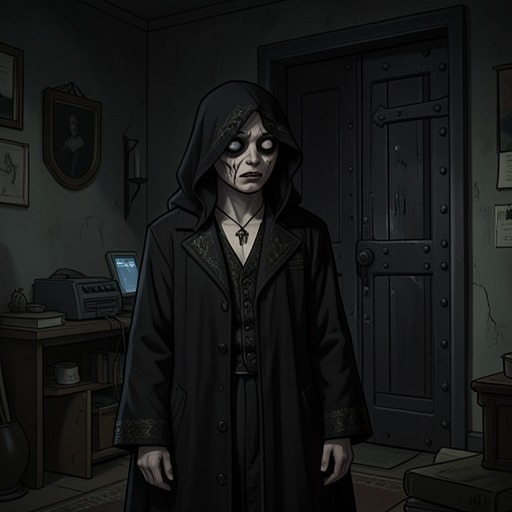
Suga
Living with 7 vampiresSuga is one of the seven vampires at the center of Y/N’s captivity, escape attempts, and confrontation with the forces connected to the mirrors. He is introduced through physical control and predatory danger, but the narrative gradually complicates that first impression: the same character who grabs Y/N, resists releasing her, and moves toward her neck also treats her wounds, interrupts hostile encounters, helps move her when she is helpless, and joins the search for V. His decisive significance lies in this unstable position between vampire instinct and chosen restraint.
Identity and Introduction
Suga first appears as an immediate bodily threat rather than as a fully explained individual. Someone remarks on Y/N’s pleasant smell, then suddenly touches and grabs her wrist; when she asks to be released, the response is refusal. Jin identifies the aggressor as Suga and tells him to stop being annoying, establishing Suga’s presence within the vampire group while also showing that the others can challenge his behavior. The scene makes his relationship to Y/N begin with possession of movement: her wrist is seized, her attempt to leave is denied, and her fear is treated as part of the encounter’s tension.
His danger becomes more explicit when he moves away from Y/N’s face toward her neck. Y/N begs him not to continue, but Suga responds with irritation at her yelling and covers her mouth with his hand. The gesture combines feeding threat with enforced silence. It also defines an early pattern in his characterization: he acts physically first, reacts impatiently to resistance, and appears more concerned with controlling the situation than with reassuring the human caught inside it.
Conduct Toward Y/N
Suga’s treatment of Y/N does not remain confined to predation. When he finds her bleeding, he drags her into a room, gets bandages, and asks her to show him the wound. The practical sequence is important because it places care inside the same relationship that previously involved restraint and a threatened bite. His attention to both of Y/N’s injured hands does not erase the violence of his earlier conduct, but it demonstrates that he can recognize bodily vulnerability and respond to it through direct assistance.
He later acts as an ally when Y/N is physically unable to move. As another person drags her by the hands and someone else takes hold of her wrist, Suga calls for Y/N to come with him. The narration makes clear that her body is lifeless and cannot move independently, so his intervention is not a casual invitation but an attempt to remove her from an immediate struggle. Another voice objects that Y/N does not appear willing to go, preserving the moral ambiguity of Suga’s protection: he may be rescuing her from one danger while still treating her movement as something others can decide.
Suga also becomes a force of recognition and confrontation when an apparent Jin changes in front of Y/N. He grabs the impostor by the throat, forcing the figure to release Y/N, and demands to know where Jin is. This action protects Y/N while serving a second objective, the recovery of a missing member of the group. Suga’s violence here is directed against deception rather than against Y/N, and the distinction marks a shift in his role from captor to defender within the vampire group’s crisis.
Relationships and Conflict
Suga’s relationship with the other vampires is blunt, argumentative, and protective. Jin’s command that he stop being annoying suggests familiarity with Suga’s disruptive habits, while Suga’s later insistence on finding Jin shows that irritation does not cancel attachment. When Jimin proposes going to search for V, Suga interrupts by asking where they are going. The question positions him as a participant who demands to know the group’s next move rather than remaining a passive observer. His involvement connects Y/N’s rescue efforts to the vampires’ own concern for one of their companions.
His protectiveness becomes especially visible when Mark approaches Y/N, takes her hand, and introduces himself. Suga pushes Mark away and orders him not to touch her. Mark answers by teasing him as a little kitty, turning the exchange into a provocation and exposing Suga’s possessive defensiveness. The scene does not establish whether Suga’s reaction is romantic, territorial, or simply protective, but it clearly shows that he treats unwanted contact with Y/N as a boundary worth enforcing. His response is immediate and physical, consistent with the way he handles danger throughout the story.
Suga’s conflict with Jackson reveals another aspect of his self-presentation. When the group declares that humans are not their food, Jackson points out that the speaker hunts every night. Suga replies that at least he does not kill, then tells Jackson to go home because drinks are waiting there. The exchange distinguishes Suga’s conduct from a more lethal form of vampirism without making him harmless. He accepts the identity and habits of a vampire, including hunting, but claims a limit based on whether his actions result in death. His morality is therefore defined not by innocence but by restraint within predatory behavior.
Role in the Larger Supernatural Conflict
Suga repeatedly functions as a threshold figure between Y/N and forces that seek to seize, deceive, or imprison her. He first embodies the danger of the vampire castle, then becomes one of the characters who can pull Y/N away from more concealed threats. This reversal mirrors the book’s broader instability of appearances: a familiar figure may be replaced by another entity, a mirror may become an entrance, and apparent rescue may remain coercive. Suga’s physical interventions make these shifts visible through hands, wrists, throats, and barriers rather than through abstract explanation.
His presence also intersects with the story’s recurring struggle over memory and knowledge. Y/N discovers a diary and later passes through supernatural spaces in which the truth of her origin is gradually exposed. Suga is not the principal interpreter of those revelations, but he belongs to the group whose history is repeatedly concealed, altered, or recovered. Jin explains that he sacrificed his power to lock seven other beings inside a mirror and used what remained of that power to make the others forget what had happened. Against this background, Suga’s insistence on locating Jin and his participation in the search for V carry more weight: the group’s bonds persist even when their understanding of the past has been damaged or manipulated.
When Y/N reaches the place of the four mirrors, the room turns white and returns her to that setting after another supernatural encounter. She looks around for a way out and finds no obvious exit, while the narrative continues to associate mirrors with confinement, passage, and withheld knowledge. Suga’s earlier role in pulling Y/N away from danger contrasts with this impersonal imprisonment. He can act as a bodily guide through immediate conflict, but he cannot by himself resolve the larger system of mirrors, memory alteration, and other-worldly power.
Change and Narrative Significance
Suga’s arc is less a complete moral transformation than a progressive redistribution of his function. At first, he is identified with the fear of being consumed: he grabs Y/N, refuses to let her go, approaches her neck, and silences her protest. Later, he becomes a caretaker who bandages her wounds, a rescuer who tries to move her when she cannot move herself, and an enforcer who stops Mark from touching her. These actions create a repeated contrast between appetite and discipline, suggesting that Suga’s defining struggle is not whether he is dangerous but whether danger is the only power he will exercise.
That tension remains unresolved in the available ending. Y/N ultimately takes a glass ball from Gehan, pushes him away, and summons the gates of hell, while Assiah later states that Y/N’s memory has been erased. Suga reacts with shock when he learns what Assiah has done, joining Jimin and J-Hope in demanding an explanation. His response confirms that he is not indifferent to Y/N’s identity or fate, even though the narrative does not provide a final reconciliation between his earlier aggression and later loyalty. Suga therefore remains a deliberately ambivalent character: a vampire capable of harm, a companion capable of protection, and a participant in a world where saving someone can still involve control over her body, movement, and memory.