The Green-Eyed Possession Crisis
Living with 7 vampiresThe Green-Eyed Possession Crisis marks the story’s decisive shift from suspicion of individual vampires to recognition of a wider supernatural invasion. What first appears to be strange behavior inside the castle is revealed as bodily possession: beings from another world, unable to cross into this one through the ordinary gate, enter vampire bodies while their hosts sleep. The crisis makes the vampire household unstable from within and forces Y/N to navigate a danger that cannot be identified by appearance alone.
Causes and Background
J-Hope gives Y/N the first clear explanation after asking whether the threatening figure had green eyes. He describes a neighboring world populated by beings similar to the vampires, explains that they cannot pass through the gate, and says that they sometimes take over the vampires’ bodies while the vampires sleep. This account establishes both the practical cause of the crisis and its central uncertainty: a familiar body may no longer belong to the person Y/N recognizes.
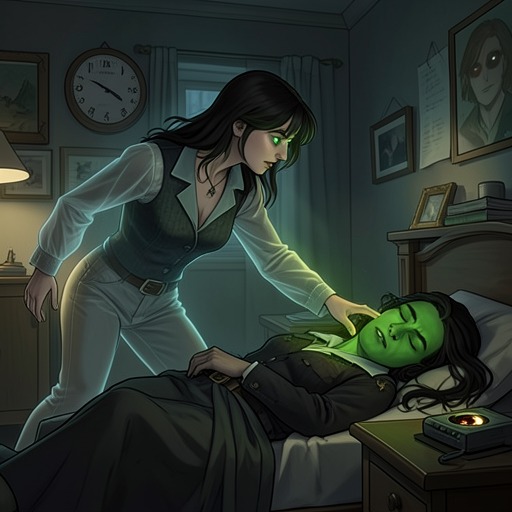
J-Hope’s warning also creates a rule for survival. If someone with green eyes asks Y/N questions, Y/N must claim to be lost or merely walking through the woods and must reveal nothing about the vampires. J-Hope directs Y/N to RM for more information because RM knows the most about the phenomenon, but the attempted transfer of knowledge immediately becomes dangerous. When RM suddenly rises from what looked like sleep, his eyes glow green, and he invites Y/N to come closer. The scene turns the explanation into an immediate test: the suspected invasion is no longer distant or theoretical, but present in the room with Y/N.
The Crisis Becomes Visible
The danger intensifies when Y/N wakes at night to find the door open and the hallway illuminated. Someone opens the way, and Y/N sees bodies lying across the floor before recognizing the figures. The apparent corpses then rise and open their eyes, every pair glowing green. This transformation converts possession into a collective spectacle: the threat is not confined to RM, and the bodies of the vampires have become a concealed battlefield between their own identities and the entities using them. When Y/N enters the living room, the others are there as well, also displaying green eyes, while an unidentified voice asks whether Y/N has been brought in and receives confirmation. The exchange suggests coordination rather than isolated attack, and the household’s familiar gathering place becomes the scene of an organized capture.
Capture, Entrapment, and Bodily Uncertainty
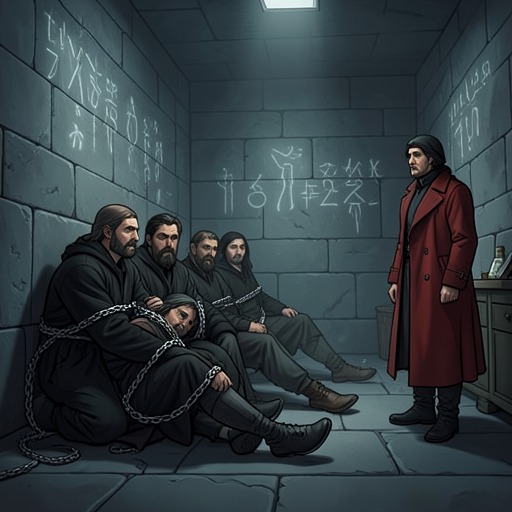
The possession crisis also extends beyond the initial revelation that the vampires can be occupied. When the shadow holding Y/N’s wrist pulls Y/N into a mirror, the mirror feels like water and becomes a passage into confinement. The abduction therefore links bodily possession with unstable boundaries between worlds: the invaders do not merely hide inside familiar bodies, but also control routes through reflective surfaces and use those routes to remove Y/N from ordinary protection. The danger remains physical throughout the episode. In the other world, Y/N feels a sharp pain in the leg and discovers an enormous water snake or similar creature, making the unfamiliar environment itself another instrument of capture. Later evidence of the violence surrounding the vampires is disguised in the human world when an examination finds various holes in Y/N’s body and Jin explains them away as injuries caused by their cat, with Suga supporting the false explanation. The cover story shows how possession and vampiric feeding force the characters to conceal bodily damage even when medical scrutiny threatens to expose what happened.
Consequences and Narrative Significance
The crisis changes the meaning of recognition throughout the surrounding story. Y/N has already experienced betrayal when a vampire drinks Y/N’s blood despite the expectation of trust, and the green-eyed invasion gives that betrayal a larger structure: danger can arrive through an apparently familiar face, a sleeping body, or an ordinary domestic space. The crisis therefore converts distrust from a reaction to one violent encounter into a necessary method of survival. Even the vampires’ attempts to protect their secret become compromised, since their bodies can be used by hostile beings while their true selves are absent or powerless.
The possession plot also repeats a wider pattern of displacement in Y/N’s life. Y/N’s mother abandons Y/N by driving away immediately after leaving Y/N outside, J-Hope later finds Y/N after Y/N runs away, and the vampires’ conflict removes Y/N from the human world through the mirror. Each movement begins as an escape or separation but leads into another form of dependence and danger. The mirror passage makes that pattern literal: Y/N is not simply taken to another place, but pulled through a boundary that feels fluid and offers no secure distinction between refuge and trap.
Its consequences extend into the vampires’ efforts to preserve an ordinary collective life. A later view of BTS shifts abruptly to domestic quarrelling over a cookie, a mundane exchange that contrasts with the violence, secrecy, and bodily instability surrounding them. The contrast does not erase the invasion; it shows what the characters are trying to protect when they continue behaving as a household. Their familiar routines exist beside possession, concealment, and supernatural pursuit, so normality becomes an activity repeatedly reconstructed rather than a stable condition.
The possession crisis is ultimately part of a chain in which bodies, memories, and identities remain vulnerable to outside control. Y/N is pulled into the mirror, injured by a water snake, and later encounters Jin with normal eyes who trembles at the blood covering his hands, while Y/N’s mother responds to the final supernatural confrontation by placing a hand on Y/N’s forehead and asking Y/N to close their eyes. These moments connect invasion with aftermath: the body records what the mind or surrounding relationships may attempt to conceal, and apparent restoration does not guarantee that the experience will remain fully remembered. The event’s decisive narrative function is thus to make identity itself a contested territory, preparing the story for later struggles over revelation, transformation, and the deliberate rewriting of memory.