The Seven Vampires in the Castle
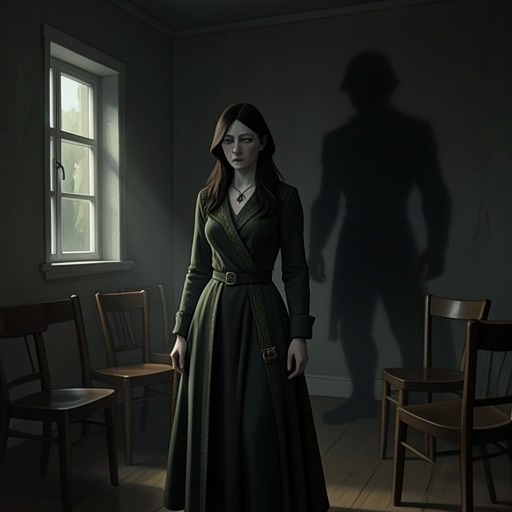
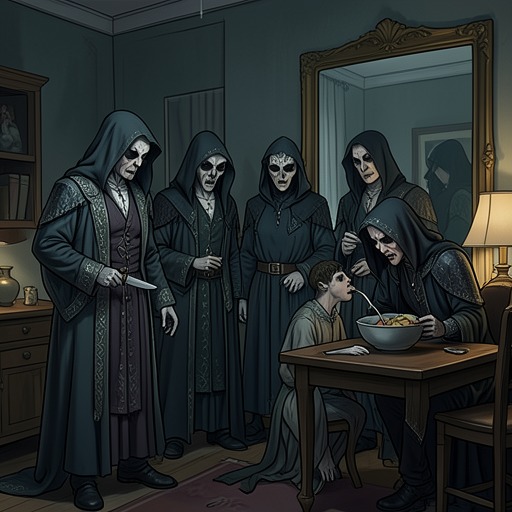
Living with 7 vampiresThe Seven Vampires in the Castle form the central supernatural household through which Y/N enters the hidden world of the story. They discover her after her mother abandons her in the woods, reveal that they are vampires, and first classify her as prey before gradually becoming the community with which her fate is intertwined. Their significance lies in this unstable mixture of refuge and threat: the castle can shelter Y/N, but its inhabitants also control her movements, consume her blood, conceal information, and repeatedly expose her to forces beyond the human world.
Nature and Household Structure
The group is presented as a collective rather than as a formal institution with a clearly stated hierarchy. Jin functions as an important spokesman and organizer. When another vampire asks who Y/N is, Jin explains that she was lost in the woods and has no one. His answer establishes the household’s first relationship to her: she is a vulnerable outsider whose lack of family makes her available to them. The group’s apparent ability to decide her fate is made explicit when Jin later tells Y/N that she will live with them because the vampires have said so, even though she has never agreed to stay.
The household is also marked by uneven personalities and loyalties. One member’s arrival is described as more welcoming than the others, while J-Hope openly questions what Y/N is doing there. Jin’s later announcement that everyone is finally present frames the vampires as a gathered group whose internal business requires collective participation. Their unity is therefore practical and situational rather than emotionally simple: they share a supernatural condition and a home, but they do not respond to Y/N in the same way.
Encounter with Y/N and the Logic of Prey
The vampires’ origin as a group in Y/N’s experience begins with her abandonment. Her mother tells her to leave the car and take her belongings, then closes the door and drives away rapidly. Y/N is left calling for her mother to return while the car disappears into the distance. The vampires consequently encounter someone already cut off from human protection, and the fact that she has no one becomes part of the justification for keeping her.
Their first major disclosure is blunt: Jin tells Y/N that the inhabitants are not human, and another vampire identifies them as vampires. This revelation does not immediately create trust. Instead, it changes the meaning of every gesture around her, because hospitality and danger now coexist within the same household. Jin eventually describes Y/N as their new prey, turning her abandonment into a resource for the group and making clear that her presence is not initially based on free choice or mutual care.
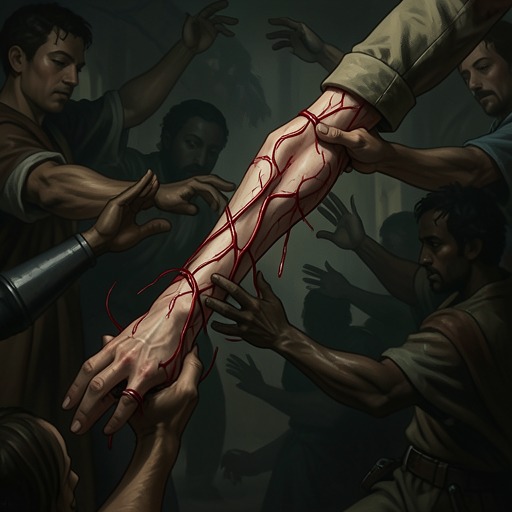
That predatory logic becomes physical when one of the vampires presses a hand over Y/N’s mouth, bites near her collarbone, and drinks her blood while she cries and screams. The scene makes the household’s power over her bodily rather than merely verbal. Y/N had believed that she could trust him, but the attack converts trust into betrayal and establishes blood as the material through which the vampires’ needs are imposed on her.
Conflict, Escape, and Repeated Exposure to Danger
Y/N does not passively accept the arrangement. After running away from the castle, she discovers J-Hope, who asks why she fled. His presence shows that escape does not end the household’s claim or its awareness of her movements. J-Hope later acknowledges that he sounded too harsh, but the apology does not erase the coercive structure already established. Jin continues to insist that life with the vampires will be better, while Y/N protests that she never said she wanted to remain there; Jin answers that the decision has been made for her.
The group’s relationship with Y/N also intersects with dangers beyond their own feeding. A shadow pulls her inside a mirror, where the surface feels like water, and she becomes trapped within the mirror. Soon afterward, an enormous water snake or similar creature bites or strikes her leg, producing a sharp pain and extending the threat from vampire predation to an entire supernatural environment. The vampires’ world is therefore not simply a shelter from the human world: entry into it exposes Y/N to portals, creatures, possession, and forms of bodily vulnerability that she cannot yet understand.
The group’s private practices are repeatedly concealed behind improvised explanations. During a medical examination, various holes are found on Y/N’s body, and Jin claims that the injuries came from their cat because it bites a lot; Suga immediately supports the explanation. The exchange demonstrates the household’s shared capacity for deception and its instinct to protect its secret, while also revealing how ordinary language is used to disguise repeated violence. Their story about the cat is not merely comic evasion: it converts evidence of supernatural feeding into an apparently domestic accident.
Internal Difference and the Green-Eyed Threat
The Seven Vampires in the Castle are not the only vampires in the narrative. Jin explains to Y/N that another group is also vampiric but differs from them, especially through its green eyes. This distinction gives the household a collective identity defined partly by opposition. The vampires recognize that the green-eyed beings possess a related nature while representing a more dangerous or alien faction, and Y/N must learn to distinguish between supernatural groups rather than treating all vampires as one undifferentiated threat.
The contrast also complicates the household’s moral position. The seven vampires feed on Y/N and conceal the truth about her injuries, yet they present themselves as distinct from the green-eyed vampires. Their claim to difference is therefore tested by behavior: both the castle household and its opponents exert power over bodies, knowledge, and movement. The story repeatedly asks whether protection can remain protection when it is enforced through possession and secrecy.
Collective Role and Narrative Significance
The group anchors the story’s recurring cycle of abandonment, capture, escape, and retrieval. Y/N begins as a child or young woman discarded by her mother, becomes prey in the vampires’ castle, escapes, encounters J-Hope again, and is later drawn into mirror passages and wider supernatural conflicts. Each stage changes the scale of the danger without eliminating the original problem of agency: other beings continue to decide where Y/N belongs and what may happen to her body.
The vampires’ collective presence also creates a counterpoint to Y/N’s fractured family history. Her mother’s abandonment leaves her alone in the woods, whereas the castle offers a crowded household, though not a fully safe one. Even later scenes retain traces of ordinary group life: while Y/N worries about how the others are doing, a viewpoint shift shows Jimin and V quarrelling over a cookie. Such domestic rivalry briefly makes the vampires resemble a family, but the memory of blood-feeding, forced residence, and concealed wounds prevents that resemblance from becoming uncomplicated.
Their identity remains unstable to the end of the supplied trajectory. Jin is later seen with normal-looking eyes, shaking and staring at his bloody hands, suggesting a moment in which the boundary between the familiar castle vampire and the threatening transformed state has become difficult to maintain. Y/N ultimately confronts Gehan, pushes him away, takes a glass ball from his pocket, and imagines the gates of hell into existence. After that struggle, her mother places a hand on Y/N’s forehead and tells her to close her eyes, indicating that supernatural conflict will be followed by another intervention over memory, identity, or knowledge. Against this shifting background, The Seven Vampires in the Castle remain the original collective through which Y/N learns that belonging can be both a refuge and a form of possession.