Vampire Instinct
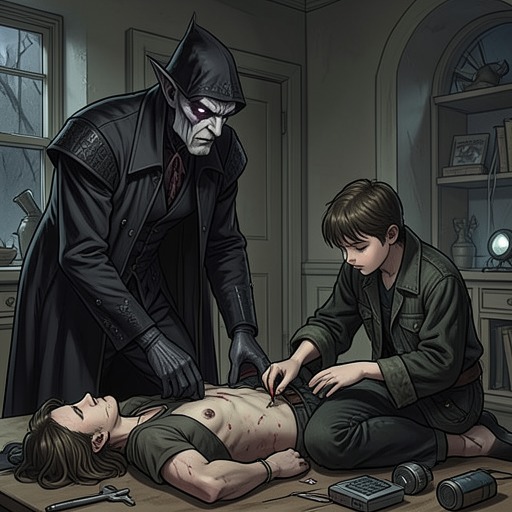
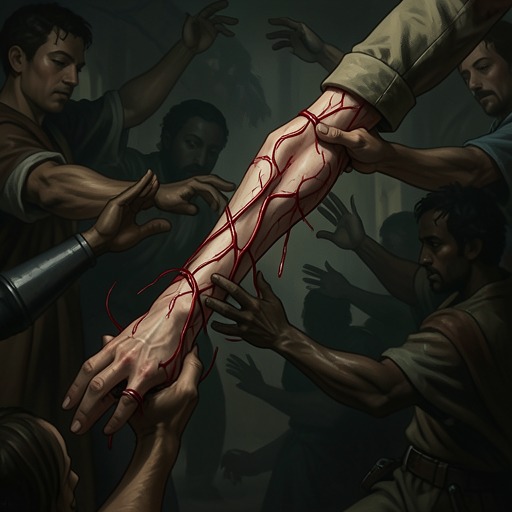
Living with 7 vampiresVampire Instinct is the recurring force that makes blood hunger more than a personal choice for the vampires. It explains why some members of the household can restrain themselves while others struggle to do so, and it turns Y/N’s presence into a continual test of whether supernatural appetite will be obeyed or resisted. The concept therefore governs both the vampires’ bodies and the ethical order of their community: hunger may be powerful, but the narrative repeatedly asks whether it must become violence.
Definition and Internal Differences
Jin explains that he, RM, Suga, and J-Hope are older vampires and have greater control over their hunger. The other three vampires are younger, possess a stronger thirst for blood, and require blood for their development as vampires. This distinction gives Vampire Instinct an important internal scale rather than treating every vampire as equally dangerous. Age, development, and discipline affect how visibly the instinct controls each individual.
Jin also warns that greater control does not mean complete immunity. He makes clear that he, RM, Suga, and J-Hope may still drink Y/N’s blood, and he suspects that Suga has already done so. The suspicion is framed through Suga’s laziness, which Jin associates with a vampire’s willingness to drink blood, but the deeper implication is that even the more controlled vampires remain vulnerable to the same appetite. Restraint is therefore a condition that can fail, not a permanent separation from instinct.
Instinct as a Moral Conflict
Y/N confronts the vampires after learning that their hunger has affected her directly. When she asks whether their willingness to kill is also part of Vampire Instinct, the vampires lower their heads and remain silent, while RM asks her to calm down. Their silence is significant because it does not refute her accusation. Instead, it exposes the discomfort surrounding the idea that predatory behavior might be explained by nature while still causing real harm.
The concept becomes especially explicit when the imprisoned green-eyed vampires ask Y/N to release them. They claim that she is the only person they can speak to because they are chained to the house in their current state. Y/N immediately identifies the danger: if freed, they would kill humans. One of them answers that this is simply their instinct and treats the desire to hunt as an unavoidable fact. Y/N counters that the other vampires can deny their instinct, creating the story’s clearest opposition between appetite and responsibility.
This exchange establishes that Vampire Instinct is not presented as an absolute excuse. The green-eyed vampires use it to justify future violence, whereas Y/N uses the behavior of Jin, RM, Suga, and J-Hope as evidence that instinct can be resisted. The conflict is consequently political as well as personal: the vampires’ rules depend on defining restraint as possible, while the green-eyed faction challenges that definition by insisting that hunting is natural.
History, Prohibition, and Control
Jin traces the conflict to an earlier decision made by the vampires who once lived together with many others. They agreed to stop attacking humans for blood because continued attacks would cause humans to pursue them and create wider danger. The decision transformed private hunger into a collective policy. Survival required the vampires to regulate the instinct that defined their species.
The seven other vampires could not accept that restriction. They wanted to leave and hunt, but the community stopped them. At first they agreed to remain inside, claiming that they would stay rather than continue trying to go out. Their later opposition shows that the prohibition did not remove Vampire Instinct; it only contained it. The house became a site of enforced restraint, and the imprisoned vampires’ demand for release became a demand to restore hunting as an accepted practice.
Jin further reveals that the green-eyed vampires possessed powers, including hypnosis, and that he sacrificed his own power to lock them inside the mirror. He then used what remained of his power to make the other vampires forget that the imprisoned group had ever existed. The history of Vampire Instinct is therefore inseparable from memory control: the community suppressed both the dangerous bodies and the knowledge of the original conflict. The instinct was contained physically in the mirror and narratively through forced forgetting.
Consequences for Y/N and the Plot
Y/N becomes the living point at which the vampires’ theory of restraint is tested. Her blood is not an abstract resource; it is repeatedly connected to fear, betrayal, and the possibility of death. When a vampire drinks her blood, the act reveals how quickly trust can be overturned by appetite. Her position also forces the household to explain distinctions that it had previously concealed, including the difference between older and younger vampires and the continuing danger posed by supposedly controlled members.
The larger plot repeatedly surrounds Y/N with broken boundaries: she is abandoned by her mother, brought into contact with J-Hope after running away, discovers her mother dead, opens the diary, is drawn through a mirror, and later faces supernatural acts that alter memory and reality. Against this pattern, Vampire Instinct functions as a recurring explanation for why apparent protectors can become threats. It is one of the forces that makes every rescue unstable: the vampires may save Y/N from one danger while remaining capable of endangering her themselves.
The concept also remains linked to the story’s later manipulation of knowledge. Y/N’s return to her room after a mirror passage, the whitening of the room and return to the place with four mirrors, and Assiah’s admission that she erased Y/N’s memory all reinforce a world in which experience can be hidden or rewritten. Vampire Instinct belongs to that same structure of concealment. The vampires’ hunger is visible through its consequences, but its history and limits must be disclosed gradually, through Jin’s explanations and the reactions of those who fear its return.
Narrative Significance
Vampire Instinct gives the vampire household its central contradiction. The vampires present themselves as capable of living under a prohibition against attacking humans, yet their bodies continue to demand blood; older vampires display control, younger vampires need blood for development, and the green-eyed vampires openly embrace hunting. The same species thus contains discipline, dependency, denial, and rebellion.
Its significance extends beyond supernatural physiology. The instinct tests whether identity is determined by origin or shaped by conduct. The green-eyed vampires claim that instinct dictates murder, while Y/N insists that the behavior of the others proves otherwise. Jin’s history confirms that restraint required collective sacrifice, imprisonment, and even the destruction of memory. Vampire Instinct is consequently both an inherited drive and a contested explanation for violence—powerful enough to shape the plot, but never sufficient to settle responsibility.