Vampire state
Living with 7 vampiresVampire state is the supernatural condition that defines Jin and the other inhabitants of Vampire Castle while sharply separating them from Y/N’s human life. It first appears as a concealed identity, then expands into a system of hunger, bodily transformation, inherited conflict, and political discipline. The state is not presented as a single moral category: some vampires attack humans, others attempt to stop, and the body can become vulnerable to forces that make identity unstable.
Identity and Disclosure
The condition is disclosed when Y/N questions Jin’s unnatural behavior. Jin states that the group is not human, and another voice identifies them as vampires. Y/N’s broken attempt to repeat the word records the revelation as a shock rather than ordinary exposition; the human world and the castle’s hidden world become incompatible in a single exchange. The disclosure also explains why Y/N has been brought into danger after being abandoned by her mother, whose car drove away rapidly and left Y/N lost.
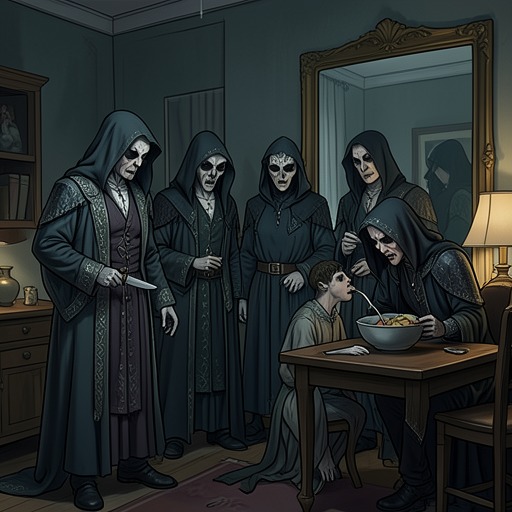
The vampire state is immediately tied to predation. One vampire drinks Y/N’s blood while holding a hand over her mouth, turning the supposed possibility of trust into an experience of pain and betrayal. The feeding establishes that Y/N’s body can be treated as a source of sustenance, while her fear and resistance remain physically contained by the vampire’s superior strength. Later, a medical examination finds various holes on Y/N’s body; Jin and Suga conceal their origin by blaming an animal, showing that vampirism must be hidden even when its effects are visible.
Physical Capacities and Bodily Instability
Vampires possess animal transformation as part of their condition. When Y/N realizes that Jin has appeared as a dog, Jin explains that all vampires can become an animal. The revelation changes the meaning of earlier encounters: an apparently ordinary creature may be a vampire in another form, and bodily appearance can no longer be treated as reliable evidence of identity. Transformation therefore functions both as a power and as a form of concealment.
The state also exposes bodies to supernatural injury and alteration. Y/N is attacked in the mirror world by an enormous water snake or something resembling one, demonstrating that the vampire-related worlds contain dangers beyond feeding. A later figure rises from water wearing a heavy metal chain around the neck, after which a seal changes to human. This contrast between altered and human forms reinforces the story’s recurring concern with bodies that cross boundaries rather than remaining securely human or supernatural.
Jin’s body shows the most violent instability. He stands frozen while Y/N approaches; his face and eyes have returned to normal, but he begins shaking and discovers that his hands are covered in blood. The restored appearance does not erase the evidence of what the body has done. Vampire state is consequently more than a visible appearance or a permanent label: it can surface as a loss of control and leave physical traces after the immediate transformation or attack has ended.
History, Restraint, and Sacrifice
Jin explains that the green-eyed vampires once lived alongside his group and many other vampires. The larger community decided to stop attacking humans for blood because continued attacks would provoke humans to pursue them. This decision establishes an internal vampire policy against predation, making restraint a collective survival strategy rather than merely an individual virtue. The policy also creates a division between vampires who accept limits and those who cannot suppress their hunger.
Seven others refused that restraint and continued attacking humans. Jin describes them as possessing powers of their own, with hypnosis identified as one power he knew for certain. Their violence transformed vampirism from a hidden condition into a political problem requiring containment. The conflict is therefore not simply humans against vampires; it also divides vampires according to whether the condition can be governed through rules and sacrifice.
Jin says that he sacrificed his powers to lock the seven into a mirror. The sacrifice made imprisonment possible, but it also left the remaining vampires badly wounded. With the last portion of power available to him, Jin made the others forget that the imprisoned group had ever existed. Vampire state is thus connected to deliberate memory control: the community protects itself not only by restricting bloodshed and imprisoning dangerous vampires, but also by removing the past from collective knowledge.
Consequences for Y/N and the Wider Conflict
Y/N’s encounter with the vampires repeatedly places the human body at the boundary of vampire society. She is fed upon, examined for wounds, pulled into a mirror by a shadow, and injured by a water snake in the mirror world. These episodes make vampirism a condition that acts on bodies before it is fully understood intellectually. Y/N’s position is especially precarious because she is both an outsider and a potential object of vampire hunger, while the vampires’ explanations repeatedly arrive only after violence has already occurred.
The condition also connects ordinary danger to larger supernatural mechanisms. When a shadow pulls Y/N inside a mirror, the mirror feels like water and becomes a passage rather than a passive object. Later, Y/N pushes Gehan away, takes a glass ball from one of his pockets, and concentrates on making the gates of hell appear. This action marks a reversal in the distribution of power: the human figure once treated as prey now exercises force against the supernatural adversary. Although the episode concerns Y/N’s emerging power rather than a simple transformation into a vampire, it places the vampire state within a broader struggle over who controls bodies, portals, memory, and escape.
The vampires’ condition also shapes their collective domestic life. While Y/N wonders how the others are doing, the BTS point of view shifts to Jimin and V arguing over a cookie. The small quarrel contrasts with feeding, imprisonment, and supernatural warfare, presenting the vampires as a group capable of ordinary attachment and irritation as well as violence. Their humanity is not restored by this domestic scene, but the scene complicates the idea that vampirism makes them monsters without social bonds.
Narrative Significance
Vampire state supplies the story’s central boundary between the familiar and the hidden. It explains the castle’s secrecy, the danger of blood, animal transformation, the green-eyed faction, the mirror imprisonment, and the need for rules governing relations with humans. Yet the narrative repeatedly unsettles that boundary. Vampires can look human, take animal form, lose control, be imprisoned in mirrors, or conceal their history through memory alteration; humans can be abandoned, hunted, and later wield supernatural power.
The state is therefore both a biological condition and a political identity. It determines who may be treated as food, who must be restrained, who possesses powers, and who has authority to erase the past. Jin’s sacrifice presents one attempt to make vampirism survivable through discipline, while the attacks on Y/N show the continuing failure of that discipline. By the time Y/N can seize Gehan’s glass ball and summon the gates of hell, the story has shifted from a frightened human discovering vampires to a conflict in which supernatural power is contested by the person who was once most vulnerable to it.