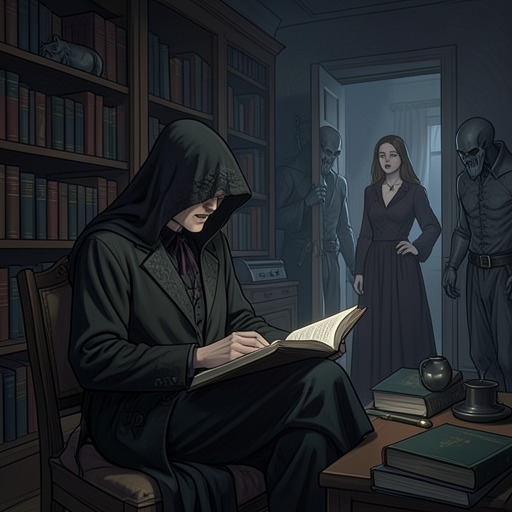
Y·N and RM
Living with 7 vampiresY/N and RM form one of the story’s most important knowledge-bearing relationships: RM repeatedly appears when Y/N is lost, explains the hidden rules of the supernatural world, and offers practical help, yet his own transformations and green-eyed state make him impossible to regard as simply safe. Their connection therefore develops through a cycle of recognition, assistance, warning, and renewed uncertainty. RM is at once guide, rescuer, vampire, shape-shifter, and potential threat, while Y/N must continually revise what RM’s presence means.
First Encounters and Recognition
RM first enters Y/N’s orbit among the strange residents surrounding the castle. While Jimin is interrupted for making noise and another figure complains about trying to read, Jin apologizes to RM, establishing RM as part of the same vampire household but also as someone associated with quiet observation and knowledge. The early social scene gives Y/N no clear explanation of who these figures are; identities are disclosed gradually through direct encounters rather than offered as stable facts from the beginning.
Y/N’s first substantial encounter with RM occurs after Y/N has been attacked and has entered the forest to hide. RM takes the book from Y/N and asks what Y/N is doing there, creating an immediate exchange between two people who are both encountered outside their expected place. When RM asks whether the vampire drank Y/N’s blood, Y/N recounts the attack, the escape aided by an owl, and the pursuit that led into the forest. RM responds that almost everybody gets lost there and says the fastest way out is by flying. The exchange makes RM a mediator between Y/N’s human confusion and the castle’s supernatural geography.
Rescue and the Owl Form
RM’s help becomes concrete when Y/N asks how escape is possible after being told that leaving the forest without wings is almost impossible. RM explains that an ordinary owl would not be strong enough, but a vampire owl could carry Y/N. He then reveals that the owl involved in Y/N’s escape was actually RM. This disclosure retroactively changes the meaning of the earlier rescue: what seemed like accidental animal assistance was RM’s intervention in another form.
The revelation also makes RM a particularly clear example of the story’s unstable self-presentation. He does not remain within a single visible identity. Y/N encounters him as a person and as an owl, and the second form is not merely decorative because it determines whether Y/N can leave the forest at all. RM’s animal transformation turns knowledge into bodily capability: he knows the route, possesses the wings required to travel it, and carries Y/N into the air before Y/N can finish asking whether the plan is dangerous. His assistance is therefore protective but also overpowering, since Y/N’s movement is suddenly placed in RM’s control.
Knowledge, Warnings, and the Green-Eyed Threat
RM becomes especially important because he knows more than the other vampires about the neighboring supernatural realm. After Y/N reports seeing a figure with green eyes, J-Hope explains that another world exists nearby and that beings there can sometimes take over the bodies of vampires while they sleep. J-Hope directs Y/N to RM for more information, explicitly identifying RM as the person who knows the most about the phenomenon. RM’s role consequently expands from transporter and rescuer to interpreter of the rules governing the green-eyed threat.
That knowledge does not make RM immune to the danger. At one point, while RM appears to be sleeping, he rises suddenly and looks at Y/N with green glowing eyes. He asks Y/N to come closer, but Y/N does not move. The scene transforms the relationship’s central source of reassurance into a source of immediate fear. RM’s earlier explanation of possession and his later green-eyed appearance create a sharp contrast between what he knows about the threat and how closely the threat can approach through him. Y/N cannot safely assume that the familiar body belongs to the familiar person.
RM also participates in the investigation of the key necklace. When he shows Y/N the key and asks where it came from, Y/N can only say that it was found in Y/N’s hand upon waking. The exchange links RM to the mystery of Y/N’s origin and to the objects that draw Y/N deeper into the supernatural conflict. His questions are investigative rather than merely conversational: RM treats the key as evidence, while Y/N experiences it as an unexplained part of personal history.
Shared Danger and Narrative Function
RM’s relationship with Y/N is repeatedly shaped by spaces that cannot be trusted. The forest causes disorientation, the mirror can imprison or transport people, and bodies can become entrances for other entities. RM helps Y/N move through this world, but he also embodies its instability. His owl form makes escape possible; his green-eyed state demonstrates that a known ally may become the vehicle of an unknown force. In this way, the relationship does not follow a simple protector-and-protected pattern. It is built around assistance that must coexist with vigilance.
The broader plot reinforces this tension. Jin’s body is later pulled into a mirror by a shadow, and RM identifies the mirror as the thing in which Jin is trapped. He explains that breaking it would not free Jin but would instead prevent Jin from ever escaping. This moment confirms RM’s continuing function as a specialist in supernatural mechanisms: he distinguishes between destroying a dangerous object and understanding the conditions that make rescue possible. His knowledge protects the group from an impulsive mistake, while also showing how much the others depend on him when ordinary solutions fail.
Development and Significance
Y/N and RM’s connection develops through repeated corrections of appearance. Y/N initially sees an owl, then learns that the owl is RM; Y/N later sees RM as a familiar vampire, then confronts the possibility that green eyes signal another entity within his body. These reversals make recognition provisional. The relationship’s emotional structure is therefore governed less by settled intimacy than by the difficult question of whether the person in front of Y/N is truly the person Y/N believes is there.
RM remains significant because he combines care with opacity. He helps Y/N escape the forest, carries Y/N through the air, explains the neighboring world, receives the report about the green-eyed figure, and investigates the key. At the same time, his green-eyed appearance prevents that assistance from becoming uncomplicated trust. Through RM, the story turns identity into something performed, transformed, and repeatedly tested in interaction. Y/N’s bond with him is thus both a practical alliance and a sustained lesson in the danger of confusing a recognizable body with a stable self.