Y·N’s Key Necklace
Living with 7 vampiresY/N’s Key Necklace is both a physical key and the first durable link between Y/N’s ordinary life and the hidden world that surrounds it. Y/N finds it in the hand of her murdered mother, uses it to unlock the diary bearing her own name, and later receives the same key from a luminous bird before opening a black room. Its importance lies in this progression: the necklace begins as an intimate remnant of family violence, becomes evidence of a concealed identity, and ultimately functions as an instrument for crossing into danger.
Discovery in the Aftermath of the Attack
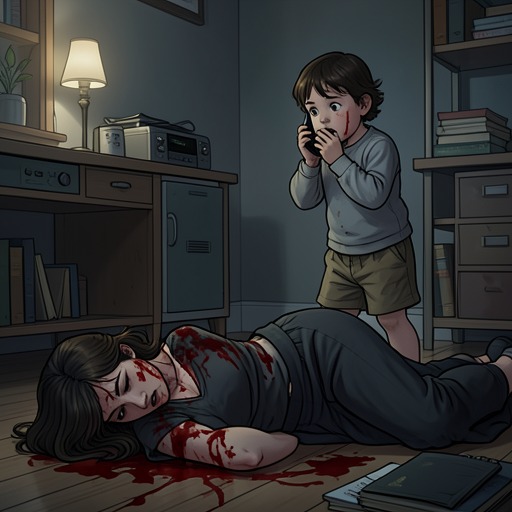
The necklace enters the story at the moment when Y/N’s family life has already been shattered. After being abandoned by her mother in the woods, Y/N later returns home and finds her mother on the ground in a pool of blood. When Y/N looks again before leaving, her mother is lying in a different position, and something is visible in her hand: a necklace. Y/N picks it up, holds it close, promises to find who did this, kisses her mother’s forehead, and runs outside. The object therefore passes directly from the dead mother to the daughter, carrying the force of a final exchange even though the mother cannot explain its meaning.
The necklace’s emotional value is inseparable from its material form. At first it appears to be a keepsake recovered from a crime scene, but Y/N soon recognizes that it is a key. That alteration in status changes the object from a memorial into a message. The mother’s hand has not merely preserved an ornament; it has placed a means of access into Y/N’s possession.
The Key to the Named Diary
The necklace’s first decisive function is revealed when Y/N retrieves the book from her room. The book had been found on the desk in her parents’ room, closed and marked with Y/N’s name. Y/N initially leaves it unopened, choosing to return first in case the attackers or her parents are present, but later discovers that the book has a lock. Looking at the necklace, Y/N realizes that its key fits the lock and uses it to open the diary.
This sequence binds three objects and three forms of knowledge together: the mother’s body, the key necklace, and the book addressed to Y/N. The necklace makes the diary legible as a deliberate inheritance rather than an accidental book. It also changes Y/N’s position in the investigation. Before finding the key, Y/N can only grieve and promise to identify the killer; after using it, she can begin reading the concealed record of her own origins.
The object’s authority comes from its circulation. It is recovered from the mother, carried to Y/N’s room, and applied to a locked text that bears Y/N’s name. Its path is therefore also a genealogy in material form: the necklace transfers a secret from one generation to the next without requiring an explanation from the person who possessed it first.
Recurrence and the Opening of a Threshold
The key later reappears in a setting far removed from the family home. Jin notices that Y/N is holding a small key, and Y/N says that it is the first time she has seen it. Jin takes it from her, but the object does not remain under his control permanently. In another scene, a bird illuminates part of a dark room, approaches Y/N, signals for her to show her hands, and drops the key into them. Y/N recognizes it as the key she had when she woke several days earlier.
The recurrence makes the necklace more than a one-use household tool. Its identity persists across changes of place, memory, and possession. Even when Y/N cannot explain where it came from, the key remains recognizable. The bird’s delivery also gives the object a new kind of agency within the plot: it is not simply found but returned, as though the surrounding supernatural environment is directing Y/N toward a particular entrance.
Y/N then inserts the key into a door. The bird and the door had given off light, but the room beyond is not glowing; it is entirely black. The key consequently opens no safe chamber or explanatory archive. It opens an unknown space whose darkness contrasts with the luminous signs that lead Y/N there. The object’s promise of knowledge is thus coupled with risk: every act of unlocking also moves Y/N farther from the ordinary world.
Relation to the Mirror Passage and the Larger Journey
The key’s threshold function anticipates the story’s later spatial ruptures. After Jin’s body falls, a shadow remains standing, holds Y/N’s wrist, and pulls her inside a mirror that feels like water. The necklace is not explicitly identified as the mechanism of that later capture, but its earlier use has established the material logic of Y/N’s journey: objects that seem small and familiar can open or connect to spaces governed by different rules. The key belongs to the same chain of crossings that includes the locked diary, the strange door, and the mirror passage.
Its significance also changes as Y/N’s body and identity are repeatedly placed under external control. She is abandoned, investigated, seized, frozen during Gehan’s movement through a circle, and drawn into a ritual beneath a blood-red moon. Later, Y/N’s light and dark aspects hold hands in a triangle and concentrate together. Against this pattern of bodily capture, the key represents a portable capacity to initiate movement. It does not make Y/N invulnerable, and it does not prevent others from taking it, but it gives her access to knowledge and thresholds that would otherwise remain closed.
Narrative Significance
Y/N’s Key Necklace converts mourning into investigation and inheritance into action. Its first appearance beside the mother’s blood makes it a token of loss; its use on the diary turns loss into evidence; its return through the bird turns evidence into a summons. The key’s repeated displacement between mother, Y/N, Jin, and the supernatural environment mirrors the unstable circulation of identity throughout the story, where names, bodies, memories, and entrances cannot be taken at face value.
The necklace is therefore important not because the narrative assigns it a decorative emblem, but because it repeatedly changes what Y/N can do. It lets her open the book that records a hidden past and later open a door into an unlit space. In a story structured by abandonment, pursuit, possession, and passage, the smallest object becomes a durable thread: a mother’s last possession, a clue to Y/N’s origin, and a material sign that the next boundary can be crossed.