Y·N's Parents' House
Living with 7 vampiresY/N's Parents' House is the old family home that turns Y/N’s abandonment into an investigation of identity. She reaches it after asking a passing driver to take her there, only to find the entrance broken open and her mother lying dead inside. In the same building, a locked book bearing Y/N’s name and opened with the key hidden in her necklace transforms the house from a lost refuge into the first material record of her concealed past.
Arrival at the Old House
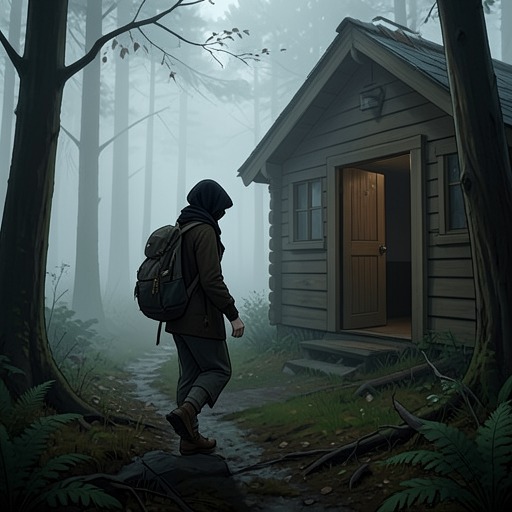
Y/N returns to Y/N's Parents' House after being deliberately left behind. Her mother had told her to get out of the car and take her belongings, then shut the door and drove away rapidly, leaving Y/N alone and frightened. After continuing to run, Y/N sees a car, asks its driver for help, and eventually reaches the old house. The journey gives the location a double meaning: it is the place Y/N still associates with home, but reaching it does not restore safety or family.
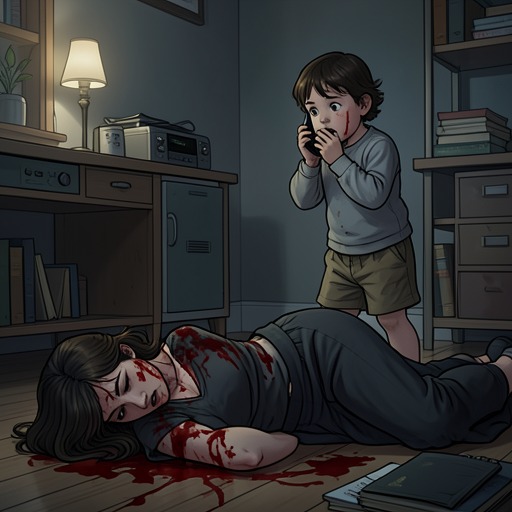
The house is already marked by intrusion when Y/N arrives. Its door has been broken open, signaling that whatever happened inside was neither peaceful nor ordinary. Y/N runs in and finds her mother on the floor in a pool of blood. She sits beside the body, holds her mother’s head in her hands, and later confirms that there is no pulse. Her grief is immediate and physical; after crying, she rises and walks toward the stairs, moving through the familiar building as though trying to make sense of a home that has become a crime scene.
The House as a Site of Bereavement
The parents’ room is especially significant because Y/N has not entered it for ages. Her return to that neglected interior follows the discovery of her mother’s death and gives the house a structure of delayed revelation: the first room contains the body, while the upstairs room contains the explanation that the body alone cannot provide. The setting thus links mourning with the need to inspect what the family had kept inaccessible.
On the desk, Y/N sees a closed book with words written on it. When she picks it up, she discovers that her own name is standing on its cover. The object is not merely found in the house; it is physically tied to Y/N and appears to have been deliberately preserved there. Its location among the parents’ possessions makes the family home an archive, but an incomplete and guarded one, because the book cannot initially be opened.
The Book and the Key Necklace
The book is locked, and the key is the necklace Y/N’s mother gave her. Y/N recognizes the necklace as a key, uses it to unlock the book, and opens it to read an entry beginning with the date 14 April. The connection between necklace and book creates a chain of custody within the house: the mother gives Y/N an object whose function remains hidden until after the mother’s death, and that object grants access to a written account kept in the parents’ room.
The diary entry states that the writer chose the name Y/N for the child and normally hated children but could not leave her outside in the cold. This disclosure overturns Y/N’s assumption that the woman she called her mother was her biological parent. Y/N immediately understands that she may not be her mother’s daughter and asks who her real parents are and why they abandoned her. The house therefore becomes the birthplace of a new question: not simply why the mother died, but where Y/N herself came from and why she had been left behind.
A Threshold in the Larger Story
Although Y/N's Parents' House is occupied by memories of family life, the narrative presents it as a threshold rather than a permanent refuge. Y/N arrives seeking the old home after abandonment, finds death instead of protection, and leaves with a book that directs her toward supernatural explanations and hidden origins. The house’s ordinary objects—its desk, book, and necklace—carry more power than their domestic appearance suggests, preserving information that the family had withheld from Y/N.
Its role also anticipates the story’s repeated movement through unstable boundaries. Later events involve Y/N being pulled inside a mirror, standing within the mirror as though it were water, and encountering spaces governed by captivity, ritual, and concealed power. Those later thresholds are supernatural, whereas Y/N's Parents' House begins with a broken door and a locked book; nevertheless, both forms of passage depend on an apparently familiar surface concealing another world. The house is the first place where Y/N learns that belonging, memory, and identity may be locked inside objects and recovered only through a key.